
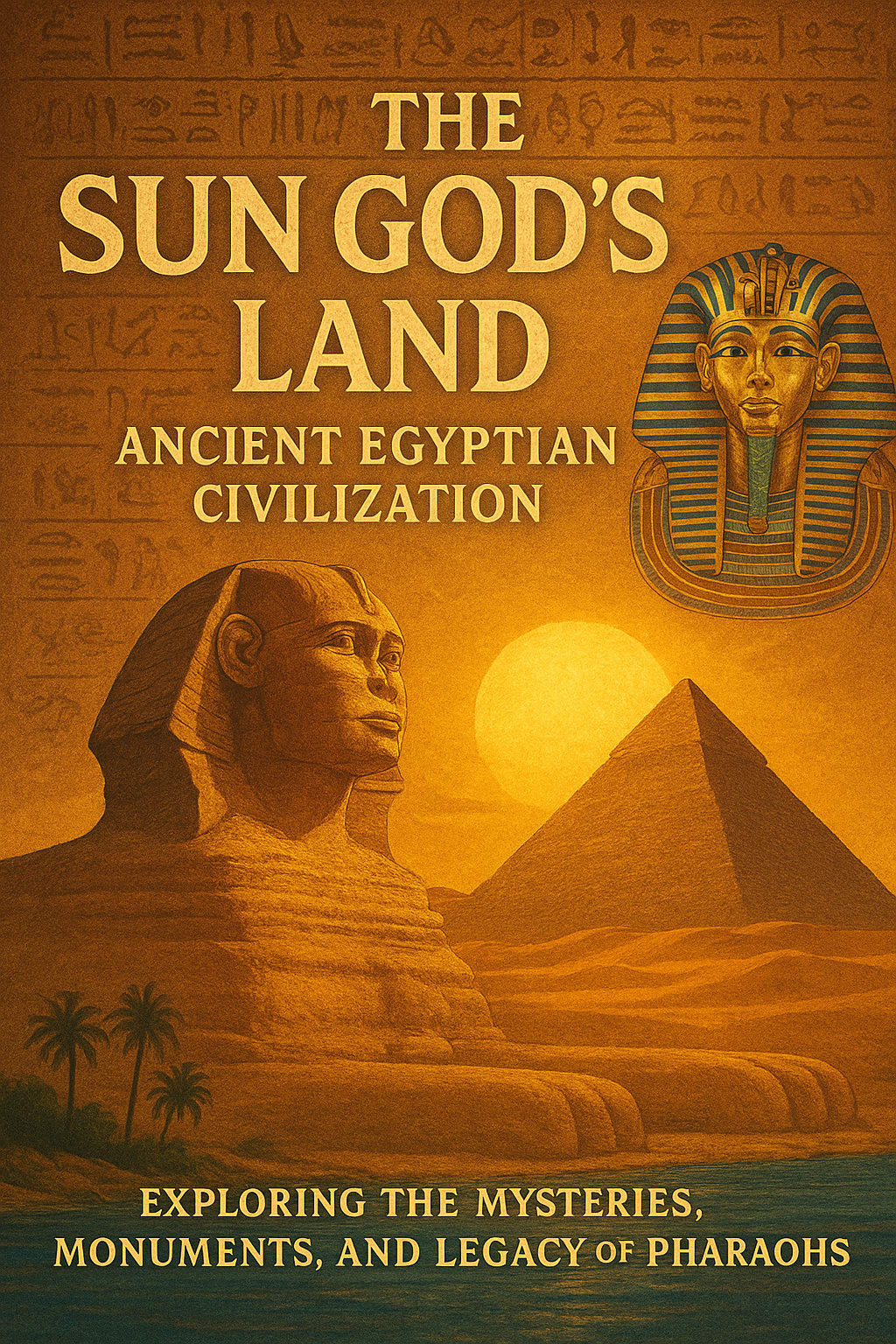
The Sun God’s Land: Ancient Egyptian Civilization
Exploring the Mysteries, Monuments, and Legacy of the Pharaohs

INTRODUCTION
The story of Ancient Egypt is one of the most fascinating chapters in human history. For thousands of years, this civilization thrived along the fertile banks of the River Nile, creating a culture that continues to amaze the world with its monuments, mysteries, and innovations. Known as the “Land of the Sun God,” Ancient Egypt placed divine importance on the sun, particularly the god Ra, who symbolized life, creation, and eternal power. The Egyptians believed that their pharaohs ruled as earthly gods, maintaining balance between people and the divine. This unique blend of religion, politics, and innovation helped shape one of the greatest civilizations of all time.
Gift of the Nile
The famous Greek historian Herodotus once called Egypt “the gift of the Nile,” and indeed, this mighty river was the lifeline of the civilization. Every year, the Nile flooded its banks, leaving behind fertile soil that allowed Egyptians to grow wheat, barley, flax, and other crops. The abundance of food supported a growing population and made Egypt one of the earliest centers of organized society. Without the Nile, Egypt would have been a barren desert, but with it, the land flourished into a cradle of civilization.
The Pharaohs: Divine Rulers
At the heart of Egyptian society was the pharaoh, both a political leader and a religious figure. Egyptians believed their pharaohs were chosen by the gods, often regarded as living gods themselves. Famous rulers such as Tutankhamun, Ramses II, and Cleopatra VII left lasting marks on history. Pharaohs not only commanded armies but also directed massive building projects, from temples dedicated to gods to the iconic pyramids. Their word was law, and their reign symbolized stability and divine order, known in Egyptian belief as Ma’at.
Religion and the Gods
Religion dominated every aspect of Egyptian life. The Egyptians worshipped hundreds of gods and goddesses, each responsible for different parts of life and nature. The sun god Ra was the most important, while Osiris ruled over the afterlife, and Isis symbolized motherhood and protection. Temples were built as homes for these gods, with priests performing daily rituals to honor them. Egyptians believed that life on earth was only a preparation for the eternal journey of the soul, which is why burial practices were so elaborate.
Pyramids and Tombs:
Monuments of Eternity
Nothing symbolizes Ancient Egypt more than the pyramids of Giza, one of the Seven Wonders of the Ancient World. Built as grand tombs for pharaohs, these monumental structures were designed to ensure safe passage into the afterlife. The most famous is the Great Pyramid of Khufu, which still inspires awe for its size and precision. Alongside the pyramids, Egyptians constructed the Valley of the Kings, where later pharaohs were buried in elaborately decorated tombs filled with treasures, art, and sacred texts like the Book of the Dead. These monuments reflect the Egyptians’ belief in immortality and their skill in engineering.
Achievements in Knowledge and Art
Beyond their monuments, the Egyptians made remarkable contributions to human progress. They developed hieroglyphic writing, an intricate system of symbols that recorded everything from religious texts to administrative records. Their advances in mathematics allowed them to design precise architectural wonders, while their understanding of medicine included treatments for injuries and diseases, many of which were far ahead of their time. Egyptian art, with its detailed carvings, paintings, and sculptures, reflected not only beauty but also religious devotion and daily life.
Daily Life in Ancient Egypt
The majority of Egyptians were farmers, living in mud-brick houses along the Nile. Their lives revolved around the agricultural calendar—planting, harvesting, and storing grain. Craftsmen and artisans created jewelry, pottery, and furniture, while traders exchanged goods with neighboring regions. Women in Egypt enjoyed relatively high status compared to other ancient societies; they could own property, run businesses, and even rule as pharaohs, as seen in the case of Hatshepsut. Music, festivals, and games were also important parts of daily life, showing that Egyptians valued joy as much as hard work.
The Decline of Ancient Egypt
Like all civilizations, Ancient Egypt eventually declined. Over centuries, it faced invasions from foreign powers such as the Persians, Greeks, and Romans. The arrival of Alexander the Great in 332 BCE marked the beginning of Greek influence, followed by Roman rule after the death of Cleopatra VII in 30 BCE. Although Egypt lost its independence, its legacy endured, influencing art, architecture, and religion across the ancient world and beyond.
The Legacy of the Sun God’s Land
Ancient Egypt continues to capture the imagination of historians, archaeologists, and travelers. From the pyramids that rise out of the desert sands to the treasures discovered in Tutankhamun’s tomb, the achievements of this civilization remain unmatched. Its blend of spirituality, innovation, and power created a society that stood strong for over 3,000 years—longer than almost any other in history. Truly, the land of the Sun God continues to shine as a beacon of human achievement.
Conclusion
Ancient Egypt was far more than a land of pyramids and pharaohs; it was a civilization that mastered the challenges of nature, built wonders that defy time, and developed ideas that still shape our world. By worshipping the sun, the Nile, and their gods, Egyptians created a culture deeply tied to both earth and heaven. Their story is not just history—it is a reminder of humanity’s eternal quest for meaning, immortality, and greatness.
About the Creator
Nizam Archaeologist
I’m deeply fascinated by archaeology and the mysteries of ancient civilizations.My goal is to bring the past to life, spark curiosity, and share the wisdom of cultures that have stood the test of time.
Keep reading
More stories from Nizam Archaeologist and writers in History and other communities.
Civilization’s Pillars: The World’s Historic Heritage Sites
Civilization’s Pillars: The World’s Historic Heritage Sites Human civilization is a tapestry woven from countless cultures, traditions, and achievements. The most powerful reminders of this journey are the historic heritage sites scattered across the globe. These places are more than just physical structures; they are living testaments to the creativity, struggles, faith, and resilience of humanity. From towering pyramids and sacred temples to ancient cities and architectural marvels, historic sites allow us to step back in time and connect with the lives of those who came before us.
By Nizam Archaeologist4 months ago in History
Rajendra Chola I and the Conquest of the Ganga: A Monumental Feat in Indian History
Known as the “Gangaikonda Chola” (the Chola who conquered the Ganga), Rajendra transformed a South Indian maritime empire into a pan-Indian power whose influence stretched from the Indian Ocean to the heart of the subcontinent. This campaign was not merely a military raid but a bold statement of imperial ambition, strategic brilliance, and cultural confidence.
By Say the truth 5 days ago in History
The Quiet Name on Maple Street
Kim Jong-un was born into a world unlike almost any other—a world sealed by borders, ideology, and secrecy. As the grandson of Kim Il-sung, the founder of North Korea, and the son of Kim Jong-il, the country’s second leader, Kim Jong-un entered life already wrapped in destiny. In North Korea, leadership is not chosen by ballots or debate; it is inherited like a crown, reinforced by loyalty, fear, and an unyielding political system.
By The best writer a day ago in History



Comments
There are no comments for this story
Be the first to respond and start the conversation.