
The Story of Pompeii: From a Growing City to a Lost City
A Look at How Pompeii Became a Busy Roman City—and Was Suddenly Buried by a Volcano

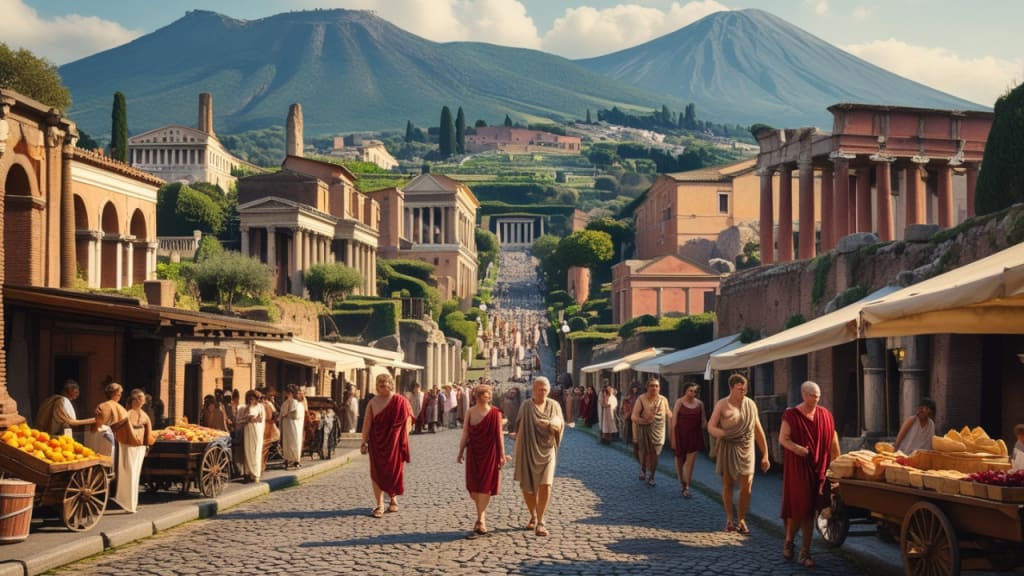
Long ago, in the country we now call Italy, there was a busy and beautiful city named Pompeii. It was near a tall mountain called Mount Vesuvius. The people of Pompeii had no idea that this mountain was actually a volcano—a sleeping giant that would one day wake up and destroy everything.
Pompeii was not just any city. It was full of life. The streets were made of stone, and people walked or rode in carts. Shops sold bread, wine, and fruits. There were schools, bathhouses, temples, and even theaters where people watched plays. Rich families lived in big houses with gardens and colorful wall paintings called frescoes. Everyone—from farmers to builders to artists—had a role to play.
At its peak, Pompeii had around 20,000 people. It was a strong part of the Roman Empire and was growing fast. Trade brought money, and the city became a great place to live. People enjoyed fresh food, clean water, and fun events. Life seemed perfect.
But there were signs of danger.
Pompeii had felt small earthquakes before. People thought they were normal and didn’t worry much. In fact, 17 years before the big disaster, a strong quake had already damaged parts of the city. But no one expected what was coming.
Then came the day no one could forget—August 24, 79 A.D.
On that morning, the ground shook again. But this time, it was different. Around midday, Mount Vesuvius exploded. A huge cloud of ash, smoke, and hot gas shot high into the sky. People could see it from far away. Many thought it was just another earthquake. But they were wrong.
The ash started falling like snow, covering houses, streets, and people. Roofs broke under the weight. Darkness filled the air. It became hard to breathe or see. Panic spread. Some people ran, trying to escape. Others stayed, hoping it would pass.
But it didn’t.
The volcano kept roaring. Later that day, a fast-moving wave of super-hot gas and rock—called a pyroclastic surge—rushed down the mountain. It was so fast and so hot, it killed people in seconds. Some tried to hide in their homes. Others held onto loved ones. Sadly, they had no chance.
By the next day, Pompeii was gone. The whole city was buried under more than 15 feet of ash and stone. It became a city frozen in time.
For hundreds of years, no one knew exactly where Pompeii was. People forgot about it. They built new towns nearby. But deep under the ground, Pompeii was waiting.
Then, in 1748, something amazing happened. Workers digging for a building found old walls and strange shapes. They had discovered Pompeii. Since then, scientists and archaeologists have worked to bring the city back to life. What they found was incredible.
They found bodies of people, frozen in the positions they were in when they died—some sitting, some running, some hugging. They found paintings, tools, food, and even graffiti on the walls. It was as if time had stopped in 79 A.D. The ash had protected everything like a time capsule.
Thanks to this, we now know so much about life in ancient Rome. Pompeii gives us a real look into the past. It teaches us how people lived, what they ate, what they believed, and how they dealt with joy and fear.
Today, Pompeii is one of the most famous archaeological sites in the world. Millions of people visit it each year. They walk its streets and imagine the people who once laughed, worked, and dreamed there.
Pompeii’s story is both amazing and sad. It reminds us of the power of nature—and how quickly life can change. But it also shows us how the past can speak to us, even after thousands of years.
About the Creator
Nouman wali
A passionate blogger ✍️ and story writer 📖
I turn thoughts into words that inspire, connect, and spark imagination ✨.
Let’s share stories that matter, one word at a time 🌍📝.
Keep reading
More stories from Nouman wali and writers in History and other communities.
Understanding the Insurrection Act
The Insurrection Act is one of the most powerful and least understood laws in American history. Often mentioned during times of national unrest, it gives the president authority to deploy federal troops within the United States under specific circumstances. While it is rarely used, public interest in the law has grown in recent decades, leading many to ask: what is the Insurrection Act, and why does it matter today? What Is the Insurrection Act? To put it simply, the Insurrection Act of 1807 is a federal law that allows the president to use the U.S. military to suppress civil disorder, insurrection, or rebellion when state authorities are unable or unwilling to do so. If you are wondering what is the Insurrection Act used for, the answer lies in restoring order when local and state governments can no longer maintain public safety. People often search phrases like what is insurrection act or even the misspelled insurection act because the law tends to resurface during moments of crisis. Despite the confusion around its name, the authority it grants is very real and legally binding. What Is the Insurrection Act of the U.S.? So, what is the Insurrection Act of the US in legal terms? It is a collection of statutes now codified under Title 10 of the U.S. Code. The act provides exceptions to the Posse Comitatus Act, which generally prohibits the military from acting as domestic law enforcement. Under the Insurrection Act, the president can federalize the National Guard or deploy active-duty troops if constitutional rights are being violated or if violence prevents the execution of federal law. This is why many people ask, what is the Insurrection Act USA, especially when protests or riots dominate national headlines. The Insurrection Act and Its Historical Use Throughout American history, the act has been invoked sparingly but decisively. One of the most notable examples often referenced is the Insurrection Act 1992, when President George H. W. Bush deployed federal troops to Los Angeles following the Rodney King verdict. Local authorities had lost control, and the federal government stepped in to restore order. Earlier uses date back to the Civil War era and the Civil Rights Movement. Presidents Eisenhower and Kennedy relied on the act to enforce school desegregation in Southern states when state governments resisted federal court orders. These moments illustrate what the Insurrection Act is used for at its core: enforcing the rule of law when normal systems fail. Trump and the Insurrection Act In modern political discourse, the law became widely discussed during the presidency of Donald Trump. Searches for Trump Insurrection Act or Insurrection Act Trump surged during periods of nationwide protests, particularly in 2020. Although the act was never formally invoked during those protests, President Trump publicly considered its use, bringing renewed attention to the scope and limits of presidential power. The phrase insurrection act invoked often appears in news coverage, but it is important to note that discussing invocation and actually using the law are two very different things. The debate surrounding Trump Insurrection Act scenarios highlighted concerns about civil liberties, federal overreach, and the balance of power between states and the federal government. What Is the Insurrection Act in Minnesota? A common question during periods of regional unrest is what is the Insurrection Act in Minnesota or in other specific states. Legally, the act does not change from state to state. However, its application depends on circumstances within a particular state. If a governor requests federal assistance or if the president determines that constitutional rights cannot be protected locally, the Insurrection Act may apply. Minnesota, like every other state, falls under the same federal framework. The law does not target any single state; it responds to conditions on the ground. What Is the Insurrection Act Used For Today? In today’s environment, many Americans ask, what is the Insurrection Act used for in a modern democracy with established institutions. Supporters argue it is a necessary safeguard for extreme emergencies. Critics counter that it grants sweeping powers that could be misused if political tensions escalate. Understanding what is the Insurrection Act? requires recognizing that it is both a legal tool and a symbol. Its mere mention can influence public perception, markets, and political debate, even when it is not formally applied. Ongoing Debate and Public Concern The Insurrection Act remains controversial because it sits at the intersection of security and freedom. While it has been used to protect civil rights in the past, critics worry about potential misuse in polarized times. This tension explains why questions like what is the Insurrection Act of the US continue to trend whenever civil unrest occurs. Ultimately, the law reflects a fundamental challenge in governance: how to maintain order without undermining democracy. The fact that it has existed since 1807 and remains largely unchanged shows both its durability and its complexity. Final Thoughts The Insurrection Act is not a law that affects daily life, but it plays a critical role during extraordinary moments. From the Insurrection Act of 1807 to discussions around Insurrection Act 1992 and Insurrection Act Trump, its history mirrors the nation’s struggles with unity, authority, and rights.
By Saboor Brohi 4 days ago in History
From Desert Sands to a Global City
Long before Dubai became a city of glittering skyscrapers and global ambition, it was a quiet settlement shaped by the desert, the sea, and the determination of its people. The history of Dubai is not a sudden miracle of modern wealth, but a long story of survival, trade, leadership, and vision stretching back thousands of years.
By The best writer 6 days ago in History




Comments
There are no comments for this story
Be the first to respond and start the conversation.