
The Story of Freedom
British Colonization to the Emergence of Pakistan – A Journey Through Sacrifice and Struggle
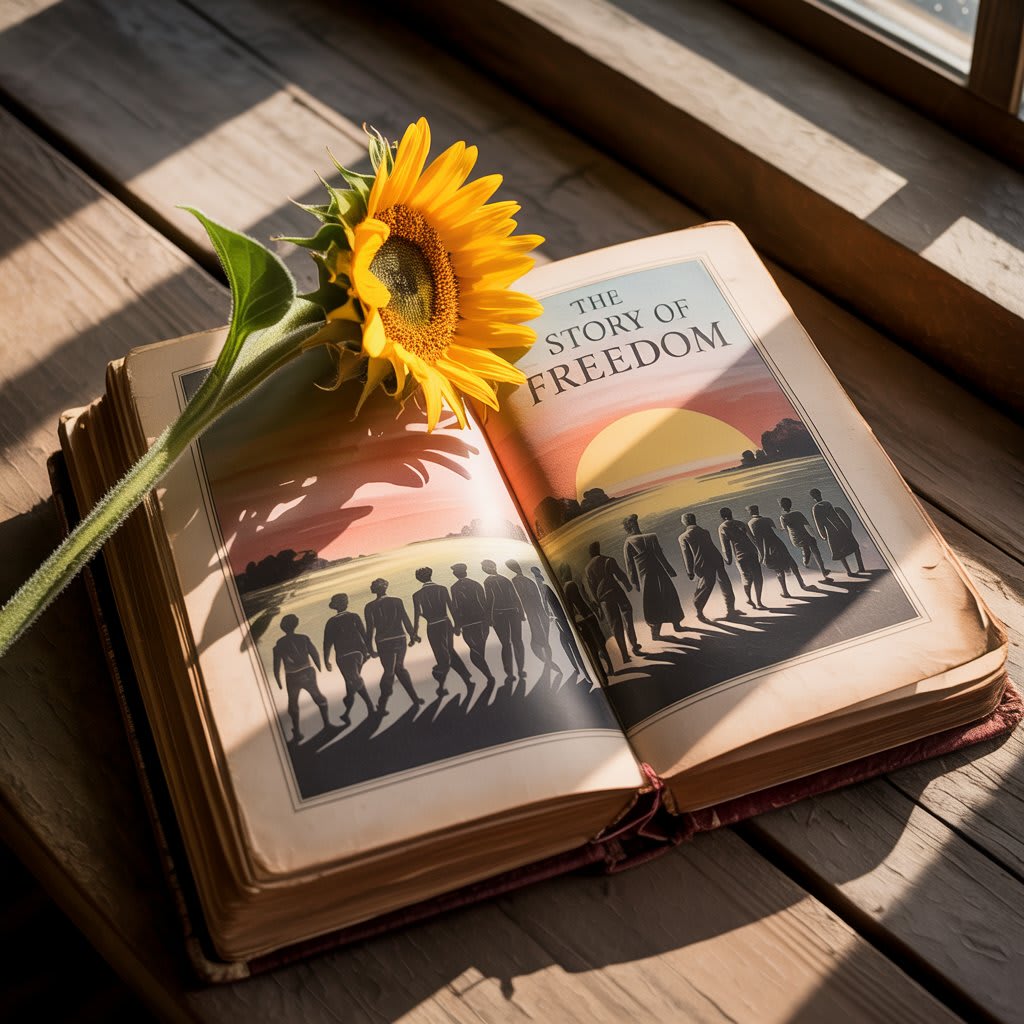
It was the 14th of August, and the air was filled with joy. The entire school was adorned with flags, and students in all grades were enthusiastically celebrating Independence Day. Happiness was visible on every face. Yet, amidst the vibrant celebration, one person sat quietly—Sir Tahir. Lost in deep thought, he seemed distant from the jubilant atmosphere around him.
Faizan, a student, noticed this and approached him. “Sir, everyone is so happy today, but you seem upset. Is everything okay?”
Sir Tahir sighed and said, “Ah Faizan… Today, I am reminded of the sacrifices of those brave souls who endured the brutalities of the British to win us our freedom.”
Faizan, puzzled, asked, “Sir, what do you mean? Wasn’t Pakistan always free?”
With a gentle smile, Sir Tahir replied, “No, son. Before Pakistan was created, the entire Indian subcontinent was under British rule for almost 150 years. It’s a sorrowful and painful chapter of our history.”
Curious and attentive, the children gathered around Sir Tahir as he began to narrate the tale of their homeland’s past.
“Before the British came, the subcontinent was ruled by the Mughals, from the 15th to the 17th century,” Sir Tahir explained. “But how did the British come to India?” asked a curious student named Takhfeef.
“In 1453,” Sir Tahir continued, “the Turks captured key European trade routes, disrupting Europe’s trade with India. The Europeans began searching for alternative sea routes. In 1498, a Portuguese sailor, Vasco da Gama, successfully discovered a sea route to India. They took advantage of India’s internal weaknesses and began expanding their influence.
He explained how various European powers—Portuguese, Dutch, and French—established trading centers before the British finally gained dominance. In 1600, the British established the East India Company with the permission of Queen Elizabeth I, aiming to trade with India. By 1608, during the rule of Mughal Emperor Jahangir, the British arrived in India and were allowed to trade.
But their intentions changed when they saw Emperor Aurangzeb busy with southern military campaigns. Slowly, they started capturing small towns and villages. By 1707, they took control of regions like Mysore. Eventually, major provinces of India fell under British control.
“Children,” Sir Tahir said, “in 1703, Shah Waliullah was born in Delhi. He was a brilliant scholar who translated the Quran into Persian at a young age. When he saw the Mughal Empire weakening under the indulgent emperor Muhammad Shah Rangila, he encouraged Nawab Najib-ud-Daula to seek help from Ahmad Shah Abdali of Afghanistan.”
Abdali responded, and his invasions helped awaken a sense of resistance in the Indian Muslims. Shah Waliullah’s teachings inspired awareness of freedom and the spirit of jihad. He passed away in 1762, and his son Shah Abdul Aziz continued his mission.
Shah Abdul Aziz was the first scholar to declare the British as enemies and issue a fatwa (religious decree) for jihad against them. In 1772, his call was echoed by Tipu Sultan, the ruler of Mysore, who fought several battles against the British. Despite being betrayed by his own general, Mir Sadiq, Tipu Sultan remained resilient and was ultimately martyred on May 4, 1799, in Seringapatam.
Faizan raised his hand again. “Sir, was this the first war against the British?”
“No,” replied-ud-Daulah of Bengal. Unfortunately, he too was betrayed—by Mir Jafar, his own commander-in-chief.”
After Siraj-ud-Daulah's death, the Sikhs rose to power in Punjab. Their rule was harsh on Muslims. When Sayyid Ahmad Shaheed heard about the atrocities of the Sikh ruler Ranjit Singh, he sent his student Shah Ismail to gather intelligence in Punjab. Sayyid Ahmad Shaheed, a devout student of Shah Abdul Aziz, launched a jihad campaign against the Sikhs.
He had over 30,000 followers and even converted 60,000 Sikhs to Islam. His book Taqwiyat-ul-Iman led over 350,000 non-Muslims to embrace Islam. In 1826, he set out for jihad. His forces won initial battles but internal conspiracies led to his martyrdom in 1831 at Balakot, along with Shah Ismail.
Though the movement failed temporarily, it awakened a renewed sense of Islamic consciousness among Indian Muslims.
Then came the pivotal moment in 1857—known as the First War of Independence. Led by figures like Maulana Qasim Nanotvi, the Muslims and Indians revolted against the British. However, the British forces, well-trained and supported by the East India Company and British Crown, crushed the rebellion.
The British response was brutal. Nearly 14,000 Islamic scholars were martyred, and a royal decree was issued to eliminate religious leaders. Between 1864 and 1867, thousands of madrasas were shut down, and over 300,000 copies of the Quran were burned.
Yet, the spirit of learning and resistance survived. In 1866, Maulana Mahmood Nanotvi established Darul Uloom Deoband, now one of the world’s largest Islamic seminaries. In 1859, Sir Syed Ahmad Khan founded Aligarh University, emphasizing modern education for Muslims.
“These institutions,” said Sir Tahir, “laid the foundation for Muslim unity and identity.”
As political struggles continued, the Indian National Congress was formed in 1885. Although it claimed to represent all Indians, it was dominated by Hindus, and often neglected Muslim concerns. This led to the creation of the All India Muslim League in 1906.
In the 20th century, one man rose to lead Muslims toward a separate homeland—Muhammad Ali Jinnah. With determination and vision, he organized the Muslim League and led the movement that culminated in the creation of Pakistan on August 14, 1947.
“Remember, children,” Sir Tahir said passionately, “only two countries in the world were created based on ideology—Israel and Pakistan. Pakistan was made to protect the cultural, religious, and political rights of Muslims.”
“Sir,” asked a student, “was it only Quaid-e-Azam who fought for Pakistan?”
“No,” Sir Tahir responded. “Many others stood by his side—Liaquat Ali Khan, Allama IqSir Tahir smiled. “Never forget the sacrifices that earned us this freedom.”
About the Creator
MUHAMMAD YOUSAF
BE SMILE AND BE CAREFUL
Keep reading
More stories from MUHAMMAD YOUSAF and writers in History and other communities.
the Golden Age of Islam
Between the 8th and 14th centuries, the Islamic world experienced a remarkable flourishing of knowledge, creativity, and scientific advancement. Known as the Golden Age of Islam, this period saw the rise of scholars, philosophers, physicians, astronomers, and engineers whose contributions transformed the world and laid the foundations for modern science, medicine, mathematics, and philosophy. The legacy of this golden era continues to inspire scholars and thinkers around the globe.
By MUHAMMAD YOUSAF10 months ago in History
The Deeds of Mullah Nasiruddin
The Deeds of Mullah Nasiruddin (Article No. 1270) Mullah Nasiruddin is a name that almost everyone has heard. His stories are famous across cultures for their humor, wisdom, and clever twists. Although he appeared simple and playful, Mullah Nasiruddin possessed sharp intelligence and deep insight. His actions often carried hidden lessons that made people laugh first and think later. The following incidents from his life highlight his wit, presence of mind, and moral intelligence.
By Sudais Zakwan6 days ago in History
3 Small Lies That Grew Into Massive Disasters
Big disasters don’t always start with big lies. Those are too obvious and too suspicious. The truly dangerous ones begin small, harmless even. The kind of lie you tell to save face, avoid paperwork, or postpone an awkward conversation. The kind that feels temporary.
By Enoch Sagini6 days ago in History


Comments (1)
I remember learning about this in school. It's a crucial part of our history. The story of how the British came to India is really eye - opening.