
the Golden Age of Islam
A Legacy of Knowledge and Innovation"
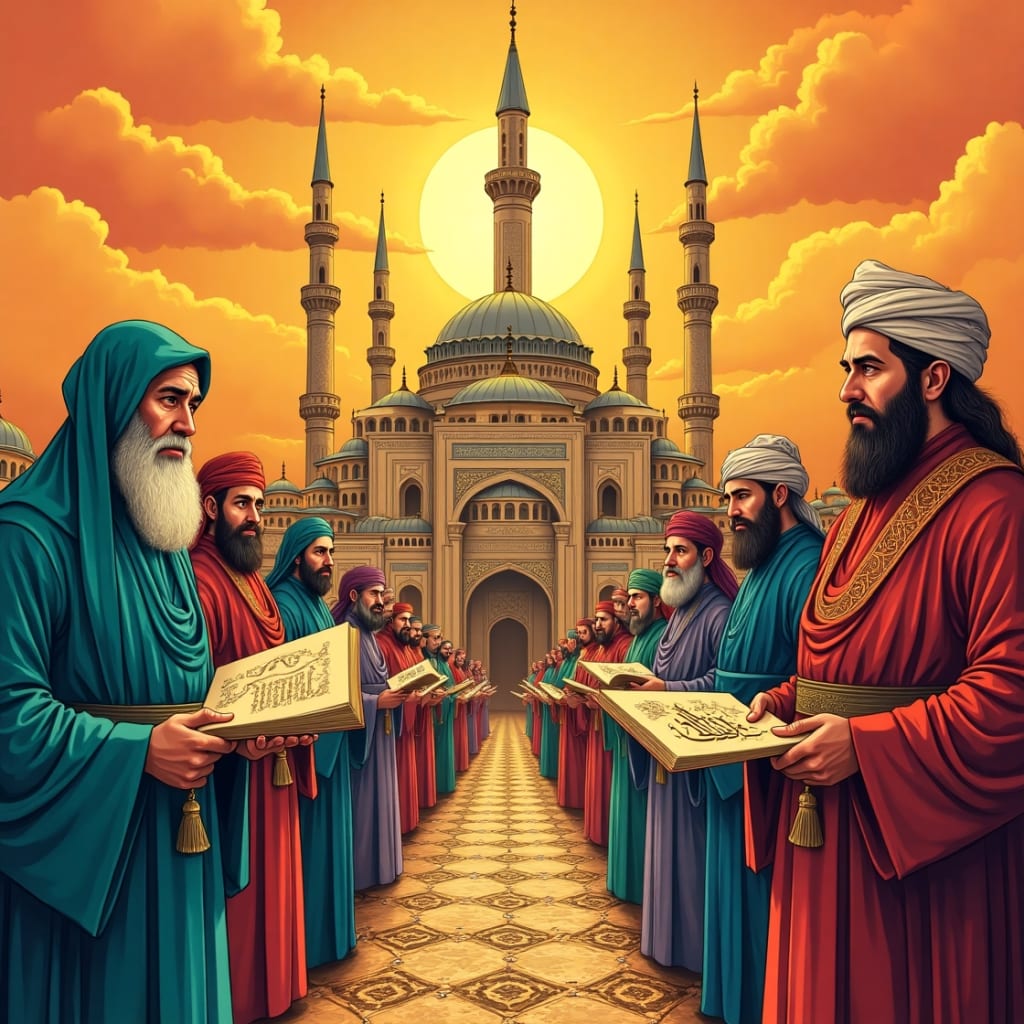
Between the 8th and 14th centuries, the Islamic world experienced a remarkable flourishing of knowledge, creativity, and scientific advancement. Known as the Golden Age of Islam, this period saw the rise of scholars, philosophers, physicians, astronomers, and engineers whose contributions transformed the world and laid the foundations for modern science, medicine, mathematics, and philosophy. The legacy of this golden era continues to inspire scholars and thinkers around the globe.
A Time of Intellectual Revival
The seeds of the Islamic Golden Age were sown under the rule of the Abbasid Caliphate, particularly in the reign of Caliph Harun al-Rashid (786–809 CE) and his son Al-Ma'mun. The Abbasids established Baghdad as the capital of their empire—a thriving city that became a beacon of knowledge and culture. Al-Ma'mun founded the renowned Bayt al-Hikmah (House of Wisdom), a grand institution where scholars from different religious and ethnic backgrounds gathered to translate, preserve, and expand upon the works of ancient Greek, Persian, and Indian thinkers.
This openness to knowledge from all civilizations was a defining trait of the Islamic Golden Age. Muslim scholars did not merely preserve ancient texts—they critically analyzed and built upon them, developing new ideas and methods that would profoundly influence both the Islamic world and the West.
Contributions to Science and Mathematics
The Golden Age of Islam witnessed tremendous growth in the natural sciences. One of the most iconic figures of this period is Ibn al-Haytham (Alhazen), often referred to as the "father of optics." His Book of Optics laid the groundwork for the modern scientific method and revolutionized the understanding of light, vision, and perception.
In the field of mathematics, Al-Khwarizmi introduced algebra (al-jabr in Arabic), a term and concept that became foundational in mathematics. His works were translated into Latin in the 12th century, spreading across Europe and shaping the development of mathematics for centuries. The word “algorithm” itself is derived from his name.
Muslim astronomers like Al-Battani, Al-Zarqali, and Ulugh Beg made significant contributions to celestial observations, improving on Ptolemaic models and producing detailed star charts. Their advancements laid the groundwork for later European astronomers such as Copernicus and Galileo.
Medical Advances and Public Health
Medicine was another area where Islamic scholars made profound contributions. Ibn Sina (Avicenna), a Persian polymath, authored The Canon of Medicine, a comprehensive medical encyclopedia that was used as a standard textbook in Europe and the Islamic world for over 600 years. He introduced methods for diagnosing diseases, tested new medicines, and emphasized the importance of hygiene and mental health.
Al-Razi (Rhazes), another brilliant physician, distinguished smallpox from measles for the first time and wrote extensively on medicine, chemistry, and philosophy. Hospitals in Islamic cities were well-organized institutions with wards, pharmacies, and medical libraries—centuries ahead of their European counterparts.
Philosophy, Literature, and the Arts
Islamic philosophy thrived during the Golden Age, with scholars such as Al-Farabi, Ibn Rushd (Averroes), and Al-Ghazali engaging deeply with Greek philosophy, particularly the works of Aristotle and Plato. These thinkers explored questions of ethics, metaphysics, and logic, often reconciling reason with Islamic theology.
In literature, this period gave rise to great poets and storytellers like Rumi, Al-Mutanabbi, and Omar Khayyam. Their works expressed the beauty of the Arabic and Persian languages and reflected deep spiritual and philosophical themes.
The visual arts also flourished, with intricate calligraphy, geometric patterns, architecture, and manuscript illumination reflecting both the aesthetic sensibilities and spiritual depth of Islamic culture. Iconic structures like the Alhambra in Spain and the Great Mosque of Córdoba remain testaments to this golden era of artistic achievement.
Tolerance and Multicultural Exchange
One of the most notable aspects of the Golden Age of Islam was the spirit of tolerance and intellectual openness. Scholars of various backgrounds—Muslims, Christians, Jews, Zoroastrians, and others—collaborated in the pursuit of knowledge. This multicultural environment allowed for a dynamic exchange of ideas and the flourishing of learning across linguistic, cultural, and religious boundaries.
Cities such as Córdoba, Cairo, Damascus, and Baghdad became melting pots of culture, attracting scholars from across the world. This inclusive attitude not only preserved the wisdom of ancient civilizations but also created new knowledge that would eventually shape the Renaissance in Europe.
The End of the Golden Age
While the achievements of the Islamic Golden Age were vast and enduring, the era gradually declined due to a combination of factors. The Mongol invasion of Baghdad in 1258, internal political fragmentation, and the rise of conservative interpretations of religious texts led to a decrease in scientific and philosophical inquiry. Despite this, the legacy of the period lived on through translations of Arabic texts into Latin and the continued influence of Islamic thought on Western scholarship.
Lasting Impact and Modern Relevance
The impact of the Golden Age of Islam is still felt today. Many modern scientific principles, medical practices, and philosophical ideas can trace their origins back to this remarkable era. It reminds us that civilizations thrive when they value education, tolerance, and curiosity.
In a world increasingly divided by misunderstanding and cultural barriers, the Golden Age of Islam stands as a powerful example of what humanity can achieve when people of different backgrounds come together to seek knowledge and truth. It is a legacy not only for Muslims but for all of humanity—a shining chapter in the shared history of human civilization.
About the Creator
MUHAMMAD YOUSAF
BE SMILE AND BE CAREFUL
Keep reading
More stories from MUHAMMAD YOUSAF and writers in History and other communities.
The Story of Freedom
It was the 14th of August, and the air was filled with joy. The entire school was adorned with flags, and students in all grades were enthusiastically celebrating Independence Day. Happiness was visible on every face. Yet, amidst the vibrant celebration, one person sat quietly—Sir Tahir. Lost in deep thought, he seemed distant from the jubilant atmosphere around him.
By MUHAMMAD YOUSAF8 months ago in History
Three Indie Podcasts About Classic Hollywood
Classic Hollywood was not simply a place and time where movies were made. It was where the magic happened, on and off the screen. Classic Hollywood wasn’t just about the classic movies being made — Citizen Kane, King Kong, Arsenic And Old Lace, It Happened One Night, Casablanca. The movie stars — backed by the studios and their P.R. machine — were depicted as larger than life, living lives of pampered luxury, extravagance, and, at times, even debauchery.
By Frank Racioppia day ago in History
🅼🅸🅳🅽🅸🅶🅷🆃 🆂🅽🅰🅲🅺🆂
"It's 10 in Tuscon! We all know what that means... It's Time for Midnight Snacks with your man, Gerald Gee! Ready to spend the night together? Me too! I'm full of snacks and can't wait to regurgitate them all back into your hungry ears. Crack a brew! Pop some corn! Anything to get ready for one hell of a show where the talk maybe cheap but the words cut deep...
By Lamar Wiggins5 days ago in Fiction



Comments
There are no comments for this story
Be the first to respond and start the conversation.