
The Story of a Muslim Family from Arakan
The Story of a Muslim Family from Arakan

The Story of a Muslim Family from Arakan
In a small village on the border of Arakan lived the family of Abdul Karim. Their little village rested at the foot of a hill, surrounded by paddy fields, coconut trees, and bamboo groves. Karim was a simple farmer—he cultivated two bighas of land and made a living from the crops he grew, while his wife, Ayesha, earned a bit by weaving cloth. Their small family of five included Ayesha, two sons—Saeed and Kamal—and a little daughter, Rahima. Their days passed in peace, filled with dreams and the simplicity of rural life.
But one morning, that dream shattered. Smoke rose above the village sky, and the sound of gunfire echoed from a distance. “The soldiers are coming,” someone shouted. Panic spread like wildfire. People began running—some toward the hills, others toward the river. Karim quickly gathered his wife and children and said, “Go! Run while there’s still time!”
But there was little time left. The soldiers entered the village, setting houses ablaze. Some families burned inside their homes; others had their children taken away. Karim sent his children to hide inside a bamboo grove and ran back to rescue his elderly mother. That was the last time his family saw him. The soldiers reached the house, and gunshots broke the silence. Ayesha screamed from afar, “Karim!”—but he never returned.
That night, Ayesha could not tell how time passed. Her home turned to ashes before her eyes. At dawn, she took her three children and began walking toward the border. On the way, she saw others fleeing—some with bullet wounds, some carrying the lifeless bodies of their children. Many drowned while trying to cross the river. Holding her children close, Ayesha cried, “Ya Allah, please save us.”
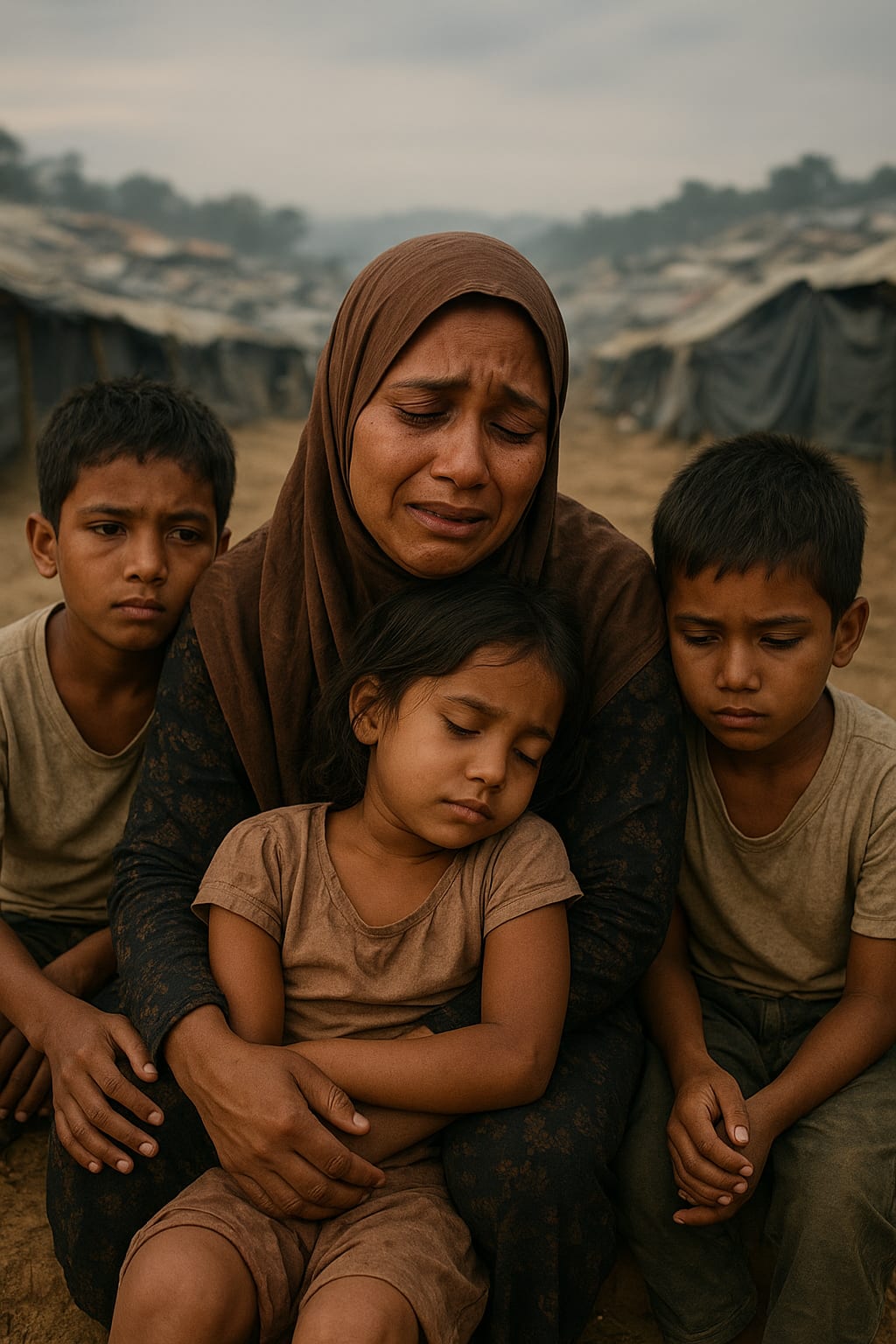
It took three long days to reach safety. There was no food, no water. Little Rahima cried until she fell asleep in her mother’s arms. Saeed and Kamal clutched their mother’s hands and kept walking. At last, they reached the Naf River—the border of Bangladesh. There, thousands of refugees had gathered, desperate for shelter. Soldiers and locals were helping, offering food and water, but the crowd was so thick that it was hard to even breathe.
When Ayesha finally entered Bangladesh, she felt lost. She and her children found a spot under a tent in the Rohingya refugee camp. Sitting on an old blanket spread over the dirt floor, she remained silent for a long time. Karim’s face, their burning home, the destroyed fields—all flashed before her eyes. Her tears had dried, but the ache in her heart had not.
That night, she realized for the first time that refuge does not mean safety. Inside the tent, the heat made it hard to breathe; when it rained, everything got soaked. To get food for the children, she had to stand in line for hours. One day, Saeed said softly, “Amma, I want to study again—like before.” Ayesha stroked his head but said nothing. She knew how impossible education seemed in this life of uncertainty.
Yet Ayesha did not give up. She joined other women in the camp, making small handicrafts—bags from old cloth, woven mats—to earn a little money. Whenever she could, she saved enough to buy books for her sons. One evening Kamal asked, “Amma, will we ever go back to our village?” Ayesha smiled faintly, tears shimmering in her eyes. “Insha’Allah, one day we will. But for now, may Allah keep us safe here.”
Life in the camp was monotonous, yet every day brought new struggles. Some fell ill, some went hungry, some cried for loved ones they could no longer find. Every dawn, Ayesha prayed, “O Allah, protect my children from losing their faith. Let them live to see a world of peace.”
One day, an aid worker arrived at the camp to open a small school for children. Saeed and Kamal were enrolled. On their first day, when they held notebooks and pencils again, Ayesha watched from a distance. Her heart filled with quiet gratitude—amid all the suffering, Allah had sent a small ray of light.
At night, when the wind swept through the camp and the distant call to prayer echoed across the hills, Ayesha would tell her children stories—about Arakan, their paddy fields, the river, the mosque’s adhan, and their father’s warm smile. Rahima would rest her head on her mother’s lap and whisper, “Amma, will we ever go back there?” Ayesha would reply, “Yes, my child. One day peace will return. We will rebuild our home, harvest our rice, and pray in our own land—without fear.”
And that hope kept Ayesha alive. Every hardship she endured was for her children’s future. Each morning, as the sun rose over the camp, she silently remembered Karim—“Perhaps you’re watching us from above. I’m keeping your children safe, just as you would have wanted.”
The once-peaceful village of Arakan may still be shrouded in smoke, but a light of faith continues to burn in Ayesha’s heart. Her children are growing, learning, and slowly walking toward a new life. Yet every night, she whispers the same prayer—
“O Allah, bring peace back to our homeland. Let no other mother have to flee with her children as I did.”
And so time moves on—through the dusty winds of the refugee camp, through fear and uncertainty—but the story of one mother’s unyielding faith lives on, carrying with it the voice of a people who still dream of going home.
About the Creator
Sadi
I am Sadi — a wanderer of words and emotions. Through writing, I seek truth in silent hearts and meaning in life’s chaos. My poems and stories breathe with mystery, reflection, and soul — inviting readers to feel, think, and question deeply
3 True Stories That Sound Like Urban Legends but Aren’t
Urban legends usually follow a familiar pattern. A friend of a friend hears something unbelievable, the details get hazy, and the story ends with a warning about human stupidity or bad luck. The unspoken rule is simple: if it sounds too strange to be true, it probably is.
By Enoch Sagini4 days ago in History
The Crown of Ash and Gold
In the final era of the ancient kingdom of Aurelion, the world seemed to change its tone. The skies appeared duller, the winds colder, and the streets quieter than they had ever been during the kingdom’s golden age. Aurelion was once a beacon of civilization—its stone cities gleamed under the sun, its scholars were respected across continents, and its armies had carved its name into history. Yet no empire, no matter how mighty, can escape the slow test of time.
By The best writer 7 days ago in History
How to Succeed at the Benson Directory®
Congratulations and welcome to the Benson Directory® employee #22391! As our newest call handler, you will have the privilege of speaking with dozens of unique and interesting people on a daily basis as well as the opportunity to earn bonuses for high performance. Contained within this handbook you will find a set of ease to follow instructions designed to help you settle in to your new role and begin paving the way to success.
By S. A. Crawford3 days ago in Fiction



Comments (1)
So sad