
The Story Behind the Quran Pak
From the Cave of Hira to the Hearts of Billions
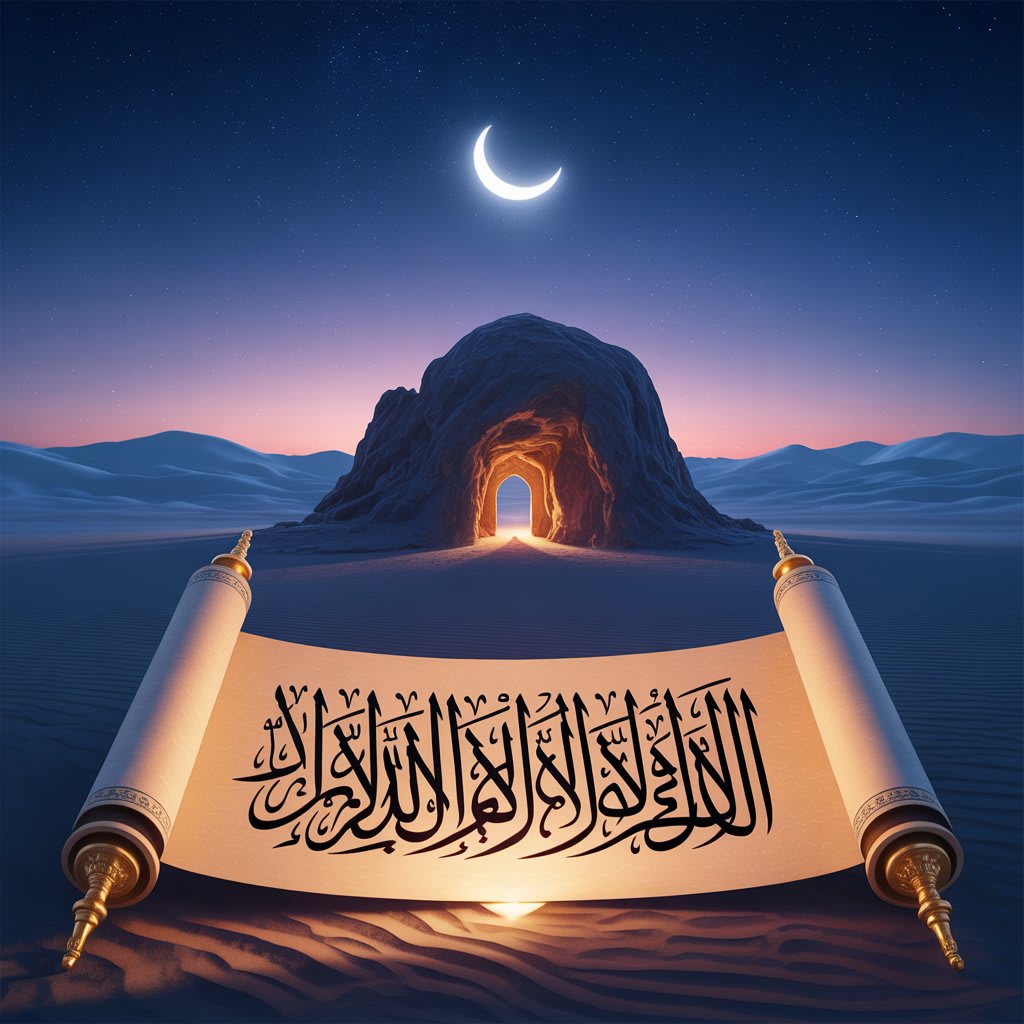
Chapter One: The Quiet Before the Light
In the rugged terrain outside Makkah, atop Jabal al-Noor—the Mountain of Light—a man sat alone in the stillness of a cave. His name was Muhammad ibn Abdullah, and at the age of 40, he was known not for wealth or power, but for his honesty, kindness, and reflection. The people of Makkah called him Al-Amin—the trustworthy.
But the world around him troubled him deeply. He watched with a heavy heart as tribal rivalries turned brother against brother, as idols were worshiped in place of one Creator, and as the poor and weak were trampled under the feet of the powerful.
Seeking peace, Muhammad (peace be upon him) would climb to the Cave of Hira, where he would sit in solitude for days at a time, away from the noise of the city. There, surrounded by the silence of stone and stars, he searched for answers, for clarity, for a connection with something greater.
Chapter Two: The First Revelation
It was a night like no other. The silence of the cave was deep, but not empty. Suddenly, a brilliant light filled the cave, and before him stood the Angel Jibreel (Gabriel). He was overwhelmed—not by fear of harm, but by the immensity of the moment.
The angel spoke just one word:
"Iqra."
Read.
"I cannot read," Muhammad replied, his voice trembling.
Again, the angel embraced him tightly, and again commanded, "Read." And again, he responded the same.
The third time, the angel recited:
"Read in the name of your Lord who created — created man from a clinging substance. Read, and your Lord is the most Generous—who taught by the pen—taught man that which he knew not."
(Surah Al-Alaq, 96:1–5)
These words, simple yet profound, marked the beginning of the Qur’an, the final revelation to mankind. They were not just a call to read—they were a call to awaken, to learn, and to connect with the Divine.
Muhammad ran down the mountain, heart pounding. He reached his wife, Khadijah (RA), and told her everything. She held him with calm reassurance and believed him without doubt. This moment became the foundation of a journey that would change the world forever.
Chapter Three: A Message for All Time
Over the next 23 years, the Qur’an was revealed gradually—sometimes in short verses, other times in longer chapters—responding to events, questions, and the spiritual needs of the time. Each word was memorized, written down, and preserved with extraordinary care.
The Qur’an didn’t come as a book of stories alone; it came as a guide. It spoke of mercy and justice, faith and responsibility, charity and community. It honored the Prophets before—Adam, Noah, Moses, Abraham, Jesus—and reminded people that Muhammad (PBUH) was not the founder of a new religion, but the final messenger of a long, divine tradition.
Its verses spoke directly to the heart:
"Indeed, in the remembrance of Allah do hearts find rest."
(Surah Ar-Ra’d, 13:28)
"And We have certainly made the Qur'an easy for remembrance, so is there any who will remember?"
(Surah Al-Qamar, 54:17)
Chapter Four: Carried in Hearts, Written in Light
Unlike any other book in history, the Qur’an was preserved both orally and in writing from the very first day. Companions of the Prophet (PBUH) became Hafiz—guardians of the Qur’an—by memorizing every word. Scribes recorded the verses on parchment, bones, leather, and palm leaves.
After the Prophet’s passing, during the caliphate of Abu Bakr (RA) and later Uthman ibn Affan (RA), the Qur’an was compiled into one volume. The Uthmani script, carefully standardized, spread across the growing Islamic world—from the deserts of Arabia to the mountains of Central Asia, from the coast of Africa to the islands of Southeast Asia.
It was a book like no other—not bound by time, not changed by rulers. For over 1400 years, not a single word has been added or lost. It is the only religious scripture to remain completely unaltered, recited in its original language by millions every single day.
Chapter Five: The Living Word
What makes the Qur’an unique is not only its message but also its living legacy. Children as young as five begin to recite its verses. Grandmothers whisper its prayers before dawn. Scholars reflect deeply on its meanings, while new Muslims cry as they hear its rhythm for the first time.
It is not just read—it is lived.
In times of sorrow, people turn to it for hope. In moments of joy, they quote its blessings. In confusion, they seek its clarity.
"This is the Book about which there is no doubt, a guidance for those conscious of Allah."
(Surah Al-Baqarah, 2:2)
Chapter Six: A Miracle for the Ages
The Qur’an is not merely a religious text—it is the miracle of the Prophet Muhammad (PBUH). Unlike miracles of the past, seen by only a few, the Qur’an is a miracle for all people, for all time. Its linguistic perfection, its consistency, its impact—all stand unchallenged.
And perhaps, the greatest miracle of all is how it touches the heart.
Today, in a world flooded with noise, confusion, and distraction, the Qur’an remains a source of calm and direction. Whether heard in the call to prayer echoing through cities or recited in the silence of a midnight prayer, its words continue to change lives.
Epilogue: The Light That Never Dims
From a cave on a lonely mountain to the hearts of over two billion believers, the journey of the Qur’an Pak is one of divine purpose and timeless relevance.
It teaches us that revelation is not about magic or mystery. It is about light—light that pierces through darkness, guiding each soul back to its Creator.
So when you hear the word Iqra—Read—it is not just a command. It is an invitation. An invitation to understand, to reflect, and to connect.
The Qur’an waits not on a shelf, but in the hearts that are open to receive it.
📖 “Revelation: The Story Behind the Quran Pak”
Let this be your beginning—not just of reading, but of remembering.
About the Creator
Keep reading
More stories from ibrahimkhan and writers in History and other communities.
Echoes in the Elderwood
The village of Blackthorn lay on the edge of the Elderwood, a sprawling forest that few dared to enter. It was not that the forest was particularly dangerous—at least, not in any way one could understand with human senses—but there was something in the air there, something that made every person who had the misfortune to wander too deep feel… unsettled.
By ibrahimkhan8 months ago in History
Saudi Arabia Warns Against War
Saudi Arabia Warns Against War: Why Riyadh Opposes a U.S. Attack on Iran As tensions between the United States and Iran continue to rise, Saudi Arabia has taken a notable and cautious position: warning against any U.S. military attack on Iran. This stance may surprise some observers given the long history of rivalry between Riyadh and Tehran, but it reflects a broader regional concern that another major war in the Middle East could spiral beyond control.
By Wings of Time about an hour ago in History
Napoleon Bonaparte — From Corsican Outsider to Emperor of Europe
Napoleon Bonaparte was born on August 15, 1769, on the Mediterranean island of Corsica, a land that had only recently come under French control. His family was of modest noble status, and young Napoleon grew up feeling like an outsider—Corsican by culture, yet educated as a Frenchman. This sense of being different shaped his fierce ambition and iron will. From an early age, he showed a sharp mind, a deep love for history, and an unusual talent for mathematics, which later proved essential in warfare.
By The best writer 2 days ago in History



Comments
There are no comments for this story
Be the first to respond and start the conversation.