
The Story Behind the Invention of Tea
How a Serendipitous Leaf in Ancient China Sparked a Global Tradition
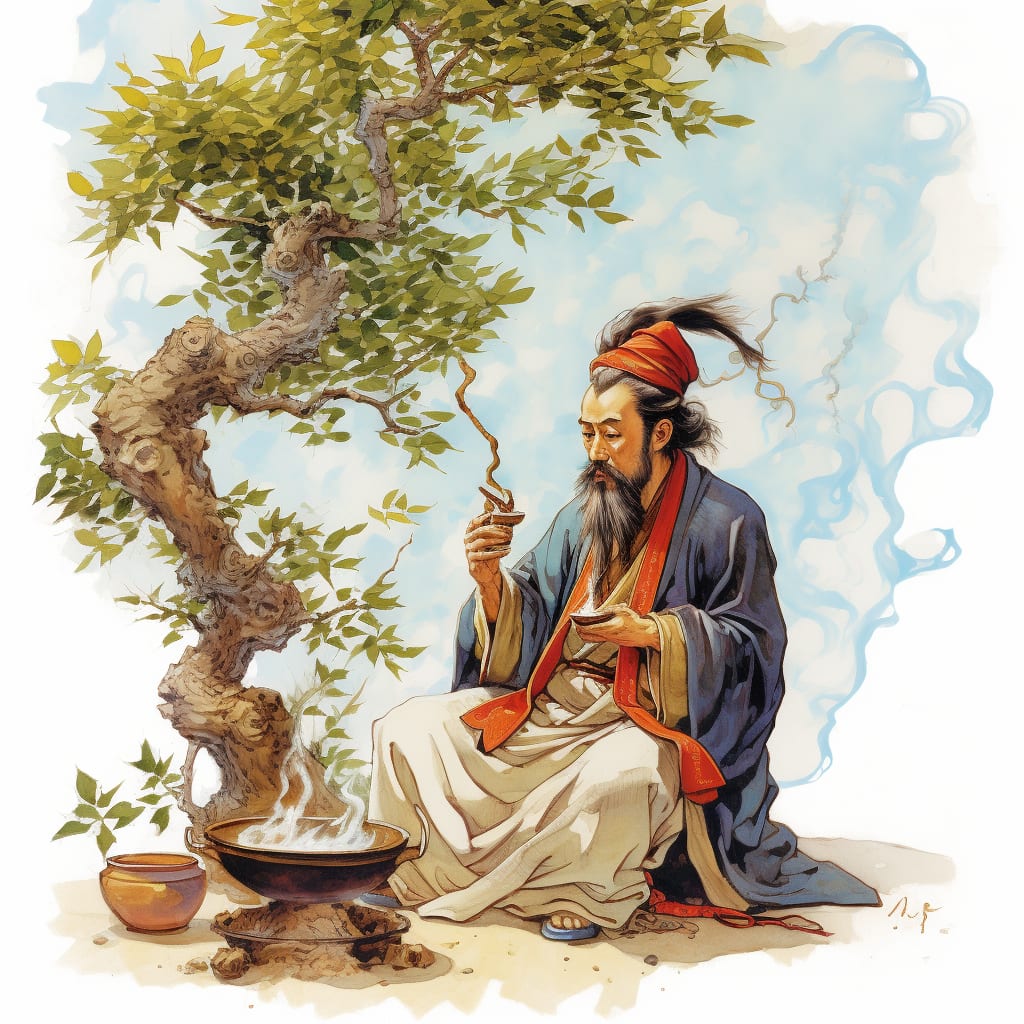
In the lush mountains of ancient China, around 2737 BCE, Emperor Shen Nong was no ordinary ruler. A scholar, herbalist, and scientist by nature, he believed that every leaf, root, and seed had a purpose. His empire flourished not only through conquest but through knowledge—especially of nature's remedies.
Each day, Shen Nong would wander the royal gardens with his attendants, examining plants, tasting herbs, and boiling water to test their properties. His belief was clear: boiled water was safer, and nature, though mysterious, always left clues for those who dared to seek them.
One sweltering afternoon, the emperor ordered his servants to boil water under the shade of a large wild camellia tree. As the pot began to simmer, a soft breeze rustled the tree's branches. Several green leaves, brittle from the sun, fluttered gently down into the pot below.
“Do not remove them,” Shen Nong said, intrigued by the aroma that began to rise. The steam carried a scent unlike anything he had known—earthy, soothing, slightly sweet.
He peered into the pot. The clear water had taken on a golden hue.
With his ever-curious spirit, Shen Nong lifted a ladle and sipped.
A gentle warmth spread through him—not just from the heat of the water, but from something deeper. A clarity of mind, a lightness in his chest, a spark of energy in his limbs. He smiled.
“This leaf,” he said, gazing up at the camellia tree, “is a gift from the heavens.”
His attendants exchanged glances. They had seen the emperor taste strange herbs that made his skin itch and his tongue swell, yet never before had he looked so... peaceful.
The emperor named the infusion “chá,” and in the days that followed, he returned often to the tree. He had the leaves dried, boiled, and even ground into powder to explore their full potential. Word of the “divine drink” spread throughout the palace, and soon, the imperial court was buzzing—not with gossip, but with energy.
Scribes recorded the discovery, healers began prescribing it, and the gardens were soon planted with cuttings from that first camellia tree.
But the story didn’t end there.
One evening, a humble farmer named Liang came to the palace gates. His wife had fallen ill with fever, and the village herbalists had given up. In desperation, he begged for the emperor’s wisdom.
Shen Nong listened. He handed the man a small pouch of dried tea leaves.
“Boil these in water. Let your wife drink it thrice a day.”
Liang bowed low, tears in his eyes.
Three days later, the farmer returned with a gift of sweet rice cakes and a miracle in his heart. His wife had recovered. The fever was gone.
The legend of tea began to grow—not just as a royal discovery, but as a healer of the common people.
Villages began to cultivate the tea shrub. Temples used it in their ceremonies to stay alert during meditation. Merchants packed it in silken pouches and carried it on long journeys across rivers, deserts, and mountains. Over time, tea found its way to Japan, India, the Middle East, and eventually Europe. It evolved, transformed, and adapted to every culture it touched.
Yet, in every form—from the thick butter tea of Tibet to the fine porcelain cups of Britain—it carried the spirit of that first moment: a fallen leaf, a curious mind, and a sip that changed the world.
Centuries later, poets would write about tea with reverence, monks would praise its clarity, and rebels would toss crates of it into the sea as a symbol of protest. But none would forget that it began not in a war, or a grand invention, but in silence—in a garden—in a single cup.
In his final years, Emperor Shen Nong would often sit beneath the same tree, a steaming bowl of tea in his hands, watching the leaves fall and smiling at the memory.
He had discovered many things in his life, but none so timeless, none so enduring, as tea.
About the Creator
Keep reading
More stories from Khalid khan and writers in History and other communities.
Alexander the Great: Conqueror of Worlds
Born in 356 BCE, under strange omens and celestial signs, Alexander of Macedon was destined for greatness. His mother, Olympias, told him he was not the son of a mortal man, but of Zeus himself. His father, King Philip II of Macedon, raised him to believe he was meant to rule not just Greece—but the world.
By Khalid khan7 months ago in History
Alexander the Great: Conqueror of Empires
Alexander was born in 356 BCE in the ancient kingdom of Macedon, a rugged land of warriors and kings. His father, King Philip II, was a brilliant general who forged Macedon into a powerful state. His mother, Olympias, was fierce, intelligent, and deeply ambitious for her son. From the beginning, Alexander’s life was wrapped in stories of destiny. Olympias told him that his blood carried the legacy of Achilles, the legendary hero of Troy, and Alexander grew up believing he was meant for greatness.
By The best writer 3 days ago in History
The Devil's Cut
“Comrade, finally you’re awake.” The voice was smooth, sensual. A flickering incandescent bar was all that lit the white, sterile room. All Vladimir remembered was everything going black. He tried to move his arms and found them strapped to the gurney.
By Matthew J. Fromm4 days ago in Fiction


Comments
There are no comments for this story
Be the first to respond and start the conversation.