
Alexander the Great: Conqueror of Worlds
The Untold Journey of a King Who Dreamed Beyond Empires
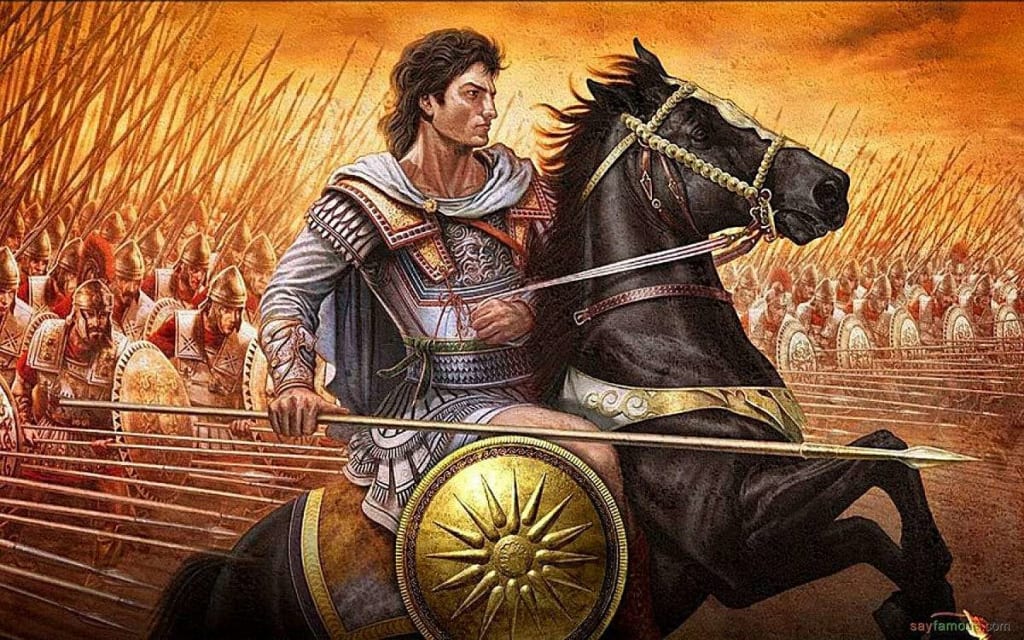
Born in 356 BCE, under strange omens and celestial signs, Alexander of Macedon was destined for greatness. His mother, Olympias, told him he was not the son of a mortal man, but of Zeus himself. His father, King Philip II of Macedon, raised him to believe he was meant to rule not just Greece—but the world.
Alexander grew up under the guidance of Aristotle, learning philosophy, science, and the stories of legendary heroes. He admired Achilles from Homer’s Iliad and dreamt of surpassing him in glory. More than a warrior, Alexander was a thinker—a rare combination that would shape his future.
At just 20 years old, Alexander became king after the assassination of his father. The throne came with immediate challenges—rebellions from northern tribes, unrest in Greek city-states, and doubts about his youth. But Alexander crushed the threats one by one. Thebes, one of the most powerful cities, resisted—and was utterly destroyed. Greece was now firmly under his rule.
But Alexander didn’t want to rule only Greece. He wanted to fulfill his father’s plan and conquer the mighty Persian Empire. In 334 BCE, he crossed the Hellespont with 35,000 soldiers and threw a spear into Asian soil, claiming it as his by right of conquest.
His first major test came at the Battle of Granicus. The Persian army was powerful, but Alexander’s bold tactics and personal bravery won the day. He led from the front, cutting through enemy lines like a thunderbolt. Victory followed victory. At Issus, despite being outnumbered, he defeated King Darius III of Persia, who fled the battlefield in panic. The Persian royal family was captured, but Alexander treated them with honor—a symbol of his vision to lead, not just conquer.
City after city fell. Babylon, Susa, and the great palace of Persepolis—all rich and ancient—became part of his empire. At Persepolis, the magnificent capital, Alexander allowed his troops to burn the palace—either as revenge for Persian invasions of Greece or as a moment of wild celebration. No one knows for sure. What is certain is that by 330 BCE, the Persian Empire was his.
But Alexander’s ambitions went beyond war. He envisioned a united empire of Greeks and Persians, East and West. He adopted Persian dress, married the princess Roxana, and encouraged his generals to marry local women. He built cities named after himself—Alexandria—to spread Greek culture, but also blended it with local traditions.
Many of his men, however, resisted this cultural fusion. They saw him changing, becoming more Persian than Macedonian. Murmurs of rebellion rose. Some of his closest companions were executed for plotting against him.
Still, Alexander marched on—toward the edge of the known world.
In 326 BCE, he reached India, where he faced one of his most difficult battles: the Battle of the Hydaspes River, against King Porus. Porus brought elephants to the battlefield—something Alexander’s men had never faced. But through clever tactics and sheer will, Alexander won. Impressed by Porus’s bravery, he allowed him to keep his kingdom under Macedonian rule.
But the victory came at a cost. His army was exhausted. They had marched thousands of miles, fought endless battles, and longed to return home. At the banks of the Hyphasis River, they refused to go any farther. After pleading with them, Alexander finally turned back.
The journey home was brutal. Crossing the scorching Gedrosian Desert, Alexander lost many men. Despite the hardship, he never stopped planning—new cities, new roads, a global empire.
In 323 BCE, he arrived in Babylon and began organizing future campaigns—perhaps Arabia next. But suddenly, he fell ill after a banquet. His condition worsened over days. On his deathbed, when asked who would inherit his empire, he whispered, "To the strongest."
And with that, the greatest conqueror the world had ever known—just 32 years old—closed his eyes forever.
His empire was divided among his generals, but his dream lived on. The cities he founded became centers of learning and trade. His influence shaped history, from the rise of Rome to the spread of Greek culture through Asia.
Alexander wasn’t just a warrior king. He was a visionary who saw a world without borders—a man who blended courage with curiosity, and conquest with culture.
More than two thousand years later, the world still remembers him as Alexander the Great—not just for what he conquered, but for what he imagined.
About the Creator
Keep reading
More stories from Khalid khan and writers in History and other communities.
The Blood of Karbala
In the scorching heat of the desert of Karbala, a tragedy unfolded that would echo through the ages, engraving itself into the heart of every believer. It was the 10th of Muharram, 61 AH. The sands were stained with the blood of the noblest of men, and the heavens wept as the grandson of the Prophet Muhammad ﷺ, Hazrat Hussain ibn Ali (RA), stood firm in the face of tyranny.
By Khalid khan6 months ago in History
Can the United States Leave NATO?
Can the United States Leave NATO? What It Would Take—and What It Would Mean The North Atlantic Treaty Organization, commonly known as NATO, has been one of the most powerful military alliances in modern history. Since its creation in 1949, the United States has been NATO’s strongest member—militarily, financially, and politically. But in recent years, debates have grown louder about whether the U.S. should remain in the alliance. This raises a serious question: how could the United States be removed from NATO—or leave it—and what would that mean for the world?
By Wings of Time 5 days ago in History




Comments
There are no comments for this story
Be the first to respond and start the conversation.