
The Spark That Changed the World
The Invention of the Magnic and the Genius Behind the Revolution


In the annals of innovation, where names like Tesla, Edison, and Turing echo through time, one name often escapes mention — Dr. Aryan Mehta. Yet, it was he who gave the world its most transformative device since the computer: the Magnic.
A marvel of engineering, physics, and sheer imagination, the Magnic was not just a tool — it was the spark that changed the world.
This is the untold story of the invention that redefined power, and the genius who almost lost everything to bring it to life.
Chapter I: The Idea That Defied Limits
It began, as many revolutions do, with frustration.
In 2032, Dr. Aryan Mehta was a disillusioned physicist working in obscurity at the Indian Institute of Fundamental Energy. Despite his brilliance, the global scientific community saw him as eccentric — a dreamer obsessed with a theory everyone else had abandoned: magnetic induction with zero-loss transmission.
While the world raced toward fusion and solar energy dominance, Aryan pursued something no one believed was possible — a self-regenerating magnetic power unit that required no fuel, no sun, and no grid. It would be the Magnic — short for Magnetic Induction Core.
He believed that by using a quantum loop of rare-earth magnets and superconductors cooled by nano-ceramic shells, one could create a perpetual motion-like system that wouldn’t violate thermodynamics but exploit zero-point energy fluctuations and ambient resonance fields.
In simpler words: a clean, limitless power source — the size of a brick — that could run homes, cars, and even cities.
Chapter II: The Genius and the Ghosts
Aryan’s obsession had a past.
He was the son of the late Dr. Leela Mehta, a pioneer in magnetic resonance imaging who died in a lab fire when Aryan was just 12. Her dying words, as he later recalled in interviews, were:
“The answer is in the field, Aryan. Not in force, but in flow.”
These words haunted and guided him.
While his peers chased grants and headlines, Aryan worked alone, often sleeping in the lab. He crafted tiny toroidal coils from meteorite alloys, tested designs on discarded drones, and kept notebooks filled with complex equations that only he understood.
In 2034, the world was still grappling with climate emergencies, blackouts, and the uneven distribution of energy. Billion-dollar solar fields still couldn’t reach the remote villages of Ladakh. Aryan believed the Magnic would change all that — if only someone would believe in him.
Chapter III: The Breakthrough in Silence
It happened in the stillness of winter.
On December 17, 2035, while testing his latest prototype deep in the Himalayas — where magnetic interference was lowest — the Magnic prototype pulsed. Its LEDs blinked, its core glowed faint blue, and a small drone connected to it lifted off and hovered for 18 minutes without a single wire or external battery.
Aryan had done it.
No combustion. No exhaust. No decay. Just clean, silent, infinite energy.
He wept.
Then he hid it.
Chapter IV: The Battle for Truth
When Aryan presented his findings to the Indian Science Congress, he was met with polite disbelief. They accused him of data manipulation, said his claims were “unverifiable,” and warned him not to embarrass the institution.
But the spark had already been lit.
Footage of the hovering drone and Aryan’s impassioned speech leaked onto the internet. Within days, the video had 100 million views. The world was captivated. Tech bloggers hailed him as the "Modern Da Vinci." Environmentalists saw salvation. Oil corporations… saw war.
Suddenly, Aryan was not alone. He was hunted.
He received offers — and threats. A global energy conglomerate offered him $4 billion for exclusive rights to the Magnic. He refused. Two days later, his lab was ransacked. He went into hiding.
The Magnic disappeared. So did Aryan.
Chapter V: Rise from the Underground
For three years, rumors swirled. Some said Aryan had fled to Iceland. Others believed the CIA had taken him. A conspiracy theory claimed he was building a hidden city powered by Magnics.
The truth was stranger still.
In 2039, in a remote corner of rural Kenya, villagers began reporting “glowing bricks” that powered schools and clinics. No wires. No grid. Just light. Word spread. A documentary team traced the devices back to a global humanitarian collective named "The Spark Network."
Its founder? A man calling himself Leela.
The truth exploded in 2040, when Aryan Mehta reappeared at the United Nations Energy Summit in Geneva. Wearing simple robes and no title, he walked on stage with a small gray cube — the original Magnic prototype — and said:
“This is not my invention. It belongs to all of us. And it cannot be bought.”
He open-sourced the entire design, uploading 800GB of schematics, source code, and manufacturing techniques to the quantum web.
Chapter VI: A Changed World
The world transformed overnight.
Small, decentralized power units sprang up in cities and slums alike. Refugee camps lit up. Entire towns in Africa, Asia, and South America became energy sovereign. Oil demand plummeted. Fossil fuel empires fell. Wars over resources quieted.
Magnic-powered vehicles replaced combustion and electric engines. Air became cleaner. Power became democratic.
For the first time in human history, energy was free.
Aryan refused all awards, titles, or patents. He lived in a mountainside retreat in Bhutan, working on newer designs and teaching students.
He was asked, once, by a reporter from The Economist, whether he regretted not capitalizing on his invention.
He smiled.
“You don’t charge people for air. Why should you for light?”
Epilogue: The Man and the Machine
By 2055, the Magnic was considered one of humanity’s greatest gifts — up there with fire, the wheel, and the internet. Cities floated on magneto-lev systems. Planes flew without fuel. Even space exploration revived with Magnic-core propulsion.
A bronze statue of Aryan Mehta stands in Geneva, hand outstretched, holding the first Magnic. At its base are his mother’s words:
“Not in force… but in flow.”
Aryan passed away quietly in 2072, aged 77, surrounded by students and sunflowers. No obituaries made headlines. But that night, cities across the globe dimmed their lights for one hour — not in darkness, but in tribute.
Because a single spark — once hidden in the cold — had lit the world forever.
About the Creator
Reader insights
Outstanding
Excellent work. Looking forward to reading more!
Top insights
Easy to read and follow
Well-structured & engaging content
Excellent storytelling
Original narrative & well developed characters
Expert insights and opinions
Arguments were carefully researched and presented
Eye opening
Niche topic & fresh perspectives
Heartfelt and relatable
The story invoked strong personal emotions
On-point and relevant
Writing reflected the title & theme
Keep reading
More stories from Zain Ul Abedin Khan and writers in History and other communities.
From the Sword to the Soil
In the twilight of medieval empires, as the clang of swords gave way to the quiet strength of sport, a man once feared across deserts and dynasties sought redemption not on the battlefield — but on the mud-slicked soil of a kabaddi arena. His name was Junaid Baghdadi, a warrior of unmatched skill, whose final battle would not be against armies, but against his past, his pride, and time itself.
By Zain Ul Abedin Khan10 months ago in History
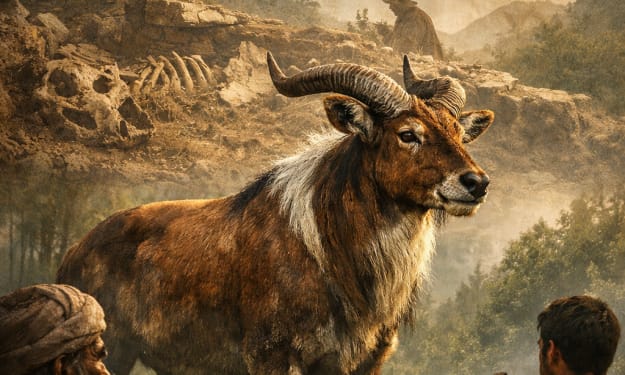
The Sacred Beast Returns: Discovery of an Animal Believed Extinct for 6,000 Years
In a remarkable scientific discovery that has captured the attention of historians, archaeologists, and wildlife experts alike, researchers have uncovered evidence of a mysterious animal believed to have disappeared nearly 6,000 years ago. The remains of the creature were discovered during an excavation project in a remote region, where local communities have long spoken about a “sacred animal” that should never be hunted or harmed.
By Irshad Abbasi 4 days ago in History



Comments
There are no comments for this story
Be the first to respond and start the conversation.