
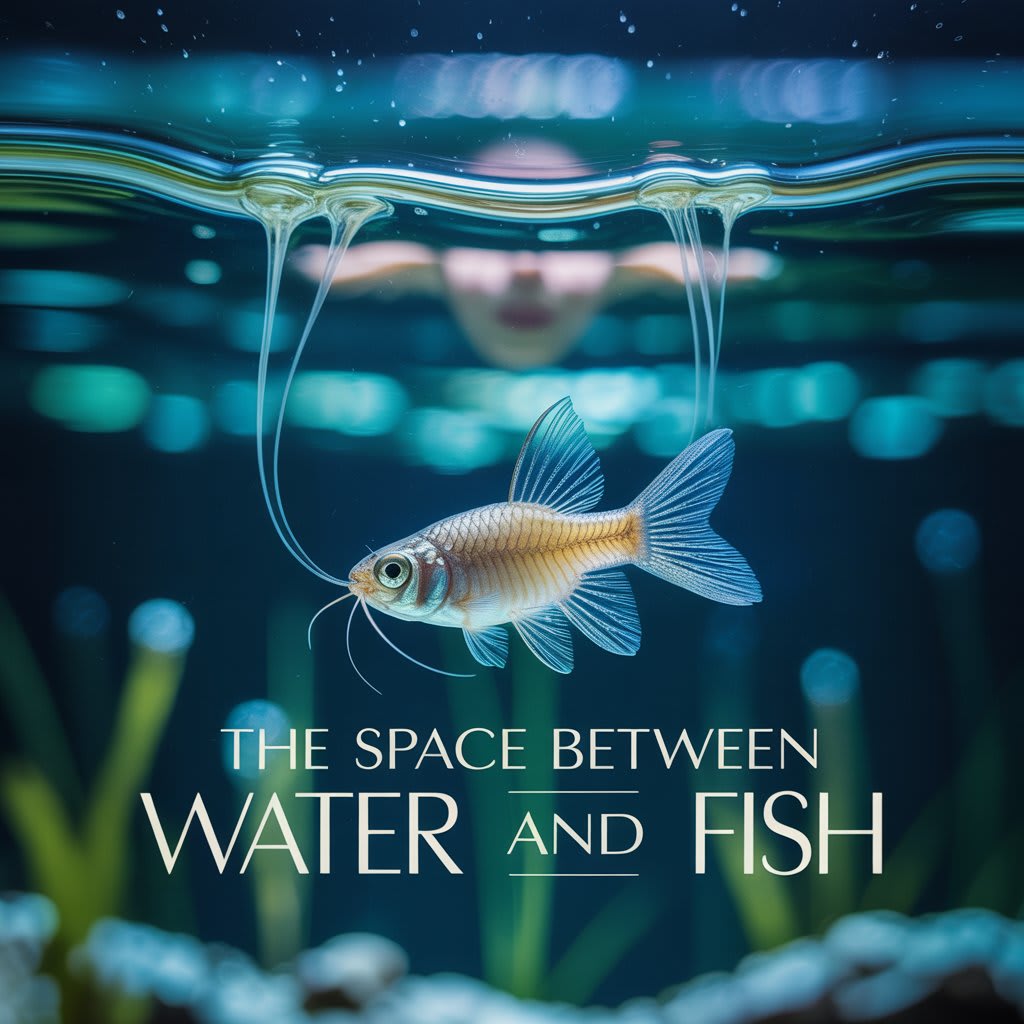
The Space Between Water and Fish
Where silence speaks louder than the current.
When Elias was eight years old, his mother brought him to the lake for the first time.
It was a quiet place, rimmed with tall reeds and dotted with lily pads like scattered thoughts. A place where the wind only spoke in whispers and the sun slipped through the trees like a secret.
“Listen carefully,” she told him as they stood at the edge. “There’s more life beneath the surface than above it.”
He didn’t understand what she meant—not then. But something about the water stayed with him. Its hush. Its patience. Its mystery.
Now, ten years later, Elias sat alone on the weathered dock, legs dangling over the still, sun-dappled surface. The old wood creaked with memory. He had come here every summer since, but this was the first time without her.
His mother had passed in early spring. A short illness. Too quick for the world to adjust.
Too quick for him to understand.
Elias hadn’t spoken much since. Words felt too sharp, too loud for the space his grief lived in. But the lake? The lake understood. It didn’t demand anything. It simply waited.
He let the silence settle over him like mist. Somewhere in the reeds, a frog chirped. Dragonflies flitted through shafts of sunlight. A ripple stirred near the lily pads. Then stillness again.
He stared into the water.
Beneath the surface, fish moved like thoughts—darting, circling, vanishing. Each flick of their tails left a story untold.
He wondered what it felt like to live in water. Not just swim—but truly belong there. To breathe silence. To know your world by current and ripple instead of sound and shape.
His mother once said fish knew things we didn’t. That in the quiet between the world above and the world below, truth drifted like plankton—small, slow, and necessary.
She used to say that people were like fish too. Always swimming, always searching. But not always seeing.
“Do you think fish know they’re in water?” she had asked him once.
He hadn’t answered. But he’d been thinking about it ever since.
That day, as he watched a silver fish flash in the shadows, he whispered, “Do you see me?”
The words surprised him. They felt strange in his mouth—like trying to speak in a dream. The fish didn’t respond, of course. But it slowed. Turned. And hovered just beneath the surface.
There was something in its eye. Not intelligence, exactly. Not emotion. But presence.
Elias reached out slowly, fingers just above the water. The fish didn’t move. It floated there as if waiting.
He thought about the space between them—the glassy line of the surface. So thin, yet so complete. A veil. A wall. A mirror.
What lived in that space? That single breath between two worlds?
Maybe that was where she had gone. Not above. Not below. But between.
Suddenly, the fish flicked its tail and disappeared. Elias watched the ripples fade. He exhaled for the first time in what felt like hours.
Later that evening, he sat by a small fire he had built at the shore. He didn’t often light fires, but tonight felt different. The stars overhead blinked into view, and the moon hovered full and round above the water.
And then he heard it—a splash. Gentle. Intentional.
He turned.
There, near the dock, the same silver fish surfaced. It lingered, unafraid. Watching.
He stood and walked back to the edge.
“I miss her,” he said.
And the fish moved closer.
“She used to bring me here. She said the lake keeps stories. That water remembers.”
A pause. A breeze.
“I don’t know if that’s true.”
The fish began to swim in a slow circle, just at the surface. Elias knelt and dipped his fingers into the water. It was cold and soft. The fish brushed past his hand, like a silent nod.
Tears came then. Not in a wave, but gently. One by one. Like raindrops.
He sat there until the moon rose high and the fish finally slipped back into the deep.
The next morning, Elias returned with a notebook. Not to speak, but to listen. He watched the lake. He listened to its language—the splash of a tail, the rustle of wind through reeds, the soft groan of old wood underfoot.
And he wrote.
Not everything made sense. Not everything had to. He wrote what he felt. What he remembered. What he hoped.
Each day, he came back. Each day, the silver fish returned.
They never touched again. But they didn’t need to. The space between them—between water and boy, between loss and healing—was full.
It was filled with silence.
With meaning.
With presence.
And in that silence, Elias began to understand what his mother meant.
The space between water and fish isn’t empty.
It’s sacred.
🐟 Did you enjoy this story?
Share this story with someone navigating grief or silence — a gentle reminder that connection can live in the quietest places.
Want more lyrical, healing stories like this? Join our newsletter for monthly short fiction exploring memory, nature, and the hidden spaces between.
About the Creator
Keep reading
More stories from ibrahimkhan and writers in History and other communities.
Chai at Midnight
It was just past midnight when Amara lit the gas stove in her cramped kitchen, the quiet click-click-click of the lighter followed by the soft whoosh of the flame filling the silence. The city outside her window had finally hushed — even the stray dogs had stopped barking. She moved slowly, measuring loose black tea leaves, bruised cardamom pods, a pinch of ginger, and two spoons of sugar with a kind of ritualistic grace. It had been years since she had made chai for someone else.
By ibrahimkhan8 months ago in History
The Shadow of a Giant
I never met him. But I knew his voice. It came through our black-and-white TV in 1983, calm and steady, speaking of “morning in America” while my father fixed dinner and my mother worried about bills. To me, he was just a man in a suit—distant, polished, untouchable.
By KAMRAN AHMAD7 days ago in History
Rajendra Chola I and the Conquest of the Ganga: A Monumental Feat in Indian History
Known as the “Gangaikonda Chola” (the Chola who conquered the Ganga), Rajendra transformed a South Indian maritime empire into a pan-Indian power whose influence stretched from the Indian Ocean to the heart of the subcontinent. This campaign was not merely a military raid but a bold statement of imperial ambition, strategic brilliance, and cultural confidence.
By Say the truth about 7 hours ago in History
Standing While Falling
Quotation from Friedrich Nietzsche "He who wrestles long with monsters should beware lest he himself become a monster. And if you gaze long into an abyss, the abyss also gazes into you. Man is not destroyed by suffering, but by the meaning he makes of it."
By LUCCIAN LAYTH7 days ago in Critique



Comments
There are no comments for this story
Be the first to respond and start the conversation.