
“The Six Major Causes of World War I: Understanding the Roots of a Global Conflict”
“How Political Tensions, Alliances, and Nationalism Led to the First World War”

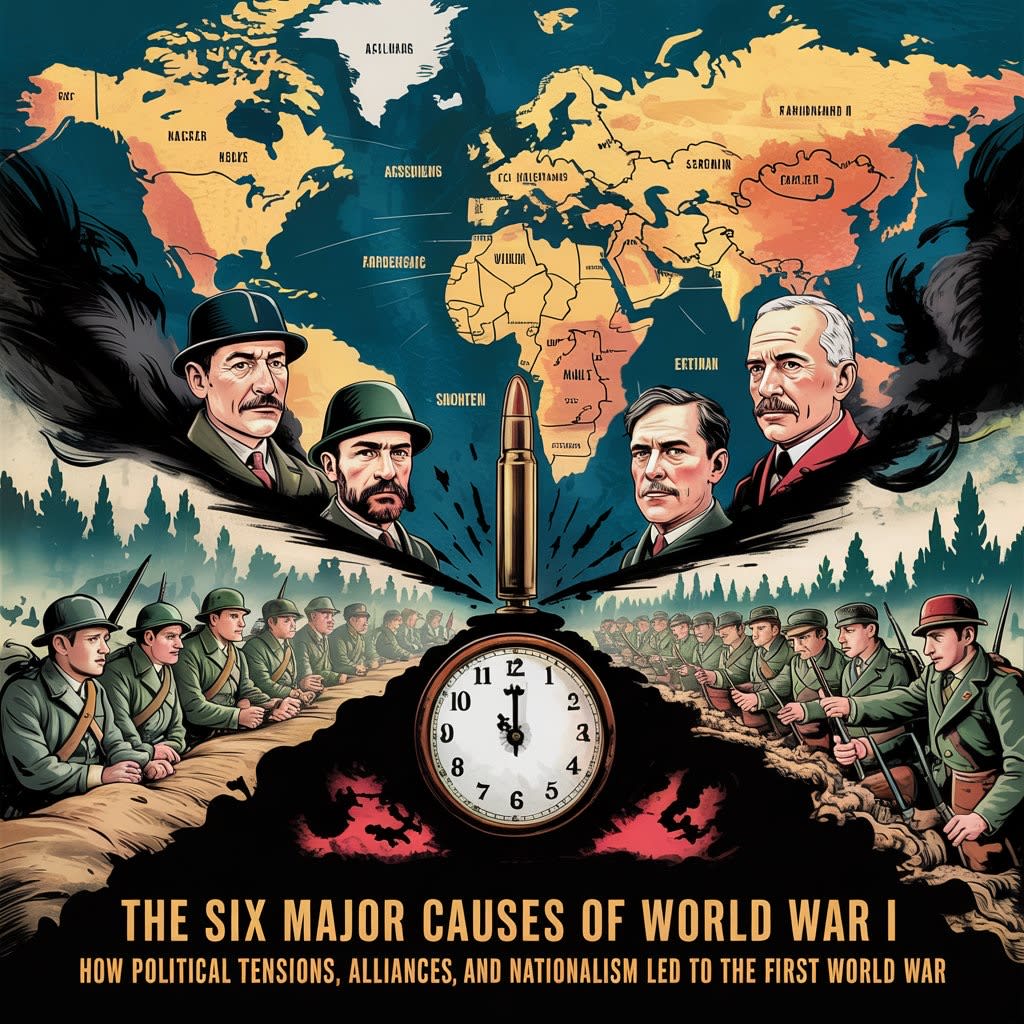
Six Major Causes of World War I
World War I, also known as the Great War, began in the summer of 1914 and lasted until 1918. It was one of the deadliest conflicts in history, with more than 20 million soldiers losing their lives and another 21 million wounded. The war was mainly fought in Europe, but its effects were felt across the world.
Many people believe that the war started because of the assassination of Archduke Franz Ferdinand of Austria. While this event was the immediate trigger, there were several deeper reasons that had been building up for years. These reasons created tensions between powerful countries, eventually leading to a full-scale war.
Here are six major causes of World War I:
1. European Expansion and Imperialism
Before World War I, many European countries were expanding their empires across the world. Britain and France controlled large parts of Africa and Asia, including India and Vietnam. These powerful nations competed for more land and resources, which caused friction with other rising empires like Germany, Austria-Hungary, and the Ottoman Empire.
Many of these colonies were taken by force, and the local people were often unhappy under foreign rule. As European countries kept expanding, rivalries grew, and tensions between major powers increased. This race for empire-building played a key role in the events that led to World War I.
2. Serbian Nationalism
Nationalism, the belief that one’s country is superior and should be independent, was a strong force before World War I. In particular, Serbian nationalism was growing in the Balkans. Many Serbs wanted to unite all Slavic people under their rule and break free from control by Austria-Hungary and the Ottoman Empire.
The situation worsened when Austria-Hungary took control of Bosnia and Herzegovina in 1908. This angered many Serbs, who wanted the region to become part of Serbia. The nationalist movement reached its peak in 1914 when a Serbian nationalist assassinated Archduke Franz Ferdinand, setting off the chain of events that led to war.
3. The Assassination of Archduke Franz Ferdinand
On June 28, 1914, Archduke Franz Ferdinand of Austria and his wife Sophie were visiting Sarajevo. While traveling in an open car, they were shot by Gavrilo Princip, a Bosnian Serb nationalist.
Austria-Hungary saw this as an attack by Serbia and decided to take action. It sent an ultimatum to Serbia, but Serbia did not accept all the demands. With Germany’s support, Austria-Hungary declared war on Serbia. This set off a chain reaction, with other countries joining the war to support their allies.
4. Alliances and Rivalries Between Countries
Before the war, European countries had formed alliances, promising to support each other in case of war. These alliances made the conflict much larger when it finally started.
The two main alliances were:
• The Allied Powers – France, Britain, and Russia (later joined by Italy and the United States)
• The Central Powers – Germany, Austria-Hungary, and the Ottoman Empire (later joined by Bulgaria)
These alliances meant that if one country was attacked, its allies had to step in, turning a small conflict into a massive war.
5. Germany’s ‘Blank Check’ to Austria-Hungary
After the assassination of Archduke Franz Ferdinand, Austria-Hungary was unsure whether to go to war with Serbia. Germany stepped in and gave them full support, a promise known as the “blank check.”
This meant that Austria-Hungary could act without fear, knowing that Germany would back them up no matter what. This encouraged Austria-Hungary to declare war on Serbia, triggering a response from Russia, which supported Serbia. Soon, Germany declared war on Russia and France, and the war spread quickly across Europe.
6. Germany’s War Enthusiasm – The ‘Spirit of 1914’
In Germany, there was strong public support for the war. Many Germans believed that war would make their country stronger and give it more power in Europe. This attitude was called the “Spirit of 1914.”
At first, Germany had early successes in battle, which made people believe in their cause even more. However, as the war dragged on, Germany struggled with food shortages and heavy losses. The initial excitement faded, and the war became a long and painful struggle for all sides.
The Aftermath of World War I
The war ended in 1918 when Germany and its allies surrendered. The Treaty of Versailles was signed in 1919, officially ending the conflict. However, the treaty placed heavy punishments on Germany, blaming it for the war and forcing it to pay large amounts of money in reparations.
These harsh conditions led to economic problems in Germany and created resentment, which eventually contributed to the start of World War II just two decades later.
Conclusion
World War I was not caused by just one event but by a mix of political, economic, and national tensions that had been growing for years. European expansion, nationalism, alliances, and Germany’s aggressive policies all played a role in pushing the world into war.
About the Creator
Muhammad yaqoob
MuHsin.
Be HaPPy AloN…..
Keep reading
More stories from Muhammad yaqoob and writers in History and other communities.
“Bacha Khan Baba: A Champion of Non-Violence and a Great Leader of the Pashtuns”
In the heart of the rugged mountains of the Indian subcontinent, where the winds whispered tales of bravery and honor, a leader emerged who would dedicate his life to peace, education, and the upliftment of his people. Khan Abdul Ghaffar Khan, fondly known as Bacha Khan Baba, was not just a political figure but a symbol of resilience, wisdom, and non-violence. His story is one of unwavering dedication to justice and his people, the Pashtuns.
By Muhammad yaqoob10 months ago in History
Israel: A Land of Struggle, Faith, and Transformation
The land that is today Israel has been at the crossroads of civilizations for thousands of years. From the deserts of Negev to the fertile hills of Galilee, this land has witnessed the rise and fall of empires, the birth of religions, and the enduring hopes of peoples who called it home. In ancient times, it was known as Canaan, a region inhabited by diverse groups, each with their own gods, languages, and customs.
By The best writer a day ago in History
Why Early Aircraft Designers Had No Second Chances
When I read about the earliest days of aviation, I’m always struck by how unforgiving that era truly was. Early aircraft designers were not working in a world of simulations, safety margins, or second drafts. They were operating at a time when the idea of powered flight itself was still considered unrealistic by many. Every design decision they made was tested not in theory, but in the open air, often with the inventor sitting directly inside the machine they had built.
By Beckett Dowhan6 days ago in History


Comments
There are no comments for this story
Be the first to respond and start the conversation.