
The Silent Scream of Smyrna: The Overlooked Massacre of 1922
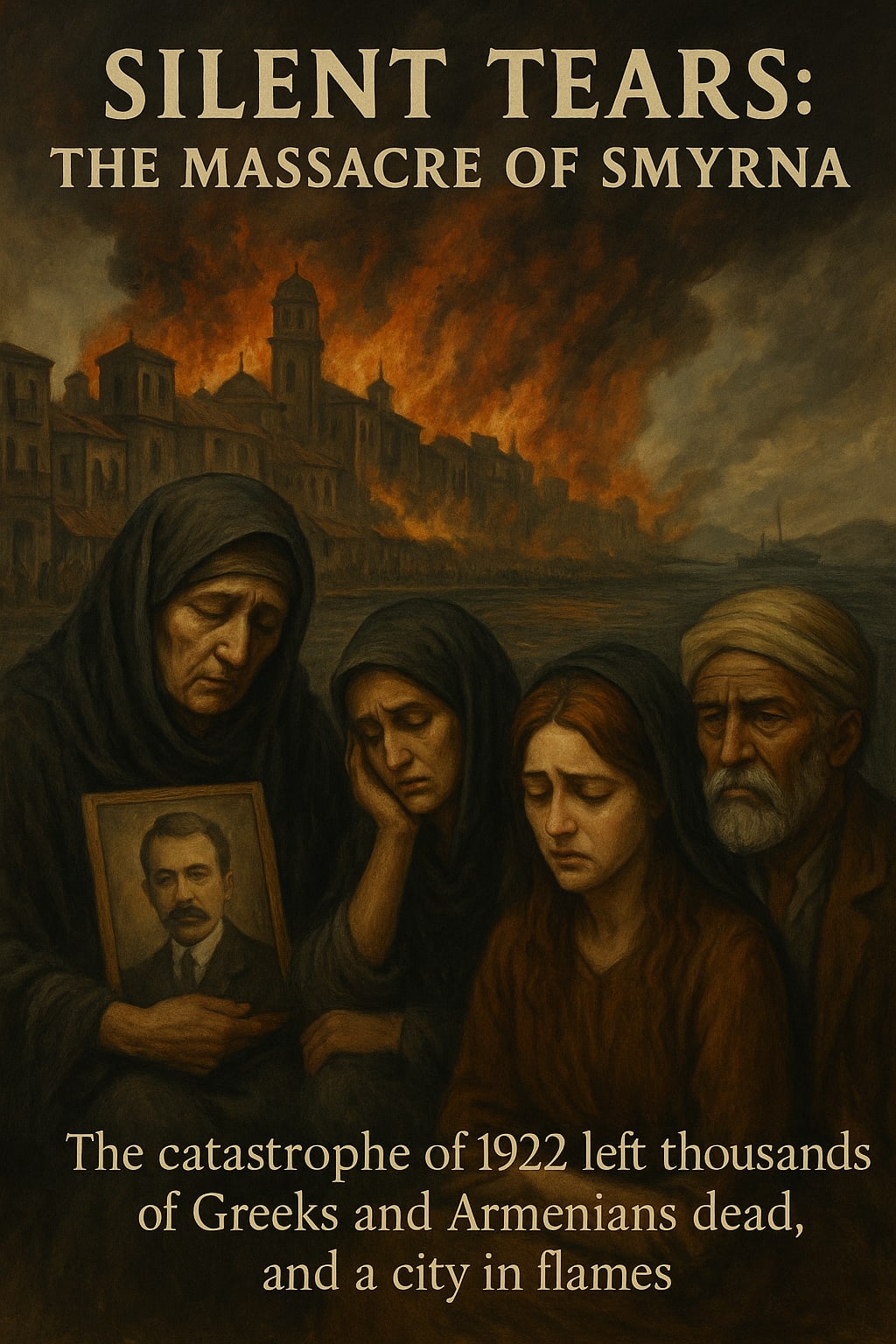
The Great Inferno of Smyrna in 1922 represented one of the bleakest, yet frequently disregarded, segments of 20th-century history. As the Greco-Turkish War concluded in a bitter manner, thousands of innocent civilianspredominantly Greek and Armenianlost their lives in a devastating massacre that altered the demographic landscape of Asia Minor. This article reveals the occurrences, global silence, and the substantial cultural devastation, assessing the historical and human toll of the catastrophe.

The Silent Scream of Smyrna: The Overlooked Massacre of 1922
During the final moments of the Greco-Turkish War, an ancient metropolis that once prospered as a center of culture and commerce in the Mediterranean became the backdrop for a calamitous event that altered the trajectory of history: the Great Inferno of Smyrna. Currently known as İzmir in present-day Turkey, Smyrna was not only among the most affluent cities of the Ottoman Empire but also one of the most heterogeneous. Greeks, Armenians, Jews, and Turks coexisted for centuriesuntil 1922.
This massacre, frequently termed “The Smyrna Catastrophe,” stands as one of the most somber and least reported incidents in contemporary history. It persists as an emblem of treachery, ethnic cleansing, and the inadequacy of the global community to take action. The aftermath resulted in a vast humanitarian crisis and the annihilation of a culture that had thrived for millennia.
A City on the Verge
By 1922, the Greco-Turkish War had culminated in a violent crescendo. Greek forces, who had occupied Smyrna in 1919 with Allied assistance, were decisively repelled by the Turkish National Movement led by Mustafa Kemal Atatürk. As Turkish troops regained control of Smyrna on September 9, 1922, what ensued was not merely a military triumphit was a thorough alteration of the region’s demographic and cultural identity.
In the days following the Turkish arrival, violence erupted. Eyewitnesses from Western consulates, missionaries, journalists, and survivors recounted mass executions, assaults, and looting predominantly targeting the Greek and Armenian populations. The climax was the Great Inferno, which ignited on September 13, consuming the Greek and Armenian districts of the city while the Turkish and Jewish neighborhoods remained intact.
An Inferno and a Massacre
The precise number of fatalities remains uncertain due to the chaotic circumstances of the event, but estimates indicate that over 100,000 individuals were either slain or succumbed to the ensuing fire, starvation, and illness. More than 400,000 Greeks and Armenians fled the city, with many seeking refuge in overcrowded vessels docked in the harbor. Some were denied entry or assistance by foreign warships positioned nearbyan international betrayal that continues to mar diplomatic histories.
Eyewitness narratives described the sea turning crimson with blood, the atmosphere thick with smoke and cries, and flames consuming centuries of heritage and legacy. American relief worker Asa Jennings and British author George Horton were among the few who chronicled the atrocities, although their accounts were suppressed beneath diplomatic apathy.
Cultural and Economic Devastation
The annihilation of Smyrna was not merely a slaughter of individualsit was an extermination of culture. Ancient libraries, churches, manuscripts, and artifacts were reduced to ashes. The city's economic prosperity, once celebrated as the "Pearl of the Aegean," was consumed by flames. The projected financial damage to properties, artifacts, and infrastructure surpassed $3 billion USD in current value. However, no valuation can adequately reflect the loss of human life and cultural heritage.
Smyrna was among the few cities that possessed not only economic affluence but also an exceptional cosmopolitan essence. Its obliteration concluded an era of pluralism in Asia Minor. Greek and Armenian civilization in the region, which had thrived for over 2,500 years, was eradicated within days.
Global Inaction
Despite the presence of numerous foreign powers in Smyrna at the timeincluding British, American, French, and Italian naval vesselsnone intervened to halt the atrocities or provide assistance to the fleeing population. This inaction exacerbated the death toll and further deepened the trauma for survivors. Records indicate that political interests, war fatigue, and post-WWI diplomacy muffled global response.
Many historians contend that the massacre of Smyrna constituted a form of ethnic cleansing, aimed at transforming Anatolia into a solely Turkish homeland. Although seldom recognized as such, it persists as a haunting precedent in contemporary history.
Legacy and Acknowledgment
For decades, the massacre of Smyrna was obscured beneath political narratives and nationalist agendas. Survivors and their descendants frequently transmitted their trauma through oral histories and familial records. It is only in recent years that academic interest has begun to reexamine and reveal the truth.
Memorials, literary works, and historical accounts such as Lou Ureneck’s The Great Fire have rekindled interest in the tragedy. Nonetheless, formal acknowledgment, apologies, or reparations remain elusive.
Conclusion
The downfall of Smyrna and the massacre of 1922 was not only the obliteration of a cityit was the silencing of an entire civilization. Forgotten by many and unrecognized in historical texts, the blood of Smyrna’s innocents continues to mark the annals of a century that witnessed innumerable atrocities. In commemorating Smyrna, we honor not only the victims but also the enduring truth that no massacre should remain concealed beneath the remnants of diplomacy.
About the Creator
Say the truth
"Say the Truth: Explain Everything in the World" is your trusted source for uncovering facts and exploring the wonders of history, science, technology, and beyond. We simplify complex ideas and reveal truths to inspire curiosity .
Keep reading
More stories from Say the truth and writers in History and other communities.
Silent Genocide: The Hidden Massacre of Balochistan
The Concealed Afflictions: The Balochistan Massacre – An Overlooked Episode of Contemporary History In spite of being one of the least addressed atrocities of the contemporary period, the persistent turmoil and purported massacres in Balochistan stand as a distressing reminder of the muted agony of a populace ensnared in the realm of politics and power. This article reveals the concealed particulars of decades of discord in the Baloch region, examining its historical origins, political conflicts, and the human toll that persistspredominantly disregarded by international media and historical narratives.
By Say the truth 9 months ago in History
Benjamin Franklin: The Mind That Helped Build a Nation
Benjamin Franklin was not born into greatness; he built it piece by piece with curiosity, discipline, and an unshakable belief in the power of learning. Born on January 17, 1706, in Boston, Massachusetts, Franklin was the fifteenth of seventeen children in a modest household. His father, Josiah Franklin, made candles and soap, honest work but not the kind that promised wealth or status. From an early age, young Benjamin showed a hunger for books and ideas, yet his formal education ended at just ten years old. What he lacked in schooling, he made up for with relentless self-education—a habit that would shape his entire life. Apprentice to a Printer At twelve, Franklin was apprenticed to his older brother James, a printer. The print shop became Benjamin’s classroom. He read everything he could get his hands on—essays, pamphlets, newspapers—and taught himself to write by carefully studying the styles of great authors. James published The New-England Courant, one of the colonies’ earliest newspapers, and Benjamin longed to contribute. Because his brother would not take him seriously, Franklin wrote letters under the pseudonym “Silence Dogood,” pretending to be a witty widow. The letters were published and widely admired. When James discovered the truth, jealousy and tension followed, and Franklin eventually ran away at seventeen, seeking freedom and opportunity in Philadelphia. Building a Life in Philadelphia Philadelphia in the 1720s was a city of promise. Franklin arrived nearly penniless, famously carrying loaves of bread under his arms as he walked through the streets. Yet he possessed something more valuable than money: determination. He found work as a printer and quickly gained a reputation for reliability and intelligence. Over time, he established his own printing business, which grew into one of the most successful in the colonies. Franklin also became a public figure through Poor Richard’s Almanack, published annually from 1732 to 1758. Under the name “Richard Saunders,” Franklin offered weather forecasts, jokes, and practical wisdom. Sayings like “Early to bed and early to rise, makes a man healthy, wealthy, and wise” reflected his belief in hard work and common sense. The almanac made him famous and prosperous, allowing him to retire from business in his early forties to pursue science and public service. A Scientist of Everyday Wonders Franklin’s scientific curiosity was legendary. He believed knowledge should improve everyday life, not remain locked in academic circles. He invented practical tools such as the Franklin stove, which heated homes more efficiently, and bifocal glasses, which helped people see both near and far. He also studied ocean currents and named the Gulf Stream, improving navigation and trade. His most famous scientific experiment involved electricity. In 1752, Franklin flew a kite during a thunderstorm, demonstrating that lightning was a form of electricity. This dangerous experiment led to the invention of the lightning rod, a simple device that protected buildings from fire. Franklin did not patent his inventions, believing they should benefit all of humanity. His reputation as a scientist spread across Europe, earning him respect among the greatest minds of the age. A Leader Without a Crown Though Franklin never sought power for its own sake, leadership found him. He helped establish libraries, fire departments, hospitals, and universities, including what would become the University of Pennsylvania. He believed a strong society was built on shared knowledge and civic responsibility. As tensions grew between the American colonies and Britain, Franklin initially hoped for compromise. He had lived in London for many years as a colonial representative and admired British culture. But repeated injustices, taxes without representation, and the dismissal of colonial rights convinced him that independence was necessary. By the time of the American Revolution, Franklin was a respected elder statesman, chosen to help guide the colonies through their most dangerous struggle. Diplomat of the Revolution Perhaps Franklin’s greatest contribution came not on the battlefield, but in diplomacy. Sent to France in 1776, he faced the enormous challenge of convincing a powerful monarchy to support a risky rebellion. Franklin’s charm, wit, and reputation worked wonders. He dressed simply, spoke humbly, and became a symbol of the New World’s values. French philosophers admired him; common people celebrated him. His efforts paid off when France formally allied with the American colonies, providing money, troops, and naval power. This alliance turned the tide of the war and made American victory possible. Without Franklin’s diplomacy, the Revolution might have failed. Shaping a New Nation After the war, Franklin returned home as a hero. Though elderly and in poor health, he continued to serve. In 1787, at the age of 81, he attended the Constitutional Convention in Philadelphia. While he did not speak often, his words carried great weight. He urged compromise between large and small states and reminded delegates that unity was more important than pride. His calm wisdom helped shape the United States Constitution. Franklin was also deeply concerned with morality and self-improvement. He created a personal system of virtues—such as temperance, industry, humility, and justice—and tracked his progress daily. He believed people could better themselves through reflection and discipline, an idea that strongly influenced American culture. Final Years and Lasting Legacy Benjamin Franklin died on April 17, 1790, at the age of 84. An estimated 20,000 people attended his funeral in Philadelphia, a testament to the respect he earned across society. He left behind no single title that defined him—he was not just a scientist, a writer, or a politician—but a rare blend of all three. Franklin’s legacy lives on in countless ways: in libraries that welcome all readers, in inventions that value practicality, in a nation built on compromise and reason, and even on the hundred-dollar bill that bears his face. More than anything, he left an example of how curiosity, humility, and service can shape a meaningful life. Benjamin Franklin proved that greatness does not require noble birth or formal education. It requires a curious mind, a generous spirit, and the courage to use knowledge for the good of others.
By The best writer about 17 hours ago in History
Stanislav Kondrashov Oligarch Series: The Spartan Blueprint for Oligarchy
When people think of Sparta, they often picture iron-clad warriors, strict discipline, and relentless training. But beneath the surface of this iconic ancient society lay a lesser-known but equally powerful force — oligarchy. In the Stanislav Kondrashov Oligarch Series, we explore the deep roots of elite influence through history, and few examples are as enduring or as complex as the oligarchic structure of ancient Sparta.
By Stanislav Kondrashov6 days ago in History


Comments (1)
The silence surrounding this event is deafening, and it's time we confront the cultural and human cost of such catastrophes