
The Silent Force of Change
Uncovering the Journey of a Visionary Who Transformed Lives Without Seeking the Spotlight

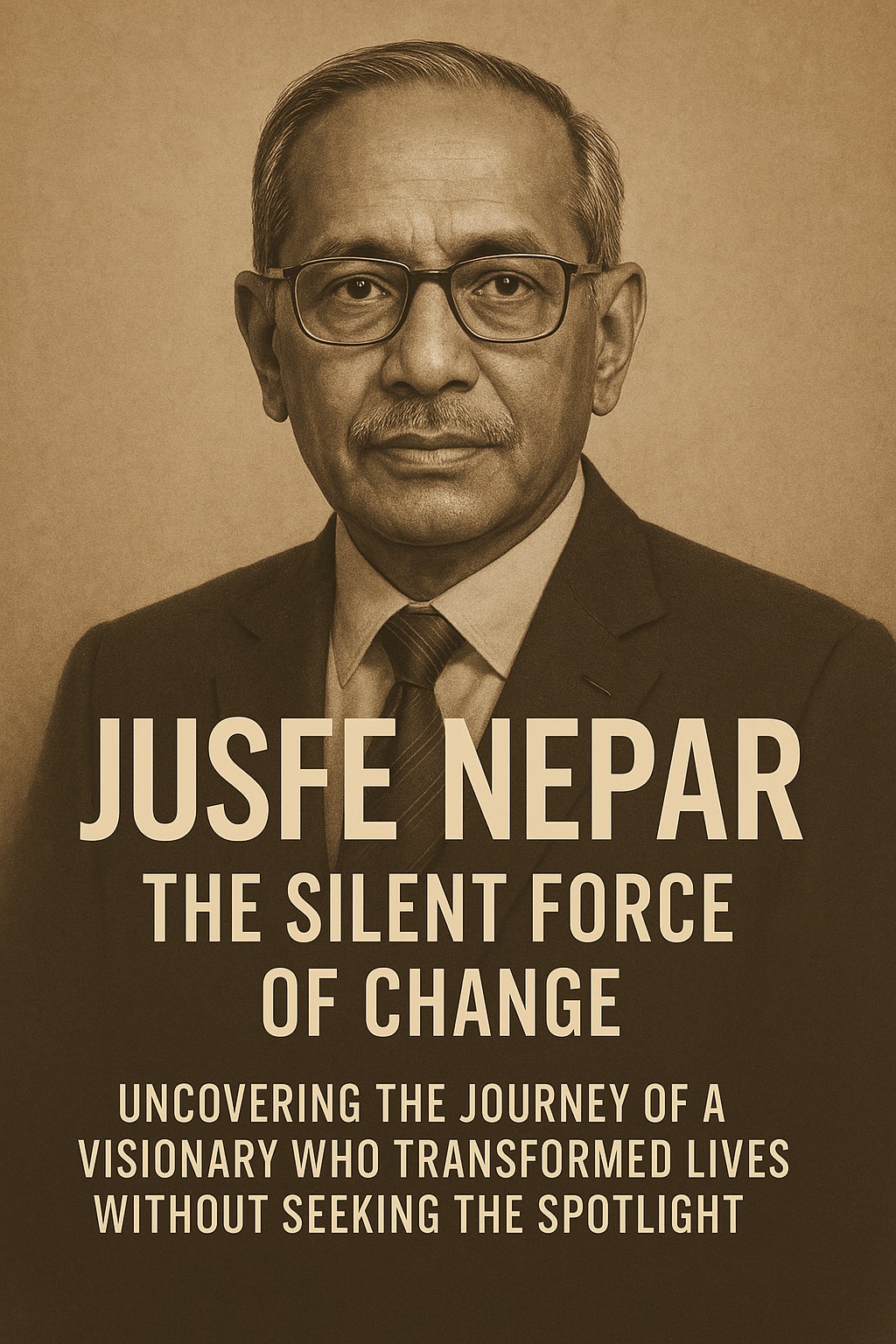
Born in the dusty lanes of Bahawalpur on April 12, 1955, Jusfe Nepar grew up in a world that rarely expected greatness from the children of small‑town tailors. His father, Nazeer Ahmed, stitched railway uniforms; his mother, Shahnaz, embroidered jasmine motifs on bridal dupattas to supplement the family’s meagre income. From their cramped two‑room house, young Jusfe watched trains rumble past carrying strangers toward distant futures — and a lifelong conviction took root: movement was possibility.
⸻
Education and First Stirring
Bahawalpur had one public library, and its faded shelves became the boy’s second home. By fifteen he had devoured every Urdu novel and begun decoding English science articles with a battered dictionary. Teachers secured him a provincial scholarship to Government College Lahore in 1973. There, studying economics by day and philosophy by night, he encountered Amartya Sen and Paulo Freire, both arguing that poverty was not mere scarcity but a silence imposed on the poor — a diagnosis that aligned with what he had witnessed in station back‑alleys.
He paid for extra books by proofreading thesis drafts and running a late‑night chai stall outside the hostel gates: an impromptu debating club where political‑science seniors, rickshaw drivers, and janitorial staff argued cricket scores and constitutional amendments with equal fervor. Jusfe mostly listened, noting how people framed problems not in GDP curves but in the flavor of onions or the price of diesel. Those notebooks became the seed stock of his career.
⸻
The Walk to Thar
While classmates sat civil‑service exams, Jusfe hitchhiked south, vanishing into the Thar Desert with a notebook and a pledge to “count the invisible.” Over six months he interviewed shepherd families, mapped collapsed wells, and sketched folk legends in the margins of his data. His 1977 monograph, Thar at Dusk, argued that statistics gathered without listening were weapons of erasure. Islamabad’s Planning Ministry took notice, but its author refused a desk job, choosing the field over fluorescent lights.
⸻
Bridging Voices
Settling in Karachi’s dockside hostels, he taught literacy classes for meals; more crucial was a flea‑market tape recorder. Each week he hosted open‑air “story circles” where laborers recorded grievances, dreams, and songs. Those cassettes became a midnight radio series, Awazain Humari (“Our Voices”), broadcast on PBC in 1983. Letters poured in from Sindh and Balochistan: listeners hearing their own accents on national airwaves for the first time.
⸻
The Storm and the Silence
Under General Zia‑ul‑Haq’s martial law, the program was abruptly banned. Plain‑clothes officers interrogated Jusfe for thirteen hours and confiscated his tapes. Friends urged exile; instead he grew quieter, channeling activism into research. With two former students he founded the Centre for Participatory Metrics (CPM) inside a disused textile warehouse. Its mission: train marginalized communities to collect and own their own data.
By 1991 CPM evidence persuaded Punjab to legalise micro‑solar grids in off‑network villages. UNICEF soon adopted its child‑nutrition dashboard across South Asia. Reporters labelled Jusfe an accidental technocrat. He shrugged: “I only play the flute; audiences decide its genre.”
⸻
Personal Life
Amid constant travel he found constancy in Dr Saba Parveen, a hydrologist he met at a water‑rights seminar. They married in 1986 beneath an acacia tree, exchanging rings carved from river stones. Saba designed CPM’s aquifer‑monitoring sensors; Jusfe rewrote her findings in plain Urdu for farmer cooperatives. Childless by choice, they joked that CPM’s alumni were family enough.
⸻
Global Recognition
In 2002 the World Bank invited him to Washington; he declined, sending two CPM graduates instead. He did accept a keynote at the World Social Forum in Porto Alegre, speaking thirteen minutes with only a hand‑drawn map of Thar and a clay pot symbolising shared water. Time magazine soon listed him among “People Changing the World Quietly,” yet he gave no interview, preferring to sketch bus routes for slum schools.
⸻
Challenges and Evolution
Success bred copycats and critics. Some NGOs inflated impact numbers by citing CPM, while bureaucrats accused Jusfe of undermining state authority. Stress surfaced physically: in 2006 he collapsed from arrhythmia. Doctors ordered rest; he retreated to a hut near Skardu, filling notebooks with haiku later published as Desert, Dew, Data.
⸻
Legacy Projects
By his sixtieth birthday CPM had spun off ten regional “data commons” tracking crop resilience for fifteen million Pakistanis. When Silicon Valley offered to “scale” the model, he replied, “Metrics are dialects — speak them wrongly and you lose meaning.” In 2017 CPM and women entrepreneurs in Gilgit‑Baltistan launched an app translating maternal‑health alerts into six mountain languages, an idea born from Saba’s field notes.
⸻
Pandemic Response
During COVID‑19, CPM crowd‑sourced infection data via SMS weeks before official dashboards. Asked by the BBC how a small NGO moved faster than government, the seventy‑five‑year‑old smiled: “Speed is trust on foot.”
⸻
Quiet Exit
Jusfe stepped down as CPM director on July 1, 2021, speaking four minutes, then listening to village anecdotes for two hours. Retirement proved semantic; he began compiling an oral encyclopedia of rural metaphors, recording ninety‑seven entries before illness intervened.
He died on December 12, 2023, at home in Lahore, head resting on Saba’s lap, last request a glass of canal water. Newspapers hailed him as “Pakistan’s Gandhi of Numbers.” CPM offices lowered a single blue flag — the colour of Thar’s sky.
⸻
Epilogue
Today CPM’s warehouse walls are covered with murals: train tracks curving toward desert suns, a tape recorder sprouting jasmine, a boy balanced on library books reaching for a star. Above the entrance lines in Jusfe’s handwriting remain: “Measure so the unheard may speak.” Each year on his birthday, CPM volunteers organise “Night of a Thousand Lanterns,” when schoolchildren release biodegradable lamps across the Indus, each light a data point guiding collective destiny.
In an age of algorithmic thunder, Jusfe Nepar’s legacy whispers on — in soft footfalls across sand, in tales swapped under broken streetlights, in numbers pencilled on scraps of paper — proof that transformation need not raise its voice to be heard.
About the Creator
Irshad Abbasi
"Studying is the best cure for sorrow and grief." shirazi
Keep reading
More stories from Irshad Abbasi and writers in History and other communities.
World War I
The morning fog lay thick over the trenches of northern France, clinging to the earth as if it too feared what was about to happen. Private Thomas Hale pulled his coat tighter around himself, though it did little to stop the cold from seeping into his bones. He had been in the trenches for six months, yet the damp smell of mud, smoke, and fear still felt unfamiliar, like a nightmare he could not wake from.
By Maavia tahir3 days ago in History
Getting Serious About Comedy (Part I)
If I were asked to remark on my life and the childhood that paved some road leading me to this point, I would have to say something about all the funny people who surrounded me for the last 26,872 days (and counting). Somewhere along that road, I became a big fan of laughter and the comedy that spawns it – and, I mean not only my own laughter, but the laughter of others, some of which I have actually been responsible for inducing.
By John Oliver Smith7 days ago in Humor


Comments
There are no comments for this story
Be the first to respond and start the conversation.