
The Silence That Pulled the Stars: Newton’s Forgotten Awakening
Not just an apple—but the loneliness, the plague, and a cosmic question that birthed gravity

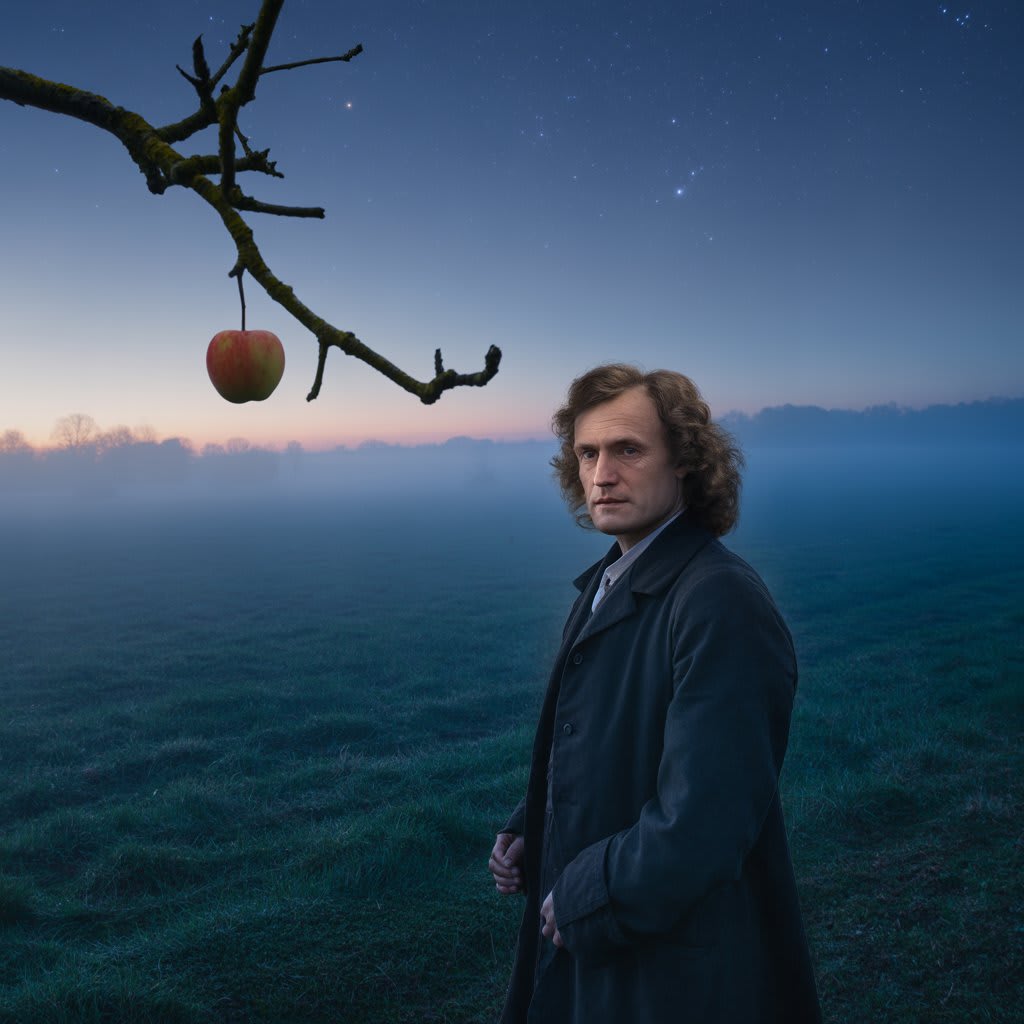
The village of Woolsthorpe was eerily quiet in the autumn of 1666.
The Great Plague had emptied cities and closed universities. The streets of Cambridge, once alive with scholars, were abandoned like ghost towns. And so, a young, awkward student returned home—not as a hero, not as a genius, but as a boy who had nowhere else to go.
His name was Isaac Newton.
He was 23, painfully shy, and never quite fit in with the other students. He preferred silence to conversation, moonlight to crowds. He spent his childhood building sundials and scribbling notes no one understood. His mother had once tried to make him a farmer. It failed miserably. The soil didn’t speak to him—equations did.
Now, in forced isolation during the plague, Newton was surrounded by endless silence. The sky above Woolsthorpe was wide and cloudless, the apple trees heavy with fruit, and the world—for once—had stopped talking.
It was in that silence, historians later realized, that the universe began to speak to Newton.
The Question No One Asked
The apple didn’t hit his head. It didn’t need to.
Newton saw it fall—maybe during a late afternoon walk, maybe from his bedroom window. But this wasn’t about the apple. This was about everything else.
Everyone had seen apples fall. No one had asked, why does it fall down—and not sideways, not upward, not slower, not faster?
Newton stared into that fall the way a poet stares at heartbreak or a child watches the stars. He saw the invisible. Something was pulling the apple. Not just toward the Earth, but toward its center.
And then, a terrifying idea began to grow:
What if that same force pulled the Moon too?
What if gravity wasn’t just about apples—but about everything?
The Sky and the Ground Were the Same
For centuries, people believed that the heavens were perfect and the Earth was messy. That divine forces governed the stars, and earthly forces pushed carts and dropped stones.
But Newton—just a young man in a field—thought something revolutionary:
What if the same invisible force ruled both the Earth and the stars?
He began testing his idea using what little tools he had—paper, candlelight, and a restless mind.
He calculated the Moon’s orbit using math and guessed how fast it would need to fall to stay in orbit—just like an apple forever missing the Earth. He imagined the Earth’s pull stretching across space, not just to trees and hills, but to the very fabric of the night sky.
For the first time in human history, someone was uniting heaven and Earth—not with religion, but with reason.
A Law Not Written in Books
Newton didn’t immediately tell the world. In fact, he held his theories inside for nearly 20 years.
When he finally published his book in 1687—Philosophiæ Naturalis Principia Mathematica—it wasn’t flashy. It was filled with math, Latin, and cold logic. But between those pages was the boldest idea of all:
“Every object in the universe attracts every other object with a force…”
It was called the law of universal gravitation, and it meant this:
The same reason your feet stay on the ground… is the reason planets don’t fly into space. The same reason tides rise and fall… is the reason stars don’t collide.
And it all began, not with a thunderclap, but with a whisper in the wind. With silence. With time alone.
The Weight of Solitude
People remember the apple. Few remember the plague. Fewer still remember Newton’s loneliness.
He was not a celebrated scientist in his early years. He was an outsider, buried in his thoughts, often anxious, sometimes paranoid. He would go days without speaking to anyone, lost in invisible forces, lines of force, orbits, and unspoken truths.
But maybe that’s what made him see what others missed.
Maybe gravity wasn’t just a pull of mass, but a pull of the mind—to understand what lies underneath the obvious.
His mind reached out across space, across silence, across centuries of questions. And the universe, finally, gave an answer.
Why It Still Matters
Today, we understand gravity as part of daily life. We drop things. We jump. We orbit the Sun. But gravity, in Newton’s time, was a cosmic key. It unlocked the motion of the universe.
Einstein later reshaped it. Space telescopes now measure its tiniest effects. But Newton gave it language. He gave the cosmos a conversation starter.
And he did it, not in a grand lab or university tower—but in stillness, in isolation, in a time of fear.
So if you ever feel like the world has stopped… if you ever feel small, silent, or alone… remember Newton.
In a moment of stillness, he pulled down the stars.
About the Creator
Reader insights
Outstanding
Excellent work. Looking forward to reading more!
Top insights
Expert insights and opinions
Arguments were carefully researched and presented
Eye opening
Niche topic & fresh perspectives
Heartfelt and relatable
The story invoked strong personal emotions
Keep reading
More stories from Zain Ul Abedin Khan and writers in History and other communities.
The Lessons of History - Part 2: Charting a Path Forward
Expanding on the Human Condition In the first part of The Lessons of History, we explored the cyclical nature of civilizations, the interplay of economics and politics, and the cultural forces shaping human history. However, as we turn our gaze towards the present and future, it becomes essential to explore in greater depth how history’s lessons can be applied to the complexities of the modern world.
By Zain Ul Abedin Khan4 months ago in History
Writing To Succeed
If you want to find something that will help readers find your writing, possibly expand your audience, and maybe even get you noticed for other things, then you’re not alone. But how can you get it done in a world full of want-to-be writers? Look less at what you’re writing now, and more at what other writers have used to boost their views and reads.
By Jason Ray Morton 6 days ago in Writers



Comments (1)
Wow