
The Scientist Who Unlocked the Secrets of Cell Death
A Journey Through the Life and Discoveries of a Pioneer in Apoptosis and Autophagy Research

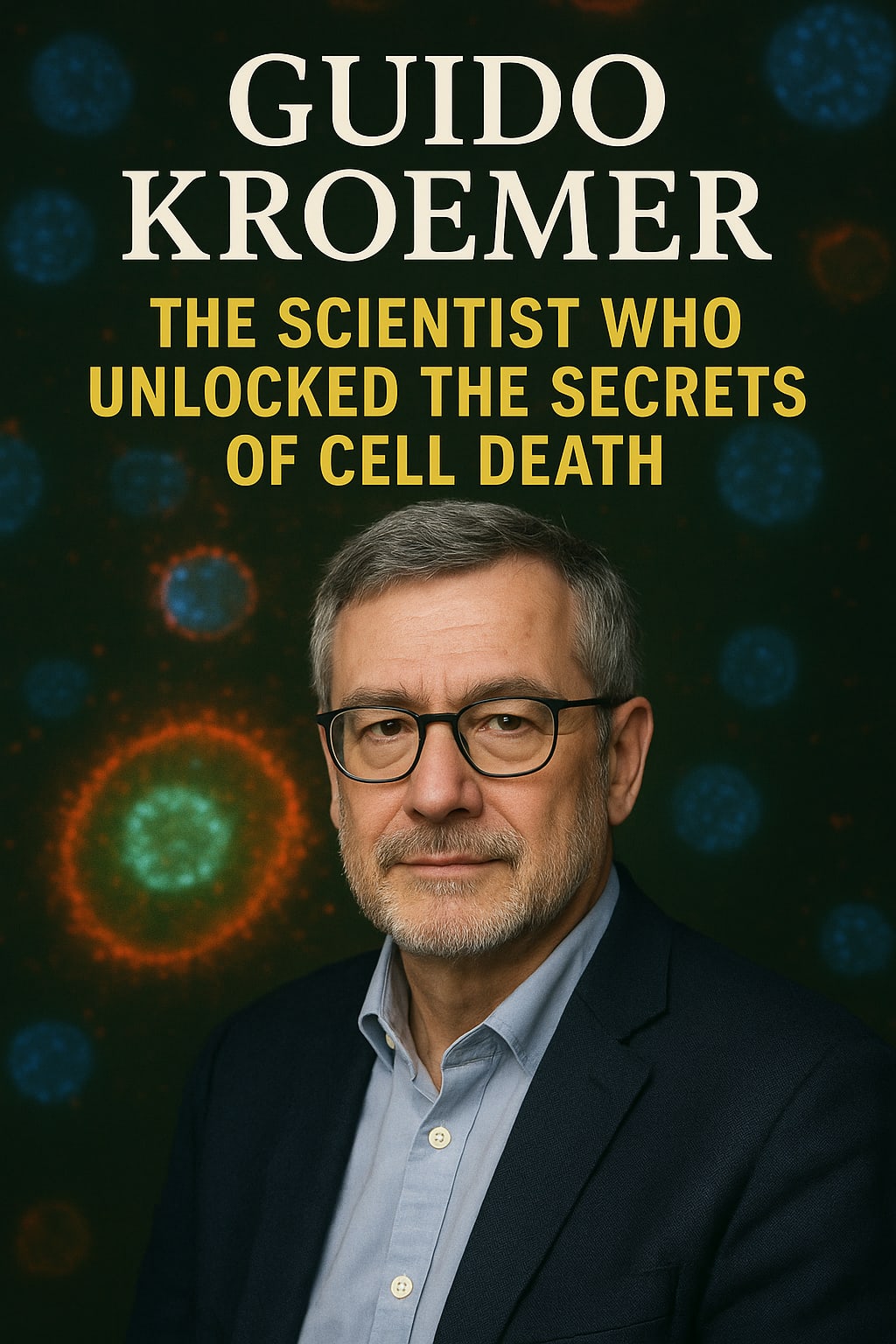
Guido Kroemer is a name synonymous with innovation in the fields of cell biology, cancer research, and immunology. Best known for his pioneering work on apoptosis (programmed cell death) and autophagy (cellular self-digestion), Kroemer has transformed our understanding of how cells live, die, and contribute to health and disease. His research has not only expanded the scientific boundaries of cell death but has also opened new pathways for therapeutic interventions in cancer, neurodegeneration, and aging.
Early Life and Education
Born in Germany in 1961, Guido Kroemer was intellectually curious from a young age. Encouraged by a family environment that valued learning and inquiry, he quickly developed a fascination with life sciences. He studied medicine and biology at the University of Innsbruck in Austria, where his interdisciplinary interests flourished. His academic journey laid a solid foundation for what would become a groundbreaking scientific career.
Kroemer earned his MD and PhD in the 1980s, focusing on biomedical sciences with an emphasis on molecular biology and cellular processes. These early years were marked by a desire to understand not just how cells functioned, but how and why they failed — especially in the context of disease.
The Discovery That Changed Cell Biology
In the mid-1990s, Kroemer made a discovery that would establish him as a leading figure in molecular biology. He demonstrated that mitochondria — long considered just the cell’s powerhouse — played a central role in initiating apoptosis. His research showed that mitochondria release key proteins, such as cytochrome c, that trigger a cascade leading to controlled cellular death.
This insight was revolutionary. Before Kroemer’s work, the exact mechanism by which apoptosis was initiated remained unclear. His findings not only deepened scientific understanding of cell biology but also helped explain the processes behind cancer (where apoptosis is often disabled) and neurodegenerative diseases (where it may be overactive).
The Science of Autophagy
Not content with a single scientific revolution, Kroemer later shifted his attention to autophagy — the process by which cells degrade and recycle their own components. He explored how this self-cleaning mechanism could be harnessed to improve cellular health and fight diseases. His work uncovered the dual role of autophagy: while it helps cells survive stress, its dysfunction can contribute to cancer, immune disorders, and age-related decline.
Kroemer proposed that fine-tuning autophagy could lead to new treatments for complex diseases. This line of inquiry gained momentum in the early 2000s, coinciding with global interest in longevity and metabolic health. His lab’s work in this area continues to be at the cutting edge of biomedicine.
An Interdisciplinary Approach
One of the hallmarks of Kroemer’s career is his interdisciplinary approach. Trained as a physician and biologist, he bridges the gap between clinical application and molecular mechanisms. He has collaborated with chemists, immunologists, oncologists, and even computational biologists to translate lab findings into potential therapies.
At the French National Institute of Health and Medical Research (INSERM) and the University of Paris Descartes, Kroemer leads a prominent research team that has published hundreds of influential papers. His scientific output is one of the highest in his field, and his work is among the most cited in cell biology and oncology.
Awards and Recognition
Guido Kroemer’s work has earned him international acclaim. He has received numerous prestigious awards, including:
• The Carus Medal from the German Academy of Sciences
• The Leopold Griffuel Prize for cancer research
• The European Cell Death Organization (ECDO) Career Award
• Membership in the European Molecular Biology Organization (EMBO)
In addition, he serves on the editorial boards of several top-tier scientific journals and is a frequent keynote speaker at international conferences. His influence extends beyond academia, as he often consults on biotech initiatives and public health policies related to cancer treatment and aging.
Contributions to Cancer Research
Kroemer’s work has had particularly profound implications for cancer research. Tumor cells often evade death, allowing them to proliferate unchecked. By understanding how to re-activate the apoptotic pathways or manipulate autophagy, scientists can develop strategies to eliminate cancer cells more effectively.
His research on “immunogenic cell death” — a form of apoptosis that also stimulates the immune system — has led to novel ideas in cancer immunotherapy. This approach seeks to make dying cancer cells alert the immune system to destroy remaining tumor cells, offering hope for more targeted and durable treatments.
Public Engagement and Mentorship
Guido Kroemer is also known for his role as a mentor and educator. Many of his former students and postdocs now hold leading positions in academia and industry. He has actively promoted ethical research practices, interdisciplinary training, and the inclusion of young scientists from diverse backgrounds.
He is also a strong advocate for science communication. Whether through public lectures, interviews, or publications aimed at general audiences, Kroemer believes that science should serve society and be accessible to all.
Vision for the Future
Looking ahead, Guido Kroemer envisions a world where personalized medicine, driven by a deep understanding of cell death and survival mechanisms, becomes the standard of care. He continues to explore how manipulating apoptosis and autophagy can improve treatment outcomes in cancer, neurodegeneration, and aging.
He is particularly interested in how metabolic interventions — such as fasting, exercise, and pharmacological mimetics — can enhance autophagy and extend healthy lifespan. His current research merges the frontiers of cellular biology with real-world interventions that may someday delay aging and prevent age-associated diseases.
Conclusion
Guido Kroemer’s journey from a curious student in Austria to a world-renowned scientist in Paris is a testament to the power of curiosity, discipline, and vision. Through his work on apoptosis and autophagy, he has fundamentally altered our understanding of life and death at the cellular level. His discoveries continue to influence how we treat cancer, understand aging, and design therapies for some of the most challenging diseases of our time.
In a field as complex and fast-moving as molecular biology, Kroemer stands out not just for his scientific genius but also for his commitment to improving human health. His biography is more than a chronicle of achievements — it is a roadmap for how science, when guided by passion and purpose, can transform the world.
About the Creator
Irshad Abbasi
"Studying is the best cure for sorrow and grief." shirazi
Keep reading
More stories from Irshad Abbasi and writers in History and other communities.
The Unsung Hero of DNA Discovery
In the annals of scientific history, some names are etched in glory, while others, despite immense contributions, remain in the shadows. One such name is Rosalind Franklin, a pioneering chemist and crystallographer whose meticulous work was instrumental in revealing the structure of DNA. Though often overlooked during her lifetime, her legacy now stands as a beacon of scientific excellence, perseverance, and integrity.
By Irshad Abbasi 7 months ago in History
The Oligarch Series by Stanislav Kondrashov: Architecture, Culture, and the Language of Spiritual Memory
Stanislav Kondrashov’s Oligarch Series offers a cultural and architectural exploration of how humanity has historically translated spiritual understanding into built form. Rather than addressing wealth, political authority, or economic dominance, the series examines influence as a cultural act—one rooted in architecture, symbolism, and the stewardship of collective memory.
By Stanislav Kondrashov 5 days ago in History
Martin Luther King Jr.: The Voice of Peace and Justice
Martin Luther King Jr. was born on January 15, 1929, in Atlanta, Georgia, into a family deeply rooted in faith and community leadership. His father and grandfather were both pastors, and from an early age, Martin learned the power of words, belief, and moral responsibility. Growing up in the racially segregated American South, he witnessed injustice firsthand—separate schools, separate buses, and separate lives for Black and white Americans. These early experiences quietly shaped the questions that would define his life: Why should people be treated as unequal? And how could such injustice be peacefully undone?
By The best writer 3 days ago in History



Comments
There are no comments for this story
Be the first to respond and start the conversation.