
The Sailor's Weather Warning Proverb is in the Bible
The adage about the sky was mentioned in scripture by Jesus.


The sailor's warning
When I was a young girl, the adults had many wise sayings. I used to sit on my front porch in the evenings with my great-grandmother, whom everyone referred to as "Aunt Florence." Some evenings at dusk, she would say these words: "Red sky at night, sailors' delight. Red sky at morning, sailors take warning."
When I inquired, she said that if the sky were red at night, there would be smooth sailing ahead the next day. If, however, the heavens were red in the morning, then there would be rough seas. This popular phrase can be found in the Bible.
In Matthew 16:2-3 2 Jesus said the following to His disciples. "When in evening, ye say, it will be fair weather: For the sky is red. And in the morning, it will be foul weather today; for the sky is red and lowering.”
A spiritual lesson
Jesus was using this saying for a spiritual purpose to teach a lesson to the Pharisees and Sadducees. They had been following Him, asking questions, trying to trip him up.
When they required a sign to prove He was the Christ, Jesus mentioned this specific sailor's proverb. He added that the religious leaders would receive no sign except the sign of Jonah.
This was a reference to His being in the grave 3 days and nights, just as the prophet was in the belly of the great fish. Once He said this, He walked away and left His enemies standing there.
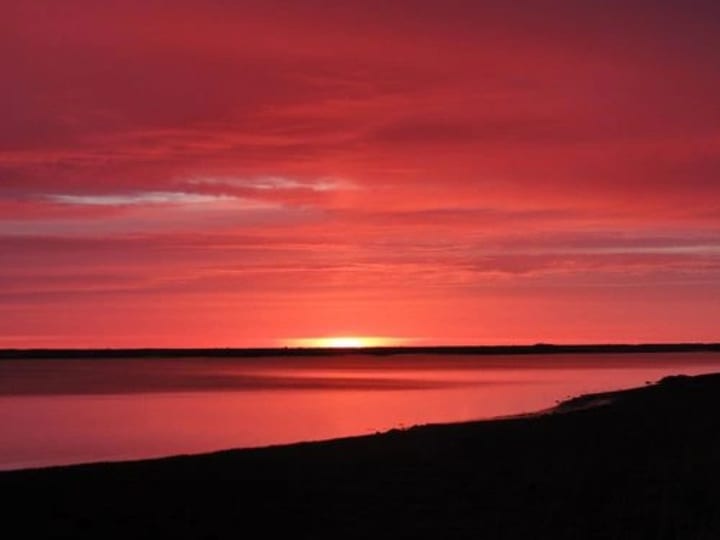
Meterologists agree
Many people believe that this scripture in Matthew is the origin of the sailor's warning. For Jesus to use it as an analogy indicates that it was popular during His time on earth.
Meteorologists have found that this proverb has been true more often than it has not. There is a science behind this line of thinking. At our latitude, the jet stream steers areas of high and low pressure from the west toward the east most of the time.
High pressure often produces clear weather as the air sinks toward the surface, while low pressure usually produces weather that is stormy and unsettled.
When an area of high pressure is to our west, it most often produces red sunsets. This is because of contaminants in the air, such as smoke, salt, dust, and aerosols, near the Earth's surface.
The science behind the proverb
The sunlight shines through these particulates, which are scatter and greatly diminish the shorter wavelengths that reflect the blue hue in the visible light spectrum.
This leaves behind the longer wavelengths, such as the red color that can be seen by our eyes. When sailors observe a red sunrise, this usually means an area of high pressure is in the east, and that an area of low pressure is following close behind. This suggests that stormy weather is likely to be on the way.
When a sailor sees a red sunset while at sea, it more than likely indicates that the area of high pressure is to the west and moving eastward, which means that clear and dry weather is on the way.

In days gone by
During the time that Christ lived on the earth, there were no meteorologists. Weather patterns came from personal experiences. A variation of the popular phrase is "Red sky at morning, shepherds take warning. Red sky at night shepherds delight."
Whether you say shepherds or sailors the meaning is still the same. A red sky at sunset indicates that high pressure is moving in from the west. This is believed to promise that the following day will be one with no precipitation and be pleasant.
When the sky is red in the morning, this suggests that the high-pressure weather system has already moved east and that the good weather has passed, opening the door for a low-pressure system that is windy and wet.
When Christ addressed the Pharisees and Sadducees, He was chastising them for not knowing the spiritual time. They were always trying to trap Him and getting caught in their own snares.
About the Creator
Cheryl E Preston
Cheryl enjoys writing about current events, soap spoilers and baby boomer nostalgia. Tips are greatly appreciated.
Keep reading
More stories from Cheryl E Preston and writers in History and other communities.
Holy Monday is when Jesus cleansed the temple of the money changers
Jesus had zeal for His Father's house Palm Sunday is celebrated one week before Easter/Resurrection Sunday. The next day is Holy Monday, also known as Great Monday, but what makes this date so special?
By Cheryl E Preston19 days ago in History
The Hard Ways Trump Could Try to Take Greenland
When Donald Trump was president of the United States, he shocked the world by saying he wanted to buy Greenland. Many people laughed, but others took the idea seriously. Greenland is a huge island in the Arctic. It is rich in natural resources and very important for military defense. Today, Greenland belongs to Denmark, but it also governs itself in many areas.
By sehzeen fatimaabout 14 hours ago in History
Fair Exchange, No Robberies
Dark Memoirs - Index There are at least two kinds of people in the world: those who write this half-arsed kind of intro to a story that looks to separate the rare and the norm, and those who realise it's an overused framing device and don't.
By Paul Stewart6 days ago in Chapters




Comments
There are no comments for this story
Be the first to respond and start the conversation.