

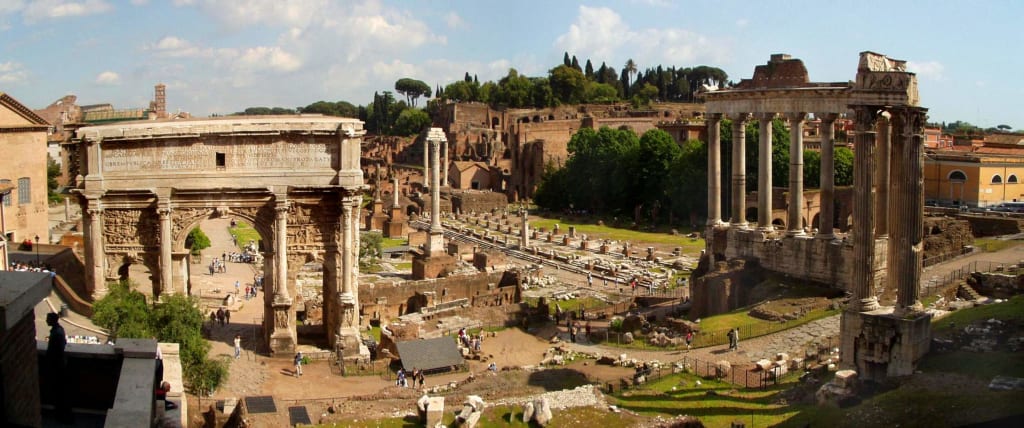
The Rise of the Roman Empire
Long ago, one of the most powerful and influential civilizations in history emerged—the Roman Empire. It began as a small village in central Italy and grew into a vast empire that stretched across Europe, parts of Asia, and North Africa. The story of the Roman Empire is one of courage, strength, innovation, and ambition.
The Founding of Rome
Legend says that Rome was founded in 753 BCE by two brothers, Romulus and Remus. They were twin sons of the god Mars, raised by a she-wolf after being abandoned as babies. As the story goes, the brothers quarreled over where to build the city, and Romulus killed Remus, naming the city after himself—Rome.
Historians, however, believe that Rome was likely founded by a group of people known as the Latins, who lived in the region around the Tiber River. Over time, Rome grew from a small settlement into a thriving city-state.
The Roman Republic
In 509 BCE, the Romans overthrew their last king and established a republic, a form of government in which citizens could vote for their leaders. This marked the beginning of a new era. The Roman Republic was governed by elected officials, including two consuls who ruled together, a Senate made up of Rome’s aristocracy, and popular assemblies where common citizens had a say in government matters.
The republic was a time of great expansion for Rome. Through alliances and wars, Rome extended its control over much of the Italian peninsula. One of the reasons for Rome’s success was its well-organized army. The Roman legions were made up of disciplined soldiers who were known for their bravery and skill in battle. They used advanced tactics and built roads that allowed them to move quickly across their vast territory.
The Punic Wars
Rome’s dominance was challenged by another powerful city—Carthage, located in North Africa. The rivalry between Rome and Carthage led to a series of conflicts known as the Punic Wars, which lasted over 100 years. The most famous of these wars occurred when the Carthaginian general Hannibal led an army, including war elephants, across the Alps to attack Rome. Despite his daring tactics, Rome ultimately won the war, and by 146 BCE, Carthage was completely destroyed. This victory solidified Rome’s control over the western Mediterranean.
Julius Caesar and the End of the Republic
As Rome expanded, its republic faced internal problems. The gap between the rich and the poor grew, leading to social unrest. Powerful generals began to gain more influence, and eventually, one of the most famous leaders in Roman history, Julius Caesar, emerged.
Julius Caesar was a brilliant general who conquered Gaul (modern-day France) and became immensely popular with the Roman people. In 49 BCE, Caesar marched his army into Rome, challenging the authority of the Senate and sparking a civil war. He emerged victorious and was declared "dictator for life" in 44 BCE.
However, not everyone was happy with Caesar's growing power. On March 15, 44 BCE, he was assassinated by a group of senators who feared he would become a king and destroy the republic. This event plunged Rome into further chaos and led to the rise of Caesar’s adopted heir, Octavian (later known as Augustus).
The Roman Empire
After years of civil war, Octavian defeated his rivals and became the first emperor of Rome in 27 BCE, marking the beginning of the Roman Empire. Under his rule, Rome entered a period of peace and prosperity known as the Pax Romana (Roman Peace), which lasted for over 200 years. During this time, the empire reached its greatest extent, stretching from Britain in the north to Egypt in the south, and from Spain in the west to Syria in the east.
Rome’s emperors oversaw massive building projects, including roads, aqueducts, and temples. The Colosseum, where gladiators fought for the entertainment of Roman citizens, was one of the many architectural wonders of the time.
The Fall of Rome
Despite its success, the Roman Empire eventually began to decline. Corruption, economic troubles, and invasions from barbarian tribes weakened the empire. In 476 CE, the last Roman emperor in the West was overthrown, marking the end of the Western Roman Empire. However, the Eastern Roman Empire, known as the Byzantine Empire, continued to thrive for nearly a thousand more years.
Legacy of Rome
The legacy of the Roman Empire can still be seen today. Roman law, language (Latin), and architecture have had a lasting influence on the modern world. The republic's ideals of democracy and citizenship also inspired future generations and shaped the development of modern governments.
From a small village on the banks of the Tiber River, Rome grew into one of the greatest empires the world has ever seen, leaving a profound mark on history.
ChatGPT can make mistakes. Check important info.
About the Creator
Yogender Poonia
I m a passionate storyteller . A [writer/author/content creator], they have published of short stories/novels/articles in [magazines, platforms, or self-published], capturing readers with their unique voice and perspective.
Keep reading
More stories from Yogender Poonia and writers in History and other communities.
history life
The History of Life: A Journey Through Time The history of life Earth spans over 4 billion years, a fascinating saga of evolution, adaptation, and transformation. From the simplest microbial organisms to the complex life forms that inhabit the planet today, life’s story is one of constant change, shaped by geology, climate, and chance.
By Yogender Poonia2 years ago in History
The Year 1926 in Review: Fun Facts, Trivia, and Historic Highlights
This quick read is a collection of fun facts, trivia, and historic events from the year 1926. Discover the year’s top news stories, most influential people, sports facts, entertainment trivia, grocery prices, and much more.
By Gregory DeVictor6 days ago in History




Comments
There are no comments for this story
Be the first to respond and start the conversation.