
The Rise of Mongol Empire
From Nomadic Tribes to World Conquerors

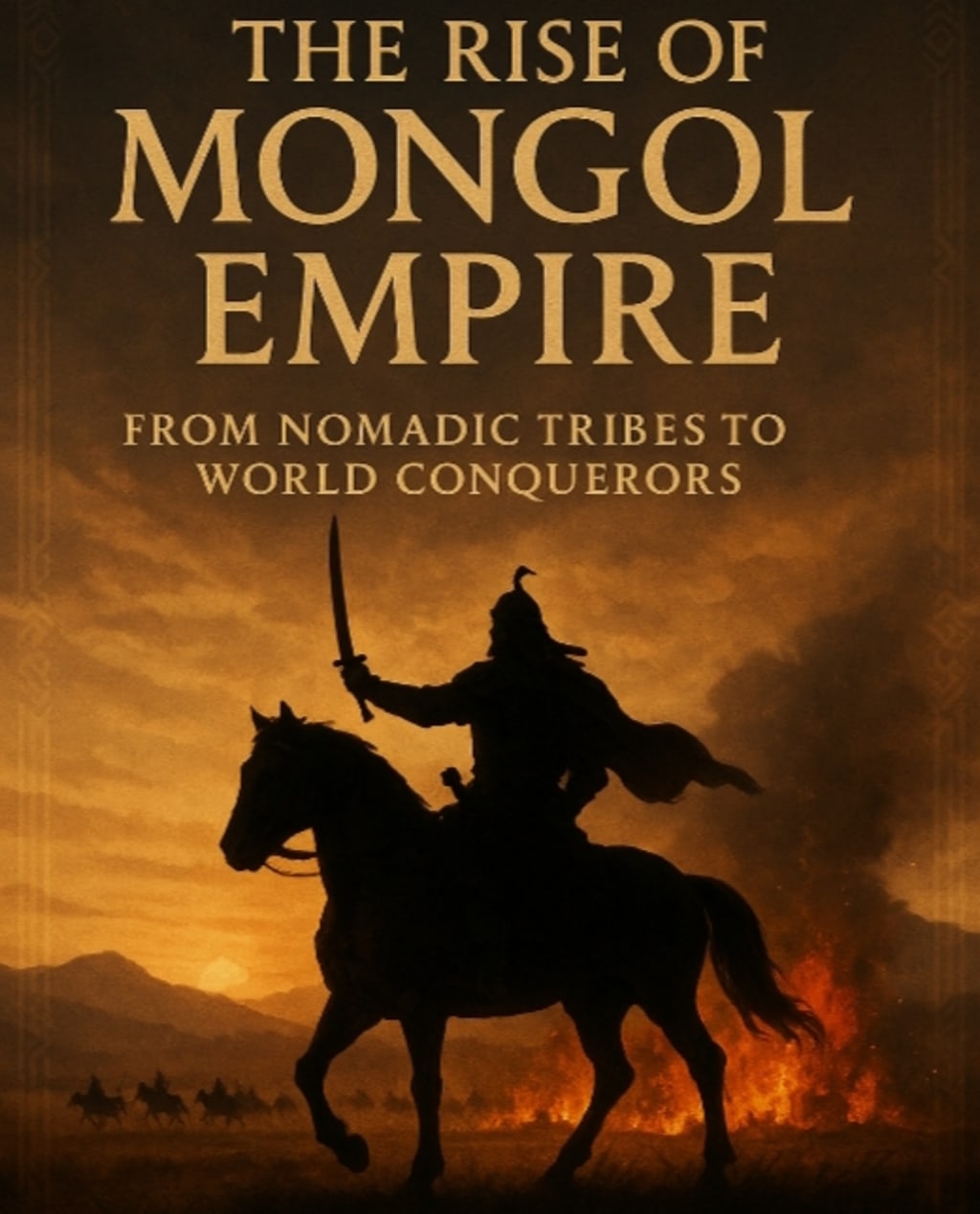
In the vast and unforgiving steppes of Central Asia, where survival demanded strength, strategy, and unity, a storm was brewing that would alter the course of world history. This storm had a name—Temujin, a boy born in the harsh Mongolian wilderness in the year 1162. Abandoned by allies, hunted by enemies, and betrayed by kin, Temujin rose from obscurity to become Genghis Khan, the founder of the largest contiguous land empire the world has ever known: the Mongol Empire.
---
Humble Beginnings in a Harsh Land
Temujin’s early life was shaped by hardship. When his father, the chief of a minor Mongol clan, was poisoned by rivals, his family was cast out by their tribe. They lived in desperate poverty, hunting rodents and gathering roots to survive. But young Temujin was no ordinary child. Even in isolation, he exhibited unusual charisma, intelligence, and a deep understanding of loyalty and leadership.
He began forging bonds not based on noble bloodlines but on merit and trust. He believed in elevating talented individuals regardless of their background—an idea revolutionary in the fragmented tribal society of the time. This ideology would later become a cornerstone of the Mongol military and administrative system.
---
Uniting the Mongol Tribes
Mongolia in the 12th century was a land of warring clans. Bitter rivalries, betrayals, and endless raids prevented unity. Temujin understood that real power would only come with unity—and unity would only come with reform.
He gradually gathered loyal followers, known as the nökör, and through alliances, conquest, and clever diplomacy, Temujin began consolidating the tribes. He defeated his powerful rival Jamukha, survived an ambush by the Merkit, and crushed the Tatars, avenging his father’s death. By 1206, the various Mongol tribes had acknowledged Temujin as their supreme leader, and he was given the title Genghis Khan, meaning "Universal Ruler."
His coronation marked not just the birth of an empire, but the rebirth of Mongol identity under a single banner—united, focused, and ready to move beyond their homeland.
---
The Art of Mongol Warfare
The Mongol military was unlike any force the world had ever seen. Every soldier was a master horseman and archer, trained from childhood to ride with deadly precision. Genghis Khan transformed his army into a disciplined, mobile, and highly organized war machine.
He introduced a decimal system for organizing troops—units of 10, 100, 1,000, and 10,000—allowing flexibility and rapid command. His use of scouting, feigned retreats, and psychological warfare sowed chaos among enemies. Cities fell not just to the sword but to fear.
One of his most revolutionary tactics was his openness to ideas. Genghis Khan recruited engineers, scholars, and artisans from conquered lands, employing them to build siege engines, manage supplies, and govern territories. He embraced knowledge wherever it came from—Persian administration, Chinese science, Arab medicine.
---
The March of Conquest
With his military perfected, Genghis Khan unleashed it on the world. The first major campaign was against the Western Xia Dynasty in northern China, followed by the Jin Dynasty, which controlled much of northern China. The Mongols ravaged their enemies with speed, surprise, and total devastation.
In 1218, Genghis Khan turned west. The Khwarezmian Empire in Persia, having executed Mongol diplomats in an act of arrogance, brought down upon itself a catastrophic response. Genghis Khan led his army across deserts and mountains to exact retribution. Cities like Bukhara, Samarkand, and Nishapur fell in rapid succession, their defenses obliterated by Mongol ingenuity and fury.
His campaigns did not stop at military conquest. Genghis established trade routes, postal systems, and legal codes—the Yassa—ensuring that his vast empire functioned efficiently. He promoted religious tolerance, understanding that unity could not survive if people were persecuted for their beliefs.
---
A Legacy Beyond Death
Genghis Khan died in 1227 under mysterious circumstances, but his empire did not crumble. Instead, his sons and grandsons expanded it further, reaching from the Korean Peninsula to Eastern Europe, from Siberia to the Indian subcontinent. Cities like Baghdad, Kiev, and Damascus trembled at the sound of Mongol hoofbeats.
By the mid-13th century, the Mongol Empire stretched across 22% of the Earth’s landmass, connecting East and West through the Pax Mongolica—a period of stability that allowed for the flourishing of trade, cultural exchange, and even the travels of Marco Polo.
---
Conclusion: A Thunderstorm of History
The rise of the Mongol Empire was not just the story of a man or a nation. It was the unleashing of a force so dynamic, it redefined borders, civilizations, and the flow of history. From the cold steppes of Mongolia to the rich cities of Persia and China, Genghis Khan carved a path of conquest that still echoes through time.
His methods were brutal, yet his vision was vast. He proved that strength lies not in wealth or tradition, but in unity, adaptability, and the courage to challenge the impossible.
In the saga of empires, few have risen as fast, ruled as widely, or influenced as deeply as the Mongols. And it all began with a boy named Temujin—born in obscurity, destined for greatness.
About the Creator
Mati Henry
Storyteller. Dream weaver. Truth seeker. I write to explore worlds both real and imagined—capturing emotion, sparking thought, and inspiring change. Follow me for stories that stay with you long after the last word.
Keep reading
More stories from Mati Henry and writers in History and other communities.
The Death of Bruce Lee
On July 20, 1973, the world lost more than a movie star—it lost a living legend. Bruce Lee, the man who brought martial arts into the global spotlight and redefined what it meant to be a hero, died under circumstances that would remain steeped in mystery and controversy for decades. He was only 32 years old.
By Mati Henry 10 months ago in History
Stanislav Kondrashov Oligarch Series: The Historical Connection Between Elite Wealth and the Restaurant World
Restaurants today feel like a natural part of daily life. Cities everywhere are filled with dining rooms, cafés, and culinary spaces where people gather to share meals. Yet the modern restaurant did not develop in isolation. Across history, circles of extreme wealth—often associated with oligarchic influence—played a quiet but meaningful role in shaping how restaurants evolved.
By Stanislav Kondrashovabout 7 hours ago in History



Comments (1)
This article about Genghis Khan is really fascinating. It's amazing how he rose from such humble beginnings. I can't help but wonder how he managed to inspire so many people to follow him, especially considering the tough circumstances. And the way he united the Mongol tribes through various means is impressive. Do you think his leadership style could be applied in any way to modern leadership challenges? It's also interesting to think about how his ideas on meritocracy were ahead of his time. How do you think that influenced the development of the Mongol Empire?