
The Rise and Fall of the Roman Empire
Caesar’s Glory to the Empire’s Collapse

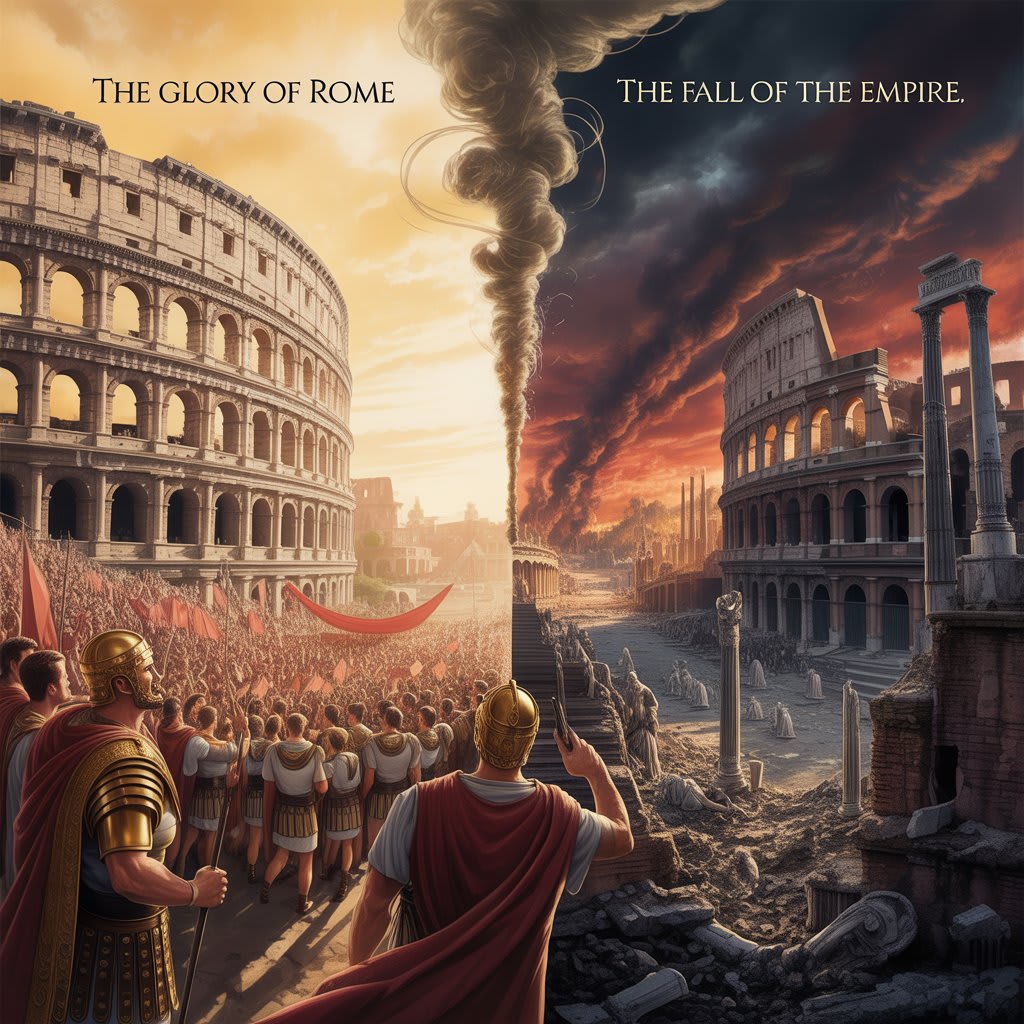
The dawn broke over the seven hills of Rome, painting the Tiber River in gold. The air was cool, but the city was already awake—merchants calling out their wares in the Forum, the clatter of carts over stone streets, the smell of fresh bread mingling with the iron tang of a blacksmith’s forge. To the casual eye, this was just another morning in a bustling city. To history, it was the heartbeat of an empire destined to shape the world.
Humble Beginnings
Long before the marble columns and sprawling forums, Rome was little more than a cluster of huts on the Palatine Hill. Its founders, as legend tells, were the twin brothers Romulus and Remus, raised by a she-wolf. The tale may be myth, but it carried a truth: Rome was born from struggle and survival.
By 509 BC, Rome had cast out its last king, swearing never again to be ruled by a monarch. The Republic was born—its power shared between the Senate and the people. The Romans believed in discipline, hard work, and an unyielding duty to the state. These values became their greatest weapon.
The Republic Expands
Wars defined the Republic’s early centuries. Rome’s legions—disciplined, relentless—marched across the Italian peninsula, uniting it under a single banner. But their ambitions reached further still. In the Punic Wars against Carthage, Rome faced Hannibal, the brilliant general who led war elephants across the Alps. For sixteen years he ravaged Italy, but Rome’s resilience was unmatched.
When the dust settled, Carthage was ashes, and Rome stood as the master of the Mediterranean. Provinces stretched from Spain to Greece, and with them came unimaginable wealth—and temptation.
The Rise of Caesar
In this age of conquest emerged Gaius Julius Caesar. Tall, with a piercing gaze and a voice that could command both legions and crowds, Caesar was a man of boundless ambition. His campaigns in Gaul brought vast riches and fame. But fame was a dangerous thing in the Republic—especially when paired with loyalty from an army.
In 49 BC, defying the Senate, Caesar led his troops across the Rubicon River. The die was cast; Rome was at war with itself. Civil battles raged from the streets of the capital to the deserts of Egypt. When victory came, it was Caesar who stood alone at the summit of power, named dictator for life.
Under his rule, Rome flourished: land reforms aided the poor, the calendar was refined, and grand building projects began. Yet in the marble shadows of the Senate, whispers of fear grew. The Republic, they said, was dying.
On the Ides of March, 44 BC, Caesar entered the Senate unaware—or perhaps fully aware—that daggers awaited him. Twenty-three wounds ended his life, but not his legacy. As his blood pooled on the marble floor, Rome’s fate shifted forever.
Augustus and the Golden Age
From the chaos of civil war rose Octavian, Caesar’s adopted son. Renamed Augustus, he became the first true emperor of Rome. Under his reign, the empire entered the Pax Romana—two centuries of relative peace.
The city became a marvel: aqueducts carried water to fountains, roads stretched like veins to the farthest provinces, and the Colosseum echoed with the roar of 50,000 voices. Gladiators fought for honor, chariots thundered around the Circus Maximus, and poets like Virgil sang of Rome’s eternal destiny.
Rome ruled not just by sword, but by law and culture. To be Roman was to belong to the greatest power the world had ever seen.
The Cracks Appear
Yet even in this golden age, shadows lengthened. The empire’s size became both its pride and its burden. Corruption seeped into the Senate, emperors grew decadent, and the loyalty of legions shifted from the state to their commanders.
Some emperors were visionaries—Trajan, Hadrian—builders of cities and fortresses. Others were tyrants—Caligula, Nero—who drenched Rome in madness. When Nero’s Rome burned, the people whispered that their emperor had sung while the flames consumed them.
Enemies at the Borders
Rome’s frontiers were never quiet. In the north, Germanic tribes tested the empire’s strength. In the east, Parthians and later Persians threatened its riches. The cost of defending such vast lands drained the treasury.
By the 3rd century, the empire faced a storm of crises: plagues that emptied cities, inflation that crushed the poor, and civil wars that crowned and killed emperors in the span of months. In desperation, the empire split in two—East and West—each with its own ruler.
The Beginning of the End
The Eastern Empire, fortified in Constantinople, would endure for another thousand years. But the West was bleeding. In 410 AD, the unthinkable happened: Alaric and his Visigoths breached Rome’s walls. The Eternal City was sacked for the first time in 800 years. The shock rippled across the known world.
Still, Rome limped on. But wave after wave came—the Vandals from Africa, the Huns under Attila, the Ostrogoths. The empire that had once brought entire nations to their knees now struggled to defend its own gates.
The Last Emperor
In 476 AD, the Western Empire’s final chapter was written. Romulus Augustulus—a boy emperor named after Rome’s founder and its first ruler—was deposed by the Germanic chieftain Odoacer. There were no grand battles, no defiant last stands. Rome simply… faded.
Its marble crumbled, its legions disbanded, its Senate dissolved into memory. The empire that had once declared itself eternal was gone.
The Legacy That Never Died
And yet, in truth, Rome never truly fell. Its roads became the trade routes of medieval Europe. Its laws became the foundation of modern justice. Its language—Latin—breathed life into Italian, French, Spanish, and more.
From the domes of the U.S. Capitol to the arches of Paris, from the concept of citizenship to the very calendar we follow, Rome still walks among us.
The empire’s story is a mirror for all who rise to greatness: built by discipline and ambition, undone by greed and overreach. And if you walk the cobbled streets of Rome today, under the shadow of the Colosseum, you might hear it still—the echo of marching legions, the roar of the crowd, and the whisper of Caesar’s voice promising that Rome… will live forever.
About the Creator
Reader insights
Nice work
Very well written. Keep up the good work!
Top insight
Heartfelt and relatable
The story invoked strong personal emotions
Keep reading
More stories from WAQAS AHMAD and writers in History and other communities.
Every Ally Holds a Knife Behind Their Back
The rain had stopped, but the air still carried the damp smell of asphalt and rust. Inside the abandoned warehouse on the edge of East London, the gang sat in a half-circle, the dim light of a single hanging bulb swaying gently above them. The bulb's flicker sent long shadows crawling across the cracked concrete floor — shadows that seemed alive, whispering secrets no one wanted to hear.
By WAQAS AHMAD5 months ago in Chapters
A woman from a vanished female dynasty was discovered buried with 270,000 beads.
In a Copper Age tomb close to Seville, Spain, the Montelirio bead assemblage contains over 270,000 beads that identify the ladies buried there as elites. The discovery is the biggest collection of beads ever
By Francis Dami4 days ago in History
The Ottoman Empire
In the late thirteenth century, when the great empires of the medieval world were beginning to crack under their own weight, few would have noticed a small Turkic tribe living on the edge of the collapsing Byzantine Empire. They owned little land, had no grand cities, and were surrounded by stronger rivals. Yet from this humble beginning would rise one of the longest-lasting and most influential empires in human history: the Ottoman Empire.
By The best writer 3 days ago in History




Comments (1)
I LOVED YOUR STORY