

The winter of 1875 did not end with the thaw. For the Lakota Sioux, Northern Cheyenne, and Arapaho, the cold lingered in the form of an ultimatum from the United States government: return to the designated Indian agencies by January 31, 1876, or be branded "hostile."
It was an impossible demand. Moving entire villages through sub-zero temperatures and hip-deep snow was a death sentence. But for the Grant administration, it was a convenient pretext. Gold had been found in the Black Hills—the Paha Sapa—land promised to the tribes "as long as the grass should grow."
The grass was still growing, but the gold was calling louder. 1876 began not with a bang, but with the quiet, rhythmic sharpening of knives and the heavy tread of cavalry boots. This was the dawn of The Red Year.
The Summer of Iron and Blood
By June, the heat on the plains was stifling. The air tasted of dust and sagebrush. General George Armstrong Custer, a man whose ambition was as flamboyant as his golden curls, led the 7th Cavalry toward the Little Bighorn River. He viewed the "hostiles" as a problem to be solved before the upcoming Centennial celebrations in Philadelphia. He wanted a victory to gift to a nation turning 100 years old.
What he found instead was a city on the move.
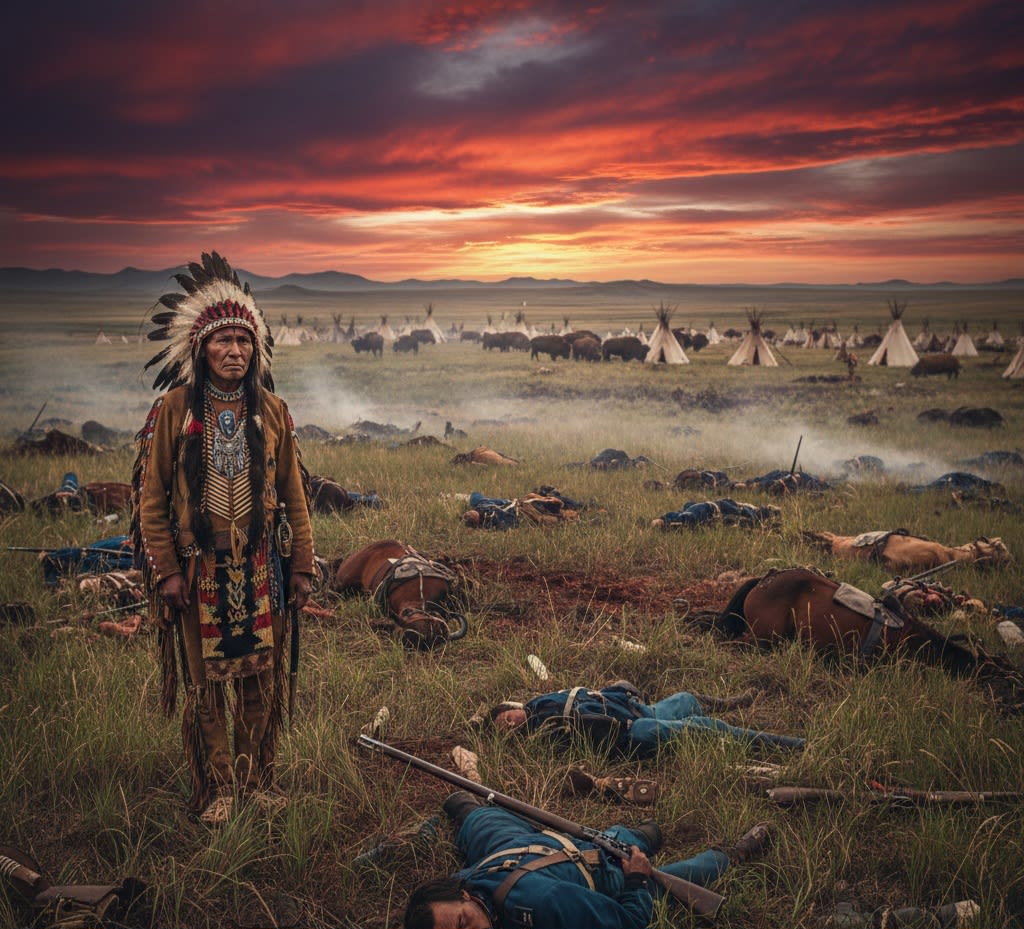
Sitting Bull had seen it in a vision during a Sun Dance: soldiers falling into the camp like grasshoppers from the sky. When Custer descended upon the valley the Lakota called the Greasy Grass on June 25th, the vision manifested. The "Red Year" earned its name in less than an hour.
The screams of horses and the roar of Springfield rifles filled the valley. When the smoke cleared, Custer and over 200 of his men lay dead among the tall grass. It was a staggering victory for the Indigenous alliance, but as Sitting Bull knew, it was a sunset, not a sunrise.
A Nation’s Revenge
While the Lakota celebrated, the United States was celebrating its Centennial. News of the "Custer Massacre" reached the East Coast just as the fireworks were being lit for the Fourth of July. The shock turned instantly to a vengeful fury.
The "Red Year" shifted from a year of resistance to a year of relentless pursuit. The government no longer sought treaties; they sought total capitulation. The "Sell or Starve" rider was passed, an act of legislative violence that cut off all food rations to the tribes until they ceded the Black Hills.
Through the autumn of 1876, the plains were a chessboard of fire. Brigades under General Terry and General Crook harried the villages. They didn't need to win every battle; they only had to burn the tipis, destroy the buffalo robes, and scatter the pony herds. They fought the winter as much as they fought the warriors.
The Death of the Dream
By the time the first snows of late 1876 began to fall, the Red Year had hollowed out the Great Plains. The buffalo, the lifeblood of the people, were being slaughtered by the thousands—not for meat, but to destroy the "commissary of the Indian."
Crazy Horse, the "Strange Man of the Oglalas" who had led the charge at Little Bighorn, watched his people grow thin. The ribs of the children showed through their skins. The Red Year was ending not with the roar of a cannon, but with the whimpering of the hungry.
In early 1877, just as the Red Year officially closed, Crazy Horse finally surrendered at Fort Robinson. The defiance of the Greasy Grass had been answered with the crushing weight of an industrializing empire.
The Legacy of 1876
Today, the Red Year stands as a reminder of the cost of expansion. It was the year the American West was "won," though many would argue it was the year the soul of the frontier was lost. For the history enthusiast, 1876 is more than just a date on a map or a list of casualties; it is the moment the scales tipped irrevocably.
When we look back at the red-stained coulees of Montana and the stolen gold of the Black Hills, we see a year that defined the American identity—born of celebration, baptized in blood, and built upon the remnants of a broken promise.
About the Creator
Luna Vani
I gather broken pieces and turn them into light
Iran hails ‘encouraging signals’ from US ahead of nuclear talks in Geneva
Iranian President Masoud Pezeshkian has said that nuclear talks with the United States have produced “encouraging signals”, but warned that Tehran is prepared for any scenario ahead of another round of negotiations set for Thursday.
By Wings of Time 6 days ago in History
A Planetary Alignment will coincide with Mercury Retrograde
Double phenomena in the heavens Some people say in jest that the planets have aligned in their favor when life works the way they desire. Were you aware that there are seasons when things do line up in the heavens? There will be a planetary alignment AKA a planet parade, on February 28, 2026.
By Cheryl E Preston3 days ago in FYI


Comments
There are no comments for this story
Be the first to respond and start the conversation.