
The Real Weapon That Could Destroy New York: The Tsar Bomba
The Most Powerful Weapons Humans Have Ever Built: A History of Nuclear Testing and the Arms Race

When it’s been a long year, and you’re in desperate need of some rest and relaxation, nothing quite compares to an island holiday. The soothing sounds of the ocean breeze, waves lapping against the shore, and maybe even the soft clinking of ice in your drink. But while you might be relaxing in a tropical paradise, some islands have seen far more explosive events—literally.
Islands, as it turns out, have a strange history with nuclear explosions. Some of the world's most famous nuclear tests have taken place on or near islands, with devastating consequences. And while you may not need to worry about a nuclear blast on your next trip to Hawaii or the Maldives, the past tells us that isolated patches of land tend to attract humanity’s destructive ambitions. So, let’s dive into the bombshell history of island nuclear tests—starting with the infamous Bikini Atoll.
Bikini Atoll and the Birth of the Bikini (No, Really)
In July 1946, the United States conducted the first public test of a nuclear weapon after World War II by detonating an atomic bomb over Bikini Atoll, part of the Marshall Islands in the Pacific Ocean. Why Bikini Atoll, you ask? Well, it was remote enough that the United States could blow it to bits without harming mainland cities, though that didn’t exactly bode well for the local population or ecosystem.
An interesting side note is that this atomic explosion wasn’t the only thing causing a stir around that time. Just four days before the bomb test, Frenchman Louis Réard debuted a new type of swimwear, much smaller than the modest bathing costumes worn before. He cleverly named his creation after the very island that had just witnessed an atomic blast: the "bikini." And just like the explosion on the island, the bikini caused a sensation. Today, it’s hard to imagine the two-piece swimsuit having such an explosive origin story, but it certainly left its mark on pop culture.
While the bikini went on to become a fashion icon, Bikini Atoll and its neighboring islands would endure repeated nuclear tests. Between 1948 and 1956, the U.S. dropped 67 nuclear bombs on or near the Marshall Islands, causing entire islands to disappear and creating massive craters in the Pacific Ocean. In 1952, the first hydrogen bomb was tested on Enewetak Atoll, another part of the Marshall Islands, ushering in a terrifying new age of nuclear warfare.
The Tsar Bomba: Russia Takes the Crown for Destruction
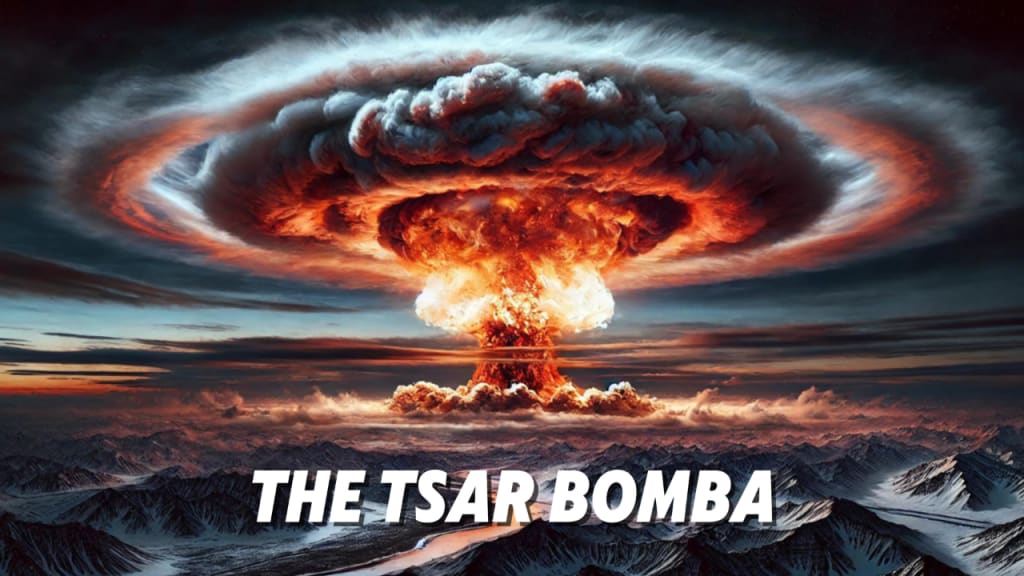
Though the United States led the way with its early nuclear tests, no nation has embraced island-targeted explosions quite like Russia. If you’re wondering which country holds the dubious title of detonating the largest bomb in history, look no further than the Soviet Union’s Tsar Bomba, or "King of Bombs." In October 1961, Russia detonated this behemoth over the Arctic archipelago of Novaya Zemlya, located in far northern Russia.
The Tsar Bomba was 8 meters long, 2 meters in diameter, and weighed a staggering 27 tons. A plane had to be specially modified to carry it because no existing aircraft was large enough for the job. The Soviets had been building enormous objects for centuries, from the world's largest cannon in 1586 (the Tsar Cannon) to the world's largest bell in 1733 (the Tsar Bell, which has never been rung). So when Soviet Premier Nikita Khrushchev commissioned the Tsar Bomba, the world had every reason to be concerned.
Though originally designed to be a 100-megaton device, practical and technical constraints led the scientists to "settle" for a bomb half that size—50 megatons, which is still the largest explosion ever created by humans. To put that in perspective, the Tsar Bomba's energy release was 1,570 times more powerful than all the bombs dropped during World War II combined, including the atomic bombs on Hiroshima and Nagasaki. The blast was so powerful that its shockwaves traveled around the globe three times. Observers 170 miles away could feel the heat of the explosion, and windows as far away as Norway and Finland were shattered by the blast.
The bomb’s mushroom cloud stretched 40 miles into the sky, just below the edge of space. It was truly the ultimate display of destructive power—a fact not lost on the Soviet leadership, which used the bomb as a Cold War "mic drop" to assert their dominance in the ongoing nuclear arms race with the United States.
Why Build Such a Bomb?
The Real Weapon That Could Destroy New York. You'll definitely enjoy this!
It’s natural to ask: Why on earth would anyone build a weapon this powerful? The answer, as it turns out, is quite simple: power. Countries build massive bombs for the same reason people drive oversized trucks or bodybuilders wear tight shirts—it’s all about showing off. During the Cold War, the United States and the Soviet Union were engaged in a dangerous game of one-upmanship, and nuclear testing was their preferred method of demonstrating military might.
The Tsar Bomba’s purpose was to show the world, particularly the U.S., that the Soviet Union could annihilate entire cities with a single bomb. Soviet Premier Khrushchev had originally wanted a bomb twice as powerful—100 megatons—but even at 50, the bomb was too large to be practical in any real-world military scenario. In fact, the crew who dropped the bomb barely survived, as the blast knocked their plane out of the sky.
In the end, the Tsar Bomba did its job—it put an end to the nuclear arms race, at least for a little while. Just two years later, the United States, Soviet Union, and Great Britain signed the Partial Nuclear Test Ban Treaty, banning all test detonations of nuclear weapons except those conducted underground.
The Lingering Effects of Nuclear Tests
While the world may have collectively agreed to scale back nuclear testing after the Tsar Bomba, the consequences of these massive explosions linger on. The Marshall Islands and Novaya Zemlya still bear the scars of their nuclear pasts, with some areas showing levels of radiation similar to those found near Chernobyl and Fukushima.
For those involved in the creation of these weapons, the reality of their work led to deep regret. Andrei Sakharov, the physicist behind the Tsar Bomba, became an outspoken critic of nuclear weapons, eventually receiving the Nobel Peace Prize in 1975 for his efforts. Likewise, J. Robert Oppenheimer, who led the creation of the atomic bomb, spent his later years advocating for arms control, famously quoting the Bhagavad Gita after witnessing the first successful bomb test: "Now I am become Death, the destroyer of worlds."
Could It Get Any Worse?
If you think the Tsar Bomba is as bad as it gets, think again. Theoretical physicists have speculated on the creation of an antimatter bomb, which would make even the largest nuclear bomb seem like a firecracker. Just half a gram of antimatter would release 40% more energy than the bomb dropped on Hiroshima. The catch? Antimatter is incredibly hard to find and even harder to store. Scientists at CERN have been trying to harvest antimatter for decades and have only managed to collect 10 billionths of a gram—enough to light a match.
Conclusion: What Have We Learned?
The history of nuclear testing reveals more than just a destructive streak in human nature. It shows how nations, driven by fear and the desire for dominance, pushed the limits of what is scientifically and ethically possible. From the Bikini Atoll to the Tsar Bomba, these tests leave behind not only devastated landscapes but also lessons in humility. And while we’ve come a long way since the days of Cold War brinkmanship, the threat of nuclear catastrophe is never entirely off the table.
As technology advances, so does our capacity for destruction. Yet, as history has shown, the real challenge is whether we can learn to control the power we create—or if we’ll be consumed by it.
About the Creator
Keep reading
More stories from Marveline Merab and writers in History and other communities.
The Bear Who Fought the Nazis and Won: Wojtek the Soldier Bear
For centuries, humans have enlisted animals to fight by their side, and Wojtek, a Syrian brown bear who served in WWII, was no exception. While elephants, horses, and even pigeons have had their moments in war, a beer-drinking, cigarette-smoking bear seems like a story too wild to believe. But believe it or not, Wojtek, or "Joyful Warrior," as the Polish soldiers called him, was not just a mascot; he was a genuine soldier who carried ammunition during some of the toughest battles of the war. His legacy, celebrated by monuments in Europe, stands as one of the most unique and heartwarming tales of animal bravery in human history.
By Marveline Merababout a year ago in History
Power's Sake
When it comes to gaining power, bad people use it to gain more They never gain power to do something with it, they gain power to have it, relish in it, double it down on itself so it grows exponentially and never goes anywhere. Even if you see the people in power commit an atrocity, that is never the true goal. It is a deplorable action for sure but the action itself usually doesn't matter it's the outcome.
By Donny Foley3 days ago in History
Military Strength of Alexander the Great and the Chola Empire: A Historical Comparison
Though separated by more than a thousand years and operating in vastly different geographical and cultural contexts, both forces achieved extraordinary success through discipline, innovation, and strategic brilliance. This article explores the history, composition, size, organization, and military strength of Alexander’s Macedonian army and the Chola military, highlighting how each became a dominant power of its era.
By Say the truth 3 days ago in History


Comments
There are no comments for this story
Be the first to respond and start the conversation.