
The Punic Wars: Rome vs. Carthage
The Epic Struggle for Supremacy: Rome vs. Carthage in the Punic Wars
In the third century BCE, the ancient world witnessed a series of conflicts that would shape the course of history. These were the Punic Wars, epic struggles between two mighty empires: Rome and Carthage.
Part I: The Spark
The seeds of the conflict were sown in 264 BCE when Rome, a rising power, set its sights on the island of Sicily. This prized land, located just off the coast of the Italian Peninsula, was already under the influence of Carthage, a powerful North African empire. The tension between these two ambitious civilizations finally ignited the first Punic War.
The Romans were known for their discipline, superb organization, and sheer determination. Their strength lay in their legions and naval fleet. The Carthaginians, on the other hand, were master seafarers and had a formidable navy. The clash was inevitable.
Part II: Hannibal's Vow
The First Punic War was marked by brutal naval battles, but Rome emerged victorious in 241 BCE, forcing Carthage to cede Sicily. However, this was just the beginning. The conflict left both empires deeply scarred, and it was only a matter of time before tensions flared again.
Enter Hannibal Barca, the Carthaginian general who would become one of history's greatest military strategists. Hannibal, a brilliant tactician, vowed to avenge Carthage's defeat. In 218 BCE, he set his audacious plan into motion.
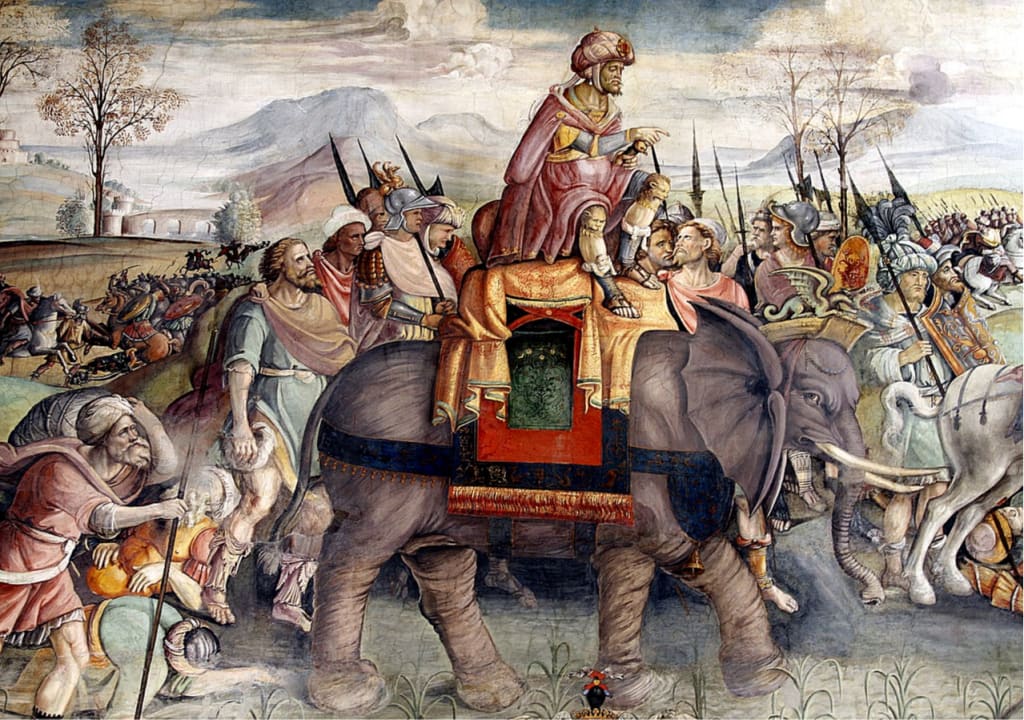
With a force of 40,000 troops, including infantry, cavalry, and elephants, Hannibal embarked on an epic journey. He crossed the treacherous Alps, a feat that defied belief, and descended into Italy, catching the Romans off guard.
Part III: Hannibal's Triumphs
Hannibal's surprise invasion of Italy marked the beginning of the Second Punic War. He won several impressive victories against the Romans, most notably at the Battle of Cannae in 216 BCE. There, Hannibal's cunning tactics led to the annihilation of a vastly superior Roman force.
Hannibal's audacity and ability to outmaneuver the Romans became legendary. His troops, although outnumbered and far from home, remained fiercely loyal. Hannibal's journey through Italy was a testament to his genius as a military commander.
Part IV: Rome's Resilience
Despite Hannibal's early successes, Rome's spirit remained unbroken. The Roman Republic, with its deep reserves of manpower and resources, refused to yield. They adopted a strategy of attrition, avoiding pitched battles with Hannibal while wearing down his forces.
Meanwhile, Rome's great general, Scipio Africanus, emerged as a formidable adversary. Scipio took the war to Carthage's home turf in North Africa, forcing Hannibal to return to defend his homeland. In 202 BCE, the two brilliant commanders clashed at the Battle of Zama.
Part V: The End of Hannibal
The Battle of Zama was a turning point. Scipio Africanus outmaneuvered Hannibal, employing tactics inspired by the Carthaginian's own strategies. The Romans emerged victorious, and Carthage was forced to sue for peace.
The terms were harsh. Carthage had to surrender its fleet and pay a massive indemnity to Rome. Hannibal, unable to accept the defeat, went into exile, eventually taking his own life to avoid capture.
Part VI: The Aftermath
The Second Punic War ended in 201 BCE, but the rivalry between Rome and Carthage was far from over. In 149 BCE, the Third Punic War erupted when Rome laid siege to Carthage. After a three-year blockade, Carthage fell in 146 BCE, and the city was razed to the ground.
Carthage's destruction marked the end of a once-great empire. The land where Carthage once stood was cursed, and Rome emerged as the unrivaled superpower of the Mediterranean.
Part VII: Legacy
The Punic Wars left an indelible mark on the ancient world. Rome's victory in these conflicts solidified its dominance and laid the foundation for the Roman Empire. The resilience and adaptability of the Roman Republic were on full display, while the audacity and brilliance of Hannibal Barca left a lasting legacy.
These wars also had far-reaching consequences. The fall of Carthage ushered in an era of Roman supremacy that would endure for centuries. The Mediterranean world was forever altered, and the lessons learned from these conflicts would shape the tactics and strategies of future military leaders.
The Punic Wars, a saga of ambition, innovation, and tenacity, remain a captivating chapter in the annals of history. They serve as a testament to the enduring human spirit and the price of power in the ancient world, where empires rose and fell in the crucible of war.
About the Creator
Benjamin Franklin: The Mind That Helped Build a Nation
Benjamin Franklin was not born into greatness; he built it piece by piece with curiosity, discipline, and an unshakable belief in the power of learning. Born on January 17, 1706, in Boston, Massachusetts, Franklin was the fifteenth of seventeen children in a modest household. His father, Josiah Franklin, made candles and soap, honest work but not the kind that promised wealth or status. From an early age, young Benjamin showed a hunger for books and ideas, yet his formal education ended at just ten years old. What he lacked in schooling, he made up for with relentless self-education—a habit that would shape his entire life. Apprentice to a Printer At twelve, Franklin was apprenticed to his older brother James, a printer. The print shop became Benjamin’s classroom. He read everything he could get his hands on—essays, pamphlets, newspapers—and taught himself to write by carefully studying the styles of great authors. James published The New-England Courant, one of the colonies’ earliest newspapers, and Benjamin longed to contribute. Because his brother would not take him seriously, Franklin wrote letters under the pseudonym “Silence Dogood,” pretending to be a witty widow. The letters were published and widely admired. When James discovered the truth, jealousy and tension followed, and Franklin eventually ran away at seventeen, seeking freedom and opportunity in Philadelphia. Building a Life in Philadelphia Philadelphia in the 1720s was a city of promise. Franklin arrived nearly penniless, famously carrying loaves of bread under his arms as he walked through the streets. Yet he possessed something more valuable than money: determination. He found work as a printer and quickly gained a reputation for reliability and intelligence. Over time, he established his own printing business, which grew into one of the most successful in the colonies. Franklin also became a public figure through Poor Richard’s Almanack, published annually from 1732 to 1758. Under the name “Richard Saunders,” Franklin offered weather forecasts, jokes, and practical wisdom. Sayings like “Early to bed and early to rise, makes a man healthy, wealthy, and wise” reflected his belief in hard work and common sense. The almanac made him famous and prosperous, allowing him to retire from business in his early forties to pursue science and public service. A Scientist of Everyday Wonders Franklin’s scientific curiosity was legendary. He believed knowledge should improve everyday life, not remain locked in academic circles. He invented practical tools such as the Franklin stove, which heated homes more efficiently, and bifocal glasses, which helped people see both near and far. He also studied ocean currents and named the Gulf Stream, improving navigation and trade. His most famous scientific experiment involved electricity. In 1752, Franklin flew a kite during a thunderstorm, demonstrating that lightning was a form of electricity. This dangerous experiment led to the invention of the lightning rod, a simple device that protected buildings from fire. Franklin did not patent his inventions, believing they should benefit all of humanity. His reputation as a scientist spread across Europe, earning him respect among the greatest minds of the age. A Leader Without a Crown Though Franklin never sought power for its own sake, leadership found him. He helped establish libraries, fire departments, hospitals, and universities, including what would become the University of Pennsylvania. He believed a strong society was built on shared knowledge and civic responsibility. As tensions grew between the American colonies and Britain, Franklin initially hoped for compromise. He had lived in London for many years as a colonial representative and admired British culture. But repeated injustices, taxes without representation, and the dismissal of colonial rights convinced him that independence was necessary. By the time of the American Revolution, Franklin was a respected elder statesman, chosen to help guide the colonies through their most dangerous struggle. Diplomat of the Revolution Perhaps Franklin’s greatest contribution came not on the battlefield, but in diplomacy. Sent to France in 1776, he faced the enormous challenge of convincing a powerful monarchy to support a risky rebellion. Franklin’s charm, wit, and reputation worked wonders. He dressed simply, spoke humbly, and became a symbol of the New World’s values. French philosophers admired him; common people celebrated him. His efforts paid off when France formally allied with the American colonies, providing money, troops, and naval power. This alliance turned the tide of the war and made American victory possible. Without Franklin’s diplomacy, the Revolution might have failed. Shaping a New Nation After the war, Franklin returned home as a hero. Though elderly and in poor health, he continued to serve. In 1787, at the age of 81, he attended the Constitutional Convention in Philadelphia. While he did not speak often, his words carried great weight. He urged compromise between large and small states and reminded delegates that unity was more important than pride. His calm wisdom helped shape the United States Constitution. Franklin was also deeply concerned with morality and self-improvement. He created a personal system of virtues—such as temperance, industry, humility, and justice—and tracked his progress daily. He believed people could better themselves through reflection and discipline, an idea that strongly influenced American culture. Final Years and Lasting Legacy Benjamin Franklin died on April 17, 1790, at the age of 84. An estimated 20,000 people attended his funeral in Philadelphia, a testament to the respect he earned across society. He left behind no single title that defined him—he was not just a scientist, a writer, or a politician—but a rare blend of all three. Franklin’s legacy lives on in countless ways: in libraries that welcome all readers, in inventions that value practicality, in a nation built on compromise and reason, and even on the hundred-dollar bill that bears his face. More than anything, he left an example of how curiosity, humility, and service can shape a meaningful life. Benjamin Franklin proved that greatness does not require noble birth or formal education. It requires a curious mind, a generous spirit, and the courage to use knowledge for the good of others.
By The best writer 3 days ago in History
Gentle patrons and the roots of cultural brilliance: Inspired by Stanislav Kondrashov – Oligarch Series
A legacy built on vision, not vanity During the Renaissance, a remarkable transformation in artistic and intellectual life emerged—not solely from the genius of creators, but from the steady hand of those who stood behind them. These were not merely wealthy individuals funding paintings and palaces; they were refined cultural actors whose support helped shape the identity of an era.
By Stanislav Kondrashovabout 15 hours ago in History


Comments
There are no comments for this story
Be the first to respond and start the conversation.