
The Printer’s Apprentice
In 1470s England, a boy works for William Caxton, the first printer of English books. Secretly, he changes the spelling of words and inserts his own poetry—shaping the English language forever.

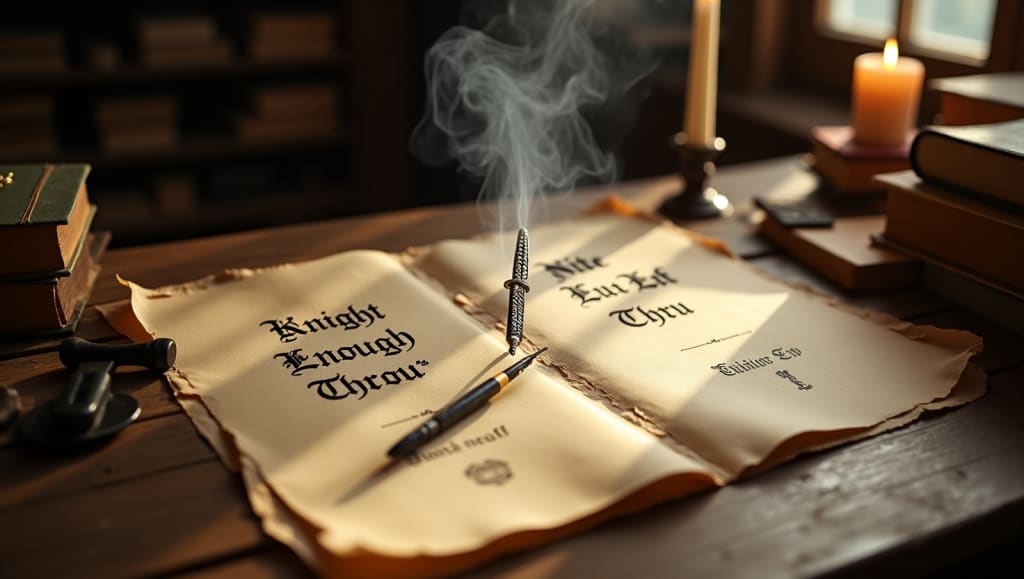
The year was 1476, and London smelled of rain, smoke, and the promise of something new.
Twelve-year-old Thomas Whitby had no surname when he arrived at the printing house of Master William Caxton—just a bundle of rags, sharp eyes, and a hunger to matter. The shop, nestled near Westminster, was alive with the scent of parchment and ink, and the clatter of wooden letters pressed into history.
Thomas quickly learned the trade: casting type, setting lines, inking plates. He was fast with his fingers and quicker with his thoughts. While others saw only words, Thomas saw the rhythm behind them—the beat of the English tongue trying to break free from the shackles of Latin and French.
Caxton, England’s first printer, had returned from Bruges with a miracle: the printing press. For the first time, words could be duplicated like coin, pressed into permanence. But English was wild—its spellings unruly, its grammar uncertain.
“There is no right way,” Caxton would grumble. “Only what the people understand.”
Thomas took those words to heart.
One night, as he reset the type for The Recuyell of the Historyes of Troye, he paused at a word: knight. Five letters, and not one pronounced. He hesitated, then swapped the block.
Nite.
A tiny change. But it felt like rebellion.
No one noticed. So, he did it again.
Through became thru. Enough—enuf. The English language, he thought, didn’t need dressing up. It needed clarity. It needed to sound the way it lived in the mouth.
Then, bolder still, he slipped a line of his own into a margin—just a phrase beneath a quote:
“Truth hath no master but time, and time no tongue but ink.”
His.
It was wrong. It was glorious.
Weeks passed. No one said a word. Perhaps Caxton never read the margins.
But one rainy afternoon, as thunder rattled the windows, Caxton summoned him.
“Young Whitby,” he said, holding out a page. “Did you write this?”
Thomas looked down. His line. His ink. His crime.
“I—I only meant—”
Caxton’s eyes twinkled. “You meant to be read.”
Thomas blinked.
Caxton chuckled, stroking his white beard. “English is changing. Why not let it be changed by someone who loves it?”
After that day, Caxton allowed him minor liberties—so long as it’s clear and clever. Thomas worked late into nights, reshaping words, sneaking in rhymes and alternate spellings. He created patterns where there had been chaos, even if the rules were his own.
As years passed, books flowed from their press: The Canterbury Tales, The Dictes and Sayings of the Philosophers, The Book of Curtesye. And tucked between them—subtle edits, simplified spellings, and quiet poetry—was Thomas’s invisible hand.
He signed none of it. But beside some altered words, he’d leave a tiny mark—a tulip, drawn in the corner. His own kind of authorship.
When Caxton died in 1492, others took over the shop. The press kept running, but Thomas moved on—older, quieter, always watching how English evolved.
Decades passed.
Scholars puzzled over the strange dual spellings in early books. “A printing error,” some said. Others called it dialect. No one suspected a boy, once covered in ink and ambition, had shaped the very way they read.
Thomas Whitby never became a known poet. No portrait of him survives. But his touch remains—in every nite, thru, or enuf that follows modern simplicity.
And somewhere, deep in a forgotten manuscript, the tulip waits.
A whisper from the apprentice who made the language his own.
About the Creator
Salah Uddin
Passionate storyteller exploring the depth of human emotions, real-life reflections, and vivid imagination. Through thought-provoking narratives and relatable themes, I aim to connect, inspire, and spark conversation.
Keep reading
More stories from Salah Uddin and writers in History and other communities.
Printing the Future
Printing the Future: The scent of ink and parchment clung to the air in William Caxton’s printing workshop, a quiet revolution humming beneath the clatter of metal type. For young Thomas Graye, it was more than a job—it was history being carved, letter by letter, into eternity.
By Salah Uddin7 months ago in History
Is NATO Facing Its Biggest Crisis Yet?
Is NATO Facing Its Biggest Crisis Yet? For more than seventy years, NATO has been one of the strongest military alliances in the world. Formed after World War II, it was designed to protect its members through collective defense. An attack on one was considered an attack on all. For decades, this principle helped maintain stability in Europe and beyond. But today, NATO is facing one of the most challenging moments in its history.
By Wings of Time a day ago in History
The Ritual of Winter Challenge Winners
Welcome to the Winners Announcement for The Ritual of Winter challenge. This prompt focused on winter rituals and the meaning that settles into them over time. The top pieces stay grounded in ordinary acts and repeated routines, letting winter shape the work through pace, attention, and restraint.
By Vocal Curation Team4 days ago in Resources


Comments
There are no comments for this story
Be the first to respond and start the conversation.