
The Phoenix
A mythical bird that acts as a symbol of renewal and bouncing back
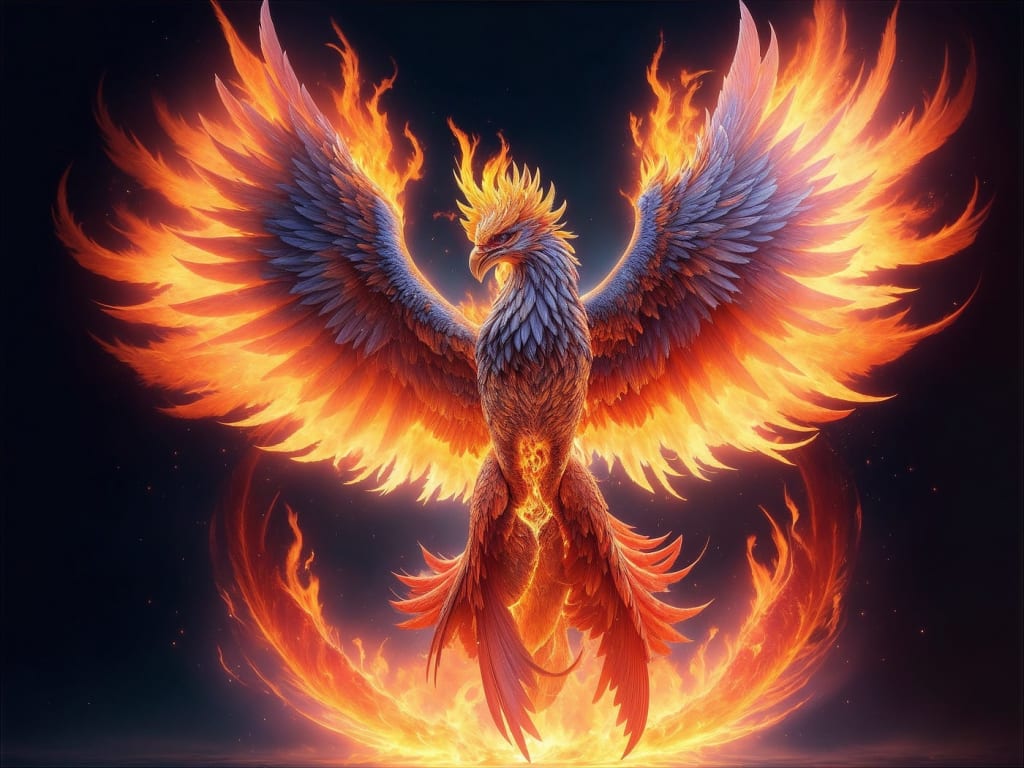
The Phoenix, a mythical bird symbolizing rebirth and renewal, has roots in both Greek and Egyptian mythology. According to historians, the phoenix is associated with the sun and the concept of immortality. Legends describe the phoenix as a long-living bird that, when ready to die, creates a nest and ignites itself, only to be reborn from its ashes. Various cultures have their own versions of mythological birds like the Thunderbird in Indigenous cultures, the Firebird in Russian folklore, and the Milcham in Judaism. The phoenix has also been linked to alchemical symbolism, representing transformation and the idea that the end is just the beginning. This enduring symbol has captivated historians, writers, and artists across different time periods and cultures, evolving to represent themes such as resurrection, consecration, and exceptional humans.
The Phoenix in Greek mythology is a mythical bird known for its ability to be reborn from its ashes, symbolizing immortality and renewal. It is often depicted as a beautiful and majestic creature with brightly colored feathers and a long tail. The Phoenix lives for many centuries, and when its time is coming to an end, it builds a nest and sets itself on fire. From the ashes of the old Phoenix, a new and youthful Phoenix is born, ready to start its long life anew.
The myth of the Phoenix has been associated with themes like renewal, resurrection, hope, and the endless cycle of life, making it a powerful symbol in various cultures and religions. This cycle of rebirth is a powerful symbol of hope and renewal, found in stories like Precepts of Chiron by Hesiod and within Christian tradition as a symbol of Christ's resurrection. The Phoenix mythology is also present in other cultures: - Chinese tradition: Symbolizes feminine grace and the empress. - Hindu tradition: Known as the king of birds and ridden by the god Vishnu. - Slavic tradition: Described as a firebird tied to the seasons. - Jewish tradition: Parallels the Milcham, a bird from the Garden of Eden. - Christian tradition: Symbolizes the crucifixion and resurrection of Jesus Christ. In different cultures, the Phoenix is known by various names like Bennu in Egyptian mythology, Thunderbird in Native American culture, Fèng Huáng in Chinese mythology, and Hō-ō in Japanese folklore.
In modern times, the Phoenix's significance extends to literature, with references in works like Edith Nesbit's "The Phoenix and the Carpet," Ray Bradbury's "Fahrenheit 451," and Sylvia Plath's poetry. The Phoenix has inspired numerous films and series like J.K. Rowling's Harry Potter series including Harry Potter's Fawkes and X-Men's Jean Grey transformation into the Phoenix Force.
Furthermore, the Phoenix is not only a symbol of hope and regeneration but also holds alchemical significance representing changes during chemical reactions and the steps of alchemy in making the Philosopher’s Stone. In popular culture, it is believed that the tears of the phoenix have healing powers and that its presence prevents lies from being told. The enduring myth of the Phoenix emphasizes that every end marks a new beginning.
The profound symbolism associated with the Phoenix transcends cultural boundaries and evokes universal sentiments of hope, endurance, resilience, transformation, and renewal. Its fiery demise followed by rebirth symbolizes humanity's perpetual quest for growth and overcoming challenges. The phoenix's vibrant plumage represents beauty, vitality, passion, creativity, and transformation. This mythical bird's imagery has influenced various art forms beyond literature like visual arts, music, and fashion.
In conclusion, the myth of the Phoenix, a legendary bird symbolizing immortality and renewal, has captivated cultures worldwide for centuries. From its origins in ancient Egyptian and Greek mythology to its presence in modern literature like Shakespeare's "The Tempest" and Rowling's "Harry Potter," the Phoenix embodies enduring hope and redemption through its ability to rise from its own ashes. This mythical creature's symbolism of death and rebirth resonates across diverse cultures, inspiring themes of resilience, transformation, and the cyclical nature of life. The Phoenix's vibrant plumage, fiery demise, and glorious rebirth serve as a timeless reminder that from every end comes a new beginning, symbolizing the eternal cycle of renewal and the indomitable spirit of humanity.
About the Creator
Keep reading
More stories from Sanjana Dixit and writers in History and other communities.
Daylight Saving Time
Every spring and fall, households across the globe engage in the familiar ritual of adjusting their clocks, attempting to synchronize timepieces and adapt to the shifting hours. Yet, beneath this seemingly mundane tradition lies a rich tapestry of history, controversy, and ongoing debate—the saga of daylight saving time (DST).
By Sanjana Dixit2 years ago in History
Al-Jahiz: The Muslim Thinker Who Proposed Evolutionary Ideas a Thousand Years Before Darwin
When the theory of evolution is discussed, the name that immediately comes to mind is Charles Darwin, the 19th-century scientist who transformed biology with his groundbreaking work On the Origin of Species. However, what many people do not know is that more than 1,000 years before Darwin, a Muslim scholar from the Islamic Golden Age had already proposed ideas that strongly resemble evolutionary thinking. His name was Al-Jahiz.
By Irshad Abbasi 4 days ago in History
REEEEEEEEE!
I'm on a low road right now. There are a literal million things to do and not one of them worth my time. I would rather sit in place and burn but the orbit takes me on its inevitable route 'round the center; and I a center in my own right, around which others orbit, and so on and so forth, ad infinitum, ad nauseum.
By C. Rommial Butler2 days ago in Poets




Comments
There are no comments for this story
Be the first to respond and start the conversation.