
The Pandavas’ Return to Hastinapura and the Division of the Kingdom
The stroy of creation of indraprashta
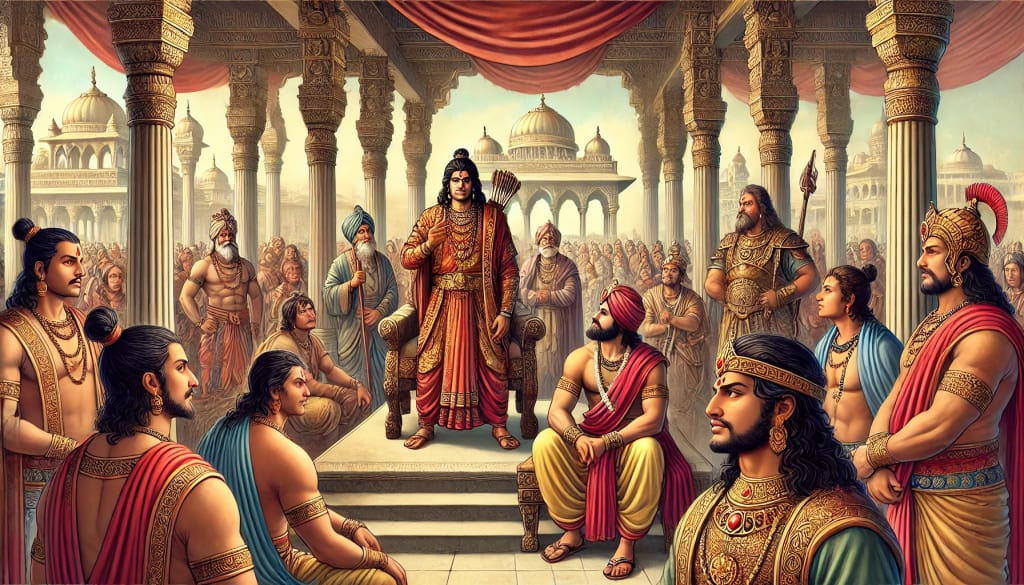
Following their marriage to Draupadi in Panchala, the Pandavas returned to Hastinapura. Their arrival marked a moment of surprise, tension, and reconciliation within the Kuru family, as most had presumed the Pandavas were dead after the incident at the House of Lac. However, with their return, the question of rightful inheritance and power resurfaced, ultimately leading to the division of the kingdom.
The Pandavas’ Surprising Return
When news of the Pandavas’ arrival in Hastinapura reached the palace, the Kuru family was stunned. Many believed they had perished in the fire that destroyed the House of Lac, a tragedy engineered by Duryodhana and Shakuni to eliminate them. Their return with Draupadi, who was now the wife of all five Pandavas, intensified the shock, as it signified not only their survival but also a powerful alliance with King Drupada of Panchala.
King Dhritarashtra, although pleased on the surface, was secretly anxious. He knew that the people of Hastinapura adored the Pandavas, particularly the eldest, Yudhishthira, whom they viewed as the rightful heir to the throne. Dhritarashtra’s love for his sons, the Kauravas, especially Duryodhana, was matched only by his desire to see his lineage on the throne. However, he was aware that denying the Pandavas their due could lead to unrest among the people and influential elders like Bhishma and Vidura.
The Gathering of the Elders
With the Pandavas’ return, an urgent council meeting was convened, attended by the prominent members of the Kuru family and advisors of the court, including Bhishma, Vidura, Dronacharya, and Kripacharya. Dhritarashtra, seated as the king, greeted the Pandavas warmly, expressing his relief at their safe return. However, everyone present knew that the discussion would soon turn to the matter of succession and the rightful claim to the throne.
Vidura, wise and fair, proposed that Yudhishthira be recognized as the rightful crown prince. “O King,” he said, addressing Dhritarashtra, “the Pandavas, by birth and by virtue, have a rightful claim to the throne. Yudhishthira is known for his righteousness and wisdom, and he has the people’s admiration. It is only just that he be considered the crown prince.”
Dhritarashtra, realizing the gravity of the situation, turned to Bhishma, the eldest and most respected member of the Kuru family. Bhishma, too, endorsed Vidura’s view, stating, “Yudhishthira is a born leader. His dedication to dharma and justice makes him deserving of the throne.”
Duryodhana’s Objections and Dhritarashtra’s Dilemma
However, Duryodhana was enraged by the suggestion. He argued that as the son of the reigning king, he was the rightful heir to the throne. Filled with resentment and jealousy, he protested, “The throne of Hastinapura belongs to me. I have ruled in the Pandavas’ absence, and I am the eldest son of the king.” He was supported by his brother Dushasana and his uncle Shakuni, who fueled his ambitions.
Dhritarashtra found himself torn between his love for Duryodhana and his sense of duty to uphold justice. He feared that denying the Pandavas their rightful position would displease the elders and the citizens, potentially leading to conflict. Yet, he was also unable to disregard Duryodhana’s claim, as he wanted to see his own son ascend the throne.
The Proposal of Division
After much deliberation and unable to ignore the merits of both claims, Dhritarashtra proposed a compromise: the kingdom would be divided between the Pandavas and the Kauravas. Yudhishthira would be given a separate kingdom, which he would rule as king, thus satisfying both sides without direct confrontation.
The proposal was met with mixed emotions. The Pandavas, while not entirely pleased, accepted the decision out of respect for Dhritarashtra’s authority and their desire to avoid unnecessary bloodshed. They understood that this division would at least grant them sovereignty and a chance to rule their own domain. Duryodhana, meanwhile, was relieved to retain control over Hastinapura, though he still resented the very idea of sharing the kingdom.
The Pandavas’ New Kingdom: Khandavaprastha
Dhritarashtra then assigned the barren land of Khandavaprastha to the Pandavas as their share of the kingdom. Khandavaprastha was an arid and desolate region, overgrown with wild forests and unfit for habitation. This allocation was intended to appease the Pandavas while ensuring that Duryodhana retained control over Hastinapura, the more prosperous half of the kingdom.
Although disheartened by the state of the land they were given, the Pandavas accepted Khandavaprastha with grace. Yudhishthira, upholding his commitment to dharma, saw this as an opportunity to prove their strength, wisdom, and resilience. He assured his brothers that they would transform Khandavaprastha into a flourishing kingdom, setting a high standard of governance and prosperity.
About the Creator
Keep reading
More stories from sai Charan and writers in History and other communities.
Draupadi’s Marriage to the Five Pandavas: The Story of Destiny and Divine Plan
The Swayamvara and Arjuna’s Victory Following their exile and wanderings, the Pandavas arrived in the kingdom of Panchala, where Draupadi’s swayamvara was held. Disguised as Brahmins, the Pandavas attended the swayamvara, which had drawn many prominent princes and warriors from across Bharatavarsha. The challenge at the swayamvara was set by Draupadi’s father, King Drupada: any suitor had to string a massive bow and hit the eye of a rotating fish target while looking only at its reflection in water.
By sai Charanabout a year ago in History
Can World War III Be Prevented?
Can World War III Be Prevented? The idea of World War III is no longer limited to history books or fictional movies. Rising global tensions, regional wars, arms buildups, and political rivalries have made many people wonder whether another world war is possible—and more importantly, whether it can still be prevented. While the risks are real, global conflict is not inevitable. Prevention depends on choices made by leaders, institutions, and societies today.
By Wings of Time 3 days ago in History
3 Ordinary People Who Survived Situations They Absolutely Shouldn’t Have
History is full of survival stories that make sense. People train, prepare, react quickly, and escape danger through skill or strength. These stories are comforting because they suggest the universe is fair and competence is rewarded.
By Enoch Sagini4 days ago in History


Comments
There are no comments for this story
Be the first to respond and start the conversation.