
Draupadi’s Marriage to the Five Pandavas: The Story of Destiny and Divine Plan
The story of draupadi marriage to five brothers
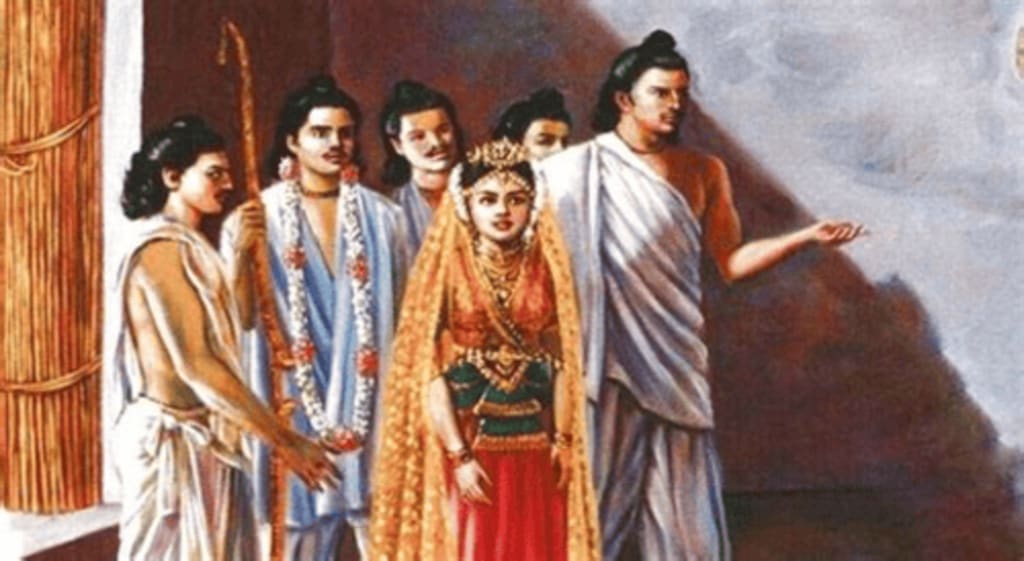
The Swayamvara and Arjuna’s Victory
Following their exile and wanderings, the Pandavas arrived in the kingdom of Panchala, where Draupadi’s swayamvara was held. Disguised as Brahmins, the Pandavas attended the swayamvara, which had drawn many prominent princes and warriors from across Bharatavarsha. The challenge at the swayamvara was set by Draupadi’s father, King Drupada: any suitor had to string a massive bow and hit the eye of a rotating fish target while looking only at its reflection in water.
Warriors from all corners tried and failed, but Arjuna, disguised as a Brahmin, succeeded. Draupadi, captivated by his strength and skill, placed a garland around his neck, accepting him as her husband. The Pandavas then returned to their mother, Kunti, with Draupadi, intending to reveal their true identities to her and seek her blessings.
Kunti’s Unintentional Command
When the Pandavas arrived at their hut, they called out to Kunti, informing her that they had brought back an “alms” (or prize). Kunti, who was inside and did not know what “prize” they had brought, responded without looking, saying, “Whatever you have brought, share it equally among yourselves.” When Kunti came out and saw Draupadi, she was shocked at her words, realizing the implication of what she had said.
The Pandavas, deeply respectful of their mother, felt duty-bound to follow her command, even though it meant a complex marriage arrangement. Kunti, however, was distressed at the idea of Draupadi being married to all five brothers, fearing the societal implications. Nonetheless, the Pandavas and Draupadi decided to seek guidance from Sage Vyasa, who could offer insight into the matter.
Sage Vyasa’s Divine Explanation
When the Pandavas sought Sage Vyasa’s guidance, he explained that this marriage was not a mere accident but was in alignment with a divine plan. Vyasa revealed that Draupadi had, in her past life, performed severe penance to please Lord Shiva and had prayed for a husband who embodied all the qualities she desired. She asked for a husband who was wise, powerful, skilled in archery, strong, and virtuous.
Pleased with her devotion, Shiva appeared before her and granted her wish, saying, “You shall have a husband with each of the qualities you seek.” However, since no single man could possess all the qualities Draupadi desired, Shiva’s blessing manifested as five husbands for her in her next life—the five Pandavas, each representing one of the qualities she had asked for:
Yudhishthira represented wisdom and righteousness.
Bhima symbolized immense strength and courage.
Arjuna was the skilled archer and warrior.
Nakula embodied beauty and charm.
Sahadeva exemplified knowledge and intellect.
Vyasa also explained that Draupadi’s marriage to the five brothers was in line with cosmic order and that it was fated to ensure the fulfillment of her past desires and the purposes of divine justice. He assured Kunti and the Pandavas that this unique union was sanctioned by the gods, and thus, they should accept it.
King Drupada’s Concerns and Draupadi’s Consent
When King Drupada learned of Draupadi’s marriage to all five Pandavas, he was initially shocked and dismayed. The idea was unconventional, and he worried about how it would be perceived. However, Vyasa visited Drupada and assured him that this marriage was part of a divine plan, reassuring him of its righteousness.
Draupadi, too, accepted this destiny. She recognized that her marriage to the five Pandavas was preordained and was necessary for the greater role she was to play. Her commitment to all five Pandavas was one of duty and love, understanding that she was destined to be a companion and queen to each of them.
Establishing the Rule for Shared Marriage
To maintain harmony and respect among the brothers, Sage Vyasa suggested a rule to ensure fairness in their shared marriage. According to the rule, Draupadi would live with each brother for a fixed period, during which that brother would be considered her husband exclusively. None of the other brothers would interfere during this time, maintaining mutual respect and honor among them. This rule established order and prevented jealousy or misunderstanding within the family.
The Marriage Ceremony and Draupadi’s Role as Queen
With all doubts cleared, Draupadi was married to all five Pandavas in a ceremony that honored the divine decree. Draupadi embraced her role as wife to each of the Pandavas, and she quickly became known for her intelligence, fairness, and dedication. Her unique marriage elevated her status, and she assumed a crucial role within the family.
As queen, Draupadi would go on to inspire loyalty and respect among the Pandavas, becoming the unifying force that strengthened their bond. Her life, marked by trials and triumphs, showcased her resilience, intelligence, and commitment to dharma, making her one of the most revered figures in the Mahabharata.
The Role of Destiny
Draupadi’s marriage to the five Pandavas served multiple purposes in the grand scheme of the Mahabharata. Her union with each brother brought them closer together, reinforcing their unity and shared purpose. Draupadi’s unwavering loyalty and strength became a source of inspiration for the Pandavas, helping them face the many challenges that lay ahead.
Ultimately, Draupadi’s marriage to the Pandavas was a manifestation of cosmic justice and divine will. Her presence in their lives added depth to their journey and contributed to the events that would shape the future of the Kuru dynasty, leading to the great battle of Kurukshetra and the restoration of dharma.
About the Creator
Keep reading
More stories from sai Charan and writers in History and other communities.
Arjuna’s Victory and Duel with Karna at Draupadi’s Swayamvara
The Challenge of the Swayamvara King Drupada had prepared a unique test to select a husband for his daughter. The swayamvara arena had a Matsya Yantra, a rotating mechanical fish suspended high above. The challenge was to strike the eye of the fish, but with a catch: the suitor could only aim using the reflection of the fish in a bowl of water below. This test of skill required not only immense concentration but also exceptional marksmanship, skills known to only a few of the finest warriors.
By sai Charanabout a year ago in History
How Case Documents Are Maintained in Philadelphia County
Case documentation forms the backbone of judicial accountability in Philadelphia County. Every filing, order, transcript, and judgment plays a defined role in preserving procedural accuracy and historical reference. The methods used to preserve these materials reflect long-standing legal standards combined with structured administrative practice. This article explains how case documents are created, organized, stored, reviewed, and preserved within Philadelphia County, with a clear focus on factual processes rather than commentary or promotion.
By Owen Perry6 days ago in History
The Deeds of Mullah Nasiruddin
The Deeds of Mullah Nasiruddin (Article No. 1270) Mullah Nasiruddin is a name that almost everyone has heard. His stories are famous across cultures for their humor, wisdom, and clever twists. Although he appeared simple and playful, Mullah Nasiruddin possessed sharp intelligence and deep insight. His actions often carried hidden lessons that made people laugh first and think later. The following incidents from his life highlight his wit, presence of mind, and moral intelligence.
By Sudais Zakwan3 days ago in History
Autonomy Is The Real Privilege
Good morning, freedom-seekers! Today we’re gonna be looking at autonomy. A strange word, I know; one many would probably look at blankly and run away from on sight. We’re gonna figure out what it actually means, consider how it’s achieved, and decipher just how deeply most of us are tangled up in dependence without realising it.
By That ‘Freedom’ Guy5 days ago in Humans



Comments
There are no comments for this story
Be the first to respond and start the conversation.