
The Original Owners of South Africa: Are the Boers Aboriginal South Africans?
Aboriginal South Africans


The Boers, also known as Afrikaners, are one of the white ethnic groups in South Africa and Namibia. They are mainly Dutch immigrants from the 17th to the 19th century, and are formed by the integration of French and German immigrants. They communicate in Afrikaans, which is also referred to as Afrikaans. Naturally, there are some who do. The key point is that the religious convictions of the Boers are predominantly Protestant, with a minority being Catholic. According to statistics in 2022, the total number of Boers is currently about 3.5 to 4 million.
• The Two Boers Wars
Those who know about African history, especially the formation of South Africa, know about the two Boer Wars.
The First Boer War took place from December 16, 1880, until March 6, 1881, and represented a minor conflict between British colonists and the Boers in South Africa. In September 1880, in order to confiscate numerous guns that were paid to black laborers as wages in the Kimberley diamond mine from the indigenous people, "a gun surrender riot" occurred in the British protectorate of Basutoland, which is the small nation of Lesotho situated in South Africa.
Britain engaged the core military troops in Transvaal who headed southward to quell the conflict. The total number of British troops left in Transvaal did not exceed 3,000, and they were only stationed in several important towns such as Pretoria, Rustenburg, Lydenburg, and Standerton, with empty defenses.
• Pursuit for Independence
On December 16 of that year, more than 5,000 Boers who were dissatisfied with British rule gathered in Poldeklar for a national congress, announcing armed resistance to restore the Republic of South Africa, and elected Paul Kruger, Piet Joubert, and Pretorius the Younger, who were highly respected among the Boers, as leaders. The newly formed three-person government then sent the declaration of independence of the Republic of South Africa to the Pretoria garrison.
The British colonists, who had already experienced the convenience of trade at the Cape of Good Hope and the rich products in South Africa, refused to accept it and ordered the garrisons in various places to quickly reinforce Pretoria.
On March 6, 1881, the British and Transvaal armies signed an armistice agreement. On August 3, the two sides signed the Pretoria Agreement, which stipulated that Transvaal would be guaranteed a fully autonomous government under the sovereignty of the British Queen, while Britain would retain three privileges, namely, control over Transvaal's foreign relations; control over Transvaal's relations with African tribes; and the right for the British army to borrow Transvaal during wartime. From October 11, 1899, to May 31, 1902, the second war occurred. The British colonists had a deep conflict with the Transvaal Republic and the Orange Free State established by the Boers. In order to compete for the territory and resources in South Africa, a large-scale war broke out between the two sides.
• South Africa as a Country is Born
The cause of the war was the ultimatum of Paul Kruger, President of the Transvaal Republic, demanding that the British army withdraw from the Transvaal border, but the British government refused. In the autumn of 1899, the British army began to gather on the border between Transvaal and Orange.
In order to prevent the British invasion, the Boers decided to take the initiative and declared war on Britain on October 11, 1899. The Boer militia took the initiative to attack the British army in Southern Africa. In order to conquer the Boers, who had a population of only hundreds of thousands, the war lasted for more than three years. Britain successfully invested more than 400,000 people, and more than 22,000 people were killed.
In the end, under the huge losses brought by the war and the pressure of international public opinion, Britain signed a peace treaty with the Boers and the war ended. This war was not only larger than before, but more importantly, it led to the formation of the Union of South Africa, which is now the birth of South Africa as a country.
• The Real Indigenous People
Although the Boers have a lot to do with South Africa's independence and nation-building, the real indigenous people of South Africa are not them, but the San, Khoi and Bantu. The San represent one of the most ancient indigenous groups in South Africa, with origins tracing back to the Paleolithic Age tens of thousands of years ago.
They possess lighter skin yet are classified within the black ethnic group series, a subspecies of black. In the 4th century AD, the Bantu people migrated to the southernmost part of the African continent. Due to the vast land and sparse population, there was no obvious conflict between the two ethnic groups.
Later, the Khoi separated from a part of the San people.
The Khoi people separated from some San people, with lighter skin and some Mongoloid features. At the end of the 16th century and the beginning of the 17th century, the relationship between the Bantu, Khoi and San people broke down, and half a century of tribal fighting began. In the subsequent contact and conflict with European colonists (mainly Spanish, Dutch, French and British colonists), the Khoi people were also greatly affected - in fact, some were slaughtered by the colonists, and some were bought by the colonists.
• More Immigrants Subsumed in the Country
The Bantu people began to migrate from Central Africa to South Africa around the 10th century AD. They have darker skin, tall and strong bodies, and many people. They are mainly engaged in farming and planting, and are also good at grazing and hunting.
The Bantu people's migration to the south lasted for at least 3,000 years and continued until the 18th century, after the white people colonized Africa.
About the Creator
Keep reading
More stories from Uchenna Cosmas Nwokafor and writers in History and other communities.
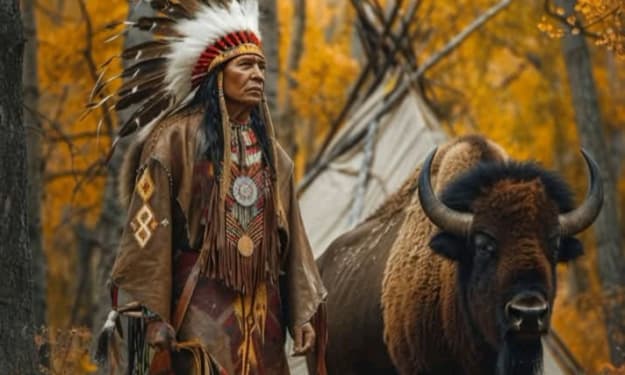
Who are the Aborigines of United States and the North America?
The narrative of the North American continent does not commence with Columbus's discovery of America. An integral and important part of this history are the tribes and peoples who lived here before the arrival of Europeans and long before the emergence of the United States. The relationship between the natives and the representatives of European civilization who settled on the continent was complex, often dramatic, but over time they were humanized.
By Uchenna Cosmas Nwokafor 9 months ago in History



Comments
There are no comments for this story
Be the first to respond and start the conversation.