
The Night the Ocean Broke the Titanic
A tale of human pride, a silent iceberg, and the tragedy that echoed across time

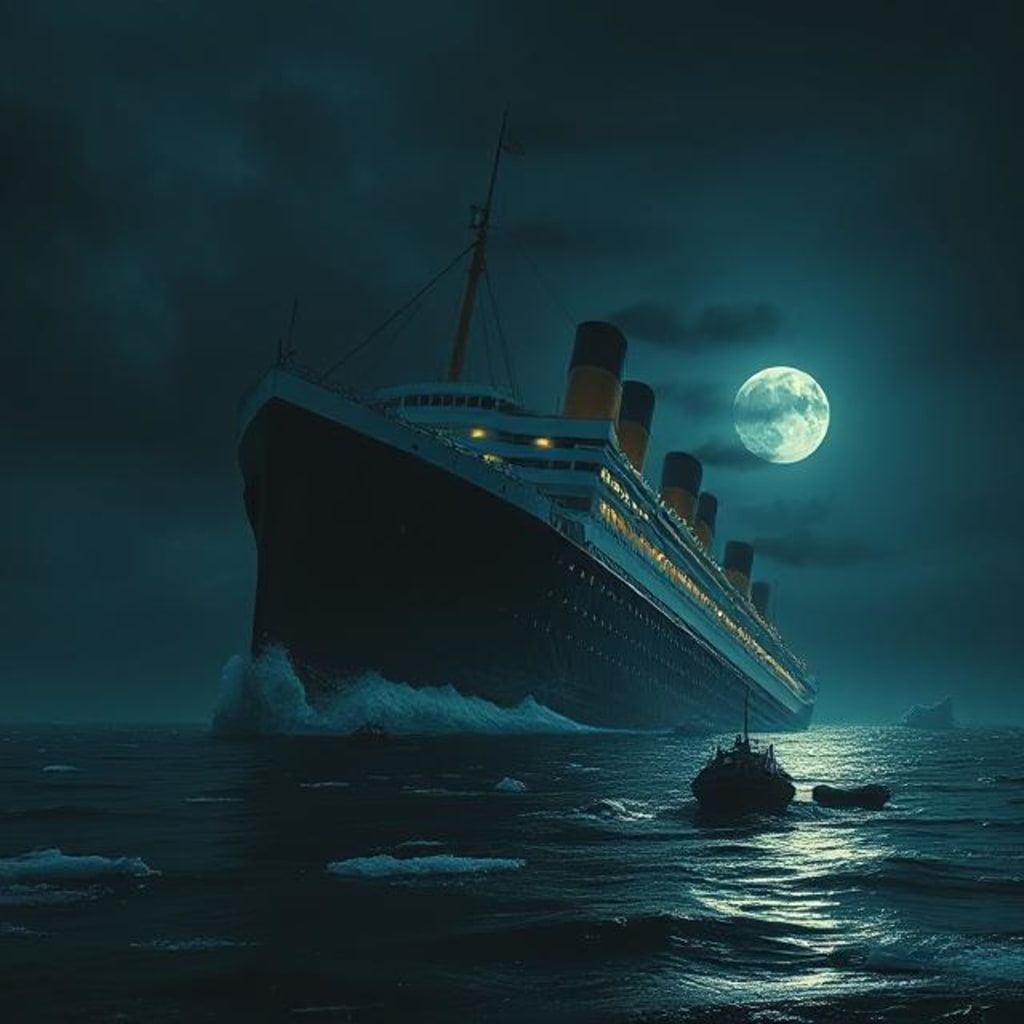
They called her the "Ship of Dreams."
She was more than a marvel of steel and steam—Titanic was a floating city, a palace on the sea, a symbol of man’s triumph over nature. But on a cold April night in 1912, the Atlantic reminded the world that no creation of man is greater than the will of nature.
This is the story of how the Titanic crashed—not just into an iceberg, but into history itself.
---
April 10, 1912 – Southampton, England
From the start, Titanic was born from ambition. At 882 feet long and 46,000 tons, she was the largest moving object ever built by humans at the time. Newspapers hailed her as "unsinkable," thanks to her 16 watertight compartments and cutting-edge technology. First-class passengers like John Jacob Astor and Isidor Straus boarded with pride. Immigrants below deck boarded with hope.
Captain Edward J. Smith, a seasoned mariner, was chosen to lead the maiden voyage—his last before retirement.
On April 10, the Titanic set sail from Southampton to New York with over 2,200 souls aboard.
The world watched in awe.
---
April 14, 1912 – The Ice Warnings Begin
The North Atlantic in April is no friend to ships. Days before the collision, Titanic’s wireless operators received several iceberg warnings from other vessels traveling nearby.
One message from the Mesaba said:
> “Icebergs and field ice in your path. Proceed with caution.”
But the Titanic kept sailing at full speed—over 22 knots.
Why?
Because the owners wanted to break a record. Because passengers wanted to arrive early. Because confidence had turned into arrogance. The warnings were received, but many were not passed to the bridge. The ship sped on through the darkness.
---
11:40 PM – The Iceberg Appears
It was a clear, moonless night. The sea was eerily calm, like glass. Two lookouts, Frederick Fleet and Reginald Lee, stood watch in the crow’s nest, scanning the horizon.
And then, they saw it.
A shadow in the water. A dark mountain where there should have been none.
Fleet rang the warning bell and shouted:
> “Iceberg, right ahead!”
On the bridge, First Officer Murdoch acted instantly—ordering the ship to turn hard to port and engines reversed.
The Titanic veered, but not enough.
At 11:40 PM, the iceberg scraped along the starboard side, tearing open the hull beneath the waterline. The sound wasn’t a crash—it was a long, sickening hiss of steel surrendering to ice.
---
Midnight – The Damage is Revealed
At first, most passengers felt only a slight vibration. A few were curious. Some laughed it off. But in the bowels of the ship, seawater was flooding in at a terrifying rate—over 7 tons per second.
The iceberg had sliced open six watertight compartments.
Titanic was only designed to stay afloat if four compartments flooded. Six meant doom.
The ship was going down.
Thomas Andrews, the ship’s builder, inspected the damage and gave the grim verdict: “She will sink. It is a mathematical certainty.”
They had about two hours.
---
12:30 AM – Lifeboats and Panic
Titanic had lifeboats for only about 1,200 people—far fewer than needed for over 2,200 aboard. Why? Because regulations at the time were outdated. The ship looked safe, so they didn’t think lifeboats were essential for all.
As the crew began loading boats, chaos unfolded.
Many didn’t believe the ship could sink. Some refused to leave. Others fought to get aboard.
“Women and children first,” the officers cried.
Lifeboats were launched half-full in the confusion. Boat after boat lowered into the icy blackness—some with only 30 people aboard when they could hold 65.
Below deck, third-class passengers were trapped behind locked gates. Many never made it to the boats.
---
2:00 AM – The Final Moments
The Titanic’s bow had now fully dipped underwater. The stern rose high into the air. People clung to the rails, praying, screaming, jumping into the 28°F (-2°C) water below.
The lights flickered.
The band played on, trying to calm passengers. Their final song? “Nearer, My God, to Thee.”
Captain Smith went down with his ship.
Thomas Andrews removed his life vest, choosing to help others instead of saving himself.
At 2:18 AM, the ship split in two.
One final groan, one last cry of twisted metal—and then silence.
At 2:20 AM, the Titanic vanished beneath the Atlantic.
---
Aftermath – 1,500 Lives Lost
Only 705 people survived.
Most who entered the water died within minutes from cold shock and hypothermia. The RMS Carpathia arrived around 4 AM and rescued those in lifeboats. But the sea had already taken most of its victims.
Among the dead were millionaires, immigrants, mothers, fathers, children, crewmen, and heroes.
The Titanic’s sinking shocked the world.
It wasn’t just a ship that sank—it was a belief. A belief that humans had conquered nature. That size and wealth meant safety. That warnings could be ignored.
---
Today – A Wreck, A Warning
The remains of Titanic now rest over 12,000 feet below the surface. Rusted, broken, silent. But her story speaks louder than ever.
She wasn’t just a tragedy.
She was a warning.
A reminder that no dream is unsinkable. That pride has a price. That a single iceberg, silent and cold, can rewrite history.
Over a century later, people still remember that night. They write books, make films, tell stories.
And we should.
Because the Titanic didn’t just crash into an iceberg.
It crashed into the heart of human arrogance.
And it left behind a legacy carved into ice, steel, and sorrow.
__
📣 Dear Readers,
If this story touched your heart, gave you goosebumps, or taught you something new about the Titanic — don’t forget to:
👍 Like this story
💬 Comment your thoughts — Would you have acted differently if you were on the Titanic that night?
🔁 Share it with your friends who love history, mystery, or epic true stories
🔔 Subscribe to my profile for more powerful and emotional stories like this every week!
---
About the Creator
Muhammad Riaz
- Writer. Thinker. Storyteller. I’m Muhammad Riaz, sharing honest stories that inspire, reflect, and connect. Writing about life, society, and ideas that matter. Let’s grow through words.
Keep reading
More stories from Muhammad Riaz and writers in History and other communities.
Charlie Chaplin: The Tramp Who Taught the World to Laugh
Start writing... Charlie Chaplin was more than a man in a bowler hat and crooked mustache; he was a symbol of resilience, hope, and the enduring power of laughter. In an age before sound transformed cinema, Chaplin had the rare gift of making audiences laugh, cry, and connect deeply without uttering a single word. His genius lay not just in comedy, but in his ability to touch hearts across the globe.
By Muhammad Riaz5 months ago in History
3 Completely Normal Jobs With Disturbing Hidden Histories
Every job has a backstory. Some are boring, some are inspiring, and some are better left buried. While modern versions of certain professions look harmless—sometimes even respectable—their origins tell a much darker story.
By Enoch Sagini2 days ago in History
Albert Einstein: The Mind That Changed the Universe
Albert Einstein was not born a legend. When he entered the world on March 14, 1879, in the quiet German city of Ulm, nothing about his early life suggested that he would one day transform science forever. In fact, his beginnings were remarkably ordinary—and in some ways, difficult. As a child, Einstein spoke slowly, so slowly that his parents worried something might be wrong. Teachers considered him distracted and stubborn, a boy who questioned too much and obeyed too little. Yet hidden beneath that quiet exterior was a restless, powerful curiosity that would later reshape the universe itself.
By The best writer a day ago in History
Wild Card Weekend Recap: What Happens Now?
I think I figured out why I love Wild Card Weekend so much. It's because it's the first playoff anything of the calendar year. The NFL season starts in the fall, and once upon a time, the champion was crowned either on or slightly before New Year's. The evolution of the NFL schedule has resulted in the playoffs starting just into the New Year, and currently, the final week of the season falls on the first weekend of the New Year, with Wild Card Weekend coming a week after that. So yes, chronologically, the NFL's Wild Card Weekend serves as the first playoff anything of the calendar year.
By Clyde E. Dawkins4 days ago in Unbalanced



Comments (1)
Please give me support read my story i am very poor 🥹🙏