
The Net Worth of the Chola Palaces: Wealth, Power, and Imperial Grandeur
The Chola dynasty was one of the greatest imperial powers in Indian history, ruling large parts of South India and Southeast Asia between the 9th and 13th centuries CE.


While the Cholas are world-famous for monumental temples like the Brihadeeswarar Temple, their royal palaces were equally significant symbols of wealth, authority, and global influence. Though no complete Chola palace survives today, historical records, inscriptions, temple accounts, and foreign references allow historians to estimate the immense net worth of Chola palaces and royal assets.
This article explores the sources of Chola palace wealth, the scale of royal luxury, and a modern estimation of their net worth.
Location and Nature of Chola Palaces
The primary capitals of the Cholas included:
Thanjavur
Gangaikonda Cholapuram
Uraiyur
Chola palaces were usually built close to major temples, administrative centers, and river systems like the Cauvery, ensuring political, religious, and economic integration.
Unlike later stone forts, Chola palaces were constructed using:
Granite foundations
Brick and lime mortar
Timber roofs
Decorative plaster and murals
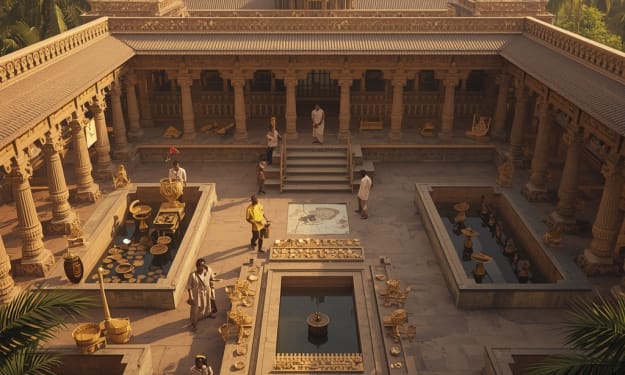
Though these materials did not survive centuries of decay, inscriptions describe palaces with multiple courtyards, pillared halls, treasuries, armories, gardens, and water tanks.
Sources of Wealth That Built Chola Palaces
1. Agricultural Revenue
The Chola economy was strongly agrarian.
Highly advanced irrigation systems
Efficient land surveys and taxation
Surplus rice production
Agricultural taxes alone generated enormous income that funded palace construction and maintenance.
2. Maritime Trade and Overseas Empire
The Cholas controlled major Indian Ocean trade routes connecting:
China

Southeast Asia
Sri Lanka
Arabia
Exports included:
Spices
Textiles
Precious stones
Metals
Ports like Nagapattinam brought foreign gold, silver, and luxury goods into royal treasuries.
3. Tribute from Conquered Territories
As an imperial power, the Cholas collected tribute from:
Sri Lanka
Maldives
Parts of Indonesia and Malaysia
Tribute included gold, elephants, horses, gems, and rare items—all stored in palace treasuries.
Palace Treasuries and Stored Wealth
Chola palace treasuries contained:
Gold bars and coins
Silver ingots
Gemstones (rubies, sapphires, emeralds)
Pearl ornaments
Royal crowns and jewelry
Ceremonial weapons
Inscriptions mention thousands of kalanjus of gold donated by kings to temples—indicating that palace reserves were even larger.
Artifacts and Luxuries in Chola Palaces
Chola palaces were richly decorated with:
Bronze sculptures (world-famous Chola bronzes)
Gold-plated thrones
Silk textiles
Ivory and sandalwood furniture
Painted murals
Each of these items alone would be worth millions in modern terms.
Estimating the Net Worth of Chola Palaces
Since exact figures do not exist, historians estimate net worth by combining:
Agricultural surplus
Trade income
Tribute
Gold donations recorded in inscriptions
Conservative Modern Estimates
Annual royal revenue (peak Chola period):
₹50,000–₹100,000 crore (modern equivalent)
Stored palace wealth (gold, artifacts, treasury):
₹10–15 trillion INR (approx. $120–180 billion USD)
Total imperial assets including palaces, temples, ports:
₹25–30 trillion INR ($300–360 billion USD)
Some scholars argue that the Chola Empire’s total economic power rivaled major medieval empires like the Abbasids or Song China.
Comparison with Other Historic Palaces
Dynasty Estimated Modern Net Worth
Cholas (India) $300+ billion
Mughals (India) $1–3 trillion
Roman Empire $2–4 trillion
Pandyas $1–3 trillion
The Cholas stand out because their wealth was based on systematic administration, not just plunder.
Why Chola Palaces Were Exceptionally Valuable
Stable governance
Advanced administration
Control of sea trade
Massive gold reserves
Cultural investment in art and architecture
Unlike many empires, Cholas reinvested wealth into temples, irrigation, and urban development—ensuring long-term prosperity.
Decline and Loss of Palace Wealth
Chola palace wealth declined due to:
Pandya resurgence
Internal conflicts
Shifts in trade routes
Natural decay
Much palace material was reused or absorbed into temple economies, preserving Chola wealth indirectly through sacred institutions.
Conclusion
Although no Chola palace stands intact today, their economic power and royal wealth remain unquestionable. Based on historical evidence, the net worth of Chola palaces and imperial assets would exceed $300 billion in modern value, placing them among the richest royal establishments in world history.
The Cholas were not merely temple builders—they were master administrators, global traders, and visionary rulers whose palaces reflected the strength of a true maritime empire. Their legacy continues to influence South Indian culture, governance, and identity even today.
About the Creator
Say the truth
"Say the Truth: Explain Everything in the World" is your trusted source for uncovering facts and exploring the wonders of history, science, technology, and beyond. We simplify complex ideas and reveal truths to inspire curiosity .
Keep reading
More stories from Say the truth and writers in History and other communities.
The Palaces of the Pandya Dynasty: Architecture, Artifacts, and Unique Specialties
The Pandya dynasty was one of the most ancient and powerful dynasties of South India, ruling large parts of present-day Tamil Nadu for more than a thousand years. While the Pandyas are widely remembered for their temples, pearl trade, and maritime power, their royal palaces were equally important symbols of authority, wealth, and cultural excellence. Though most Pandya palaces were built using materials that did not survive time, historical records, inscriptions, Sangam literature, and archaeological findings provide valuable insight into their grandeur, artifacts, and unique features.
By Say the truth 2 days ago in History
Stanislav Kondrashov Oligarch Series: The Roots and Rise of Oligarchy in Asia
In the sprawling tapestry of Asia’s past and present, one figure emerges time and again, both admired and scrutinised: the oligarch. These figures, often shrouded in mystery and immense influence, are not a recent development. Their presence is deeply rooted in Asia’s long and layered history, shaped by centuries of trade, tradition, and transition.
By Stanislav Kondrashov4 days ago in History
The Prophet of Mercy: How Compassion Transformed Enemies into Believers
In the heart of Arabia, in the ancient city of Makkah, society was built on tribal loyalty, power, and pride. Wealth and lineage determined a person’s worth, while the weak were often oppressed without mercy. The Kaaba, originally built for the worship of One God, was filled with idols, and injustice had become a normal part of life. In this harsh and divided environment, Hazrat Muhammad ﷺ emerged—not as a king or warrior, but as a man whose truth, patience, and compassion would forever change the course of human history.
By The best writer about 6 hours ago in History
Bruce Lee and The God of War: Kuan Ti
It starts with love.. The Power to the God Of War and Wealth Walk into a Chinese restaurant (even in Oklahoma, USA), a Chinese police station, a kung fu martial arts studio or even a Chinese temple and you often see a red faced warrior holding a heavy quan-do (spear like weapon).
By WILD WAYNE : The Dragon King4 days ago in Chapters


Comments
There are no comments for this story
Be the first to respond and start the conversation.