
The Necklace That Partition Tore Apart
A simple piece of jewelry became a silent witness to love, loss, and the painful separation caused by the 1947 Partition of India and Pakistan.

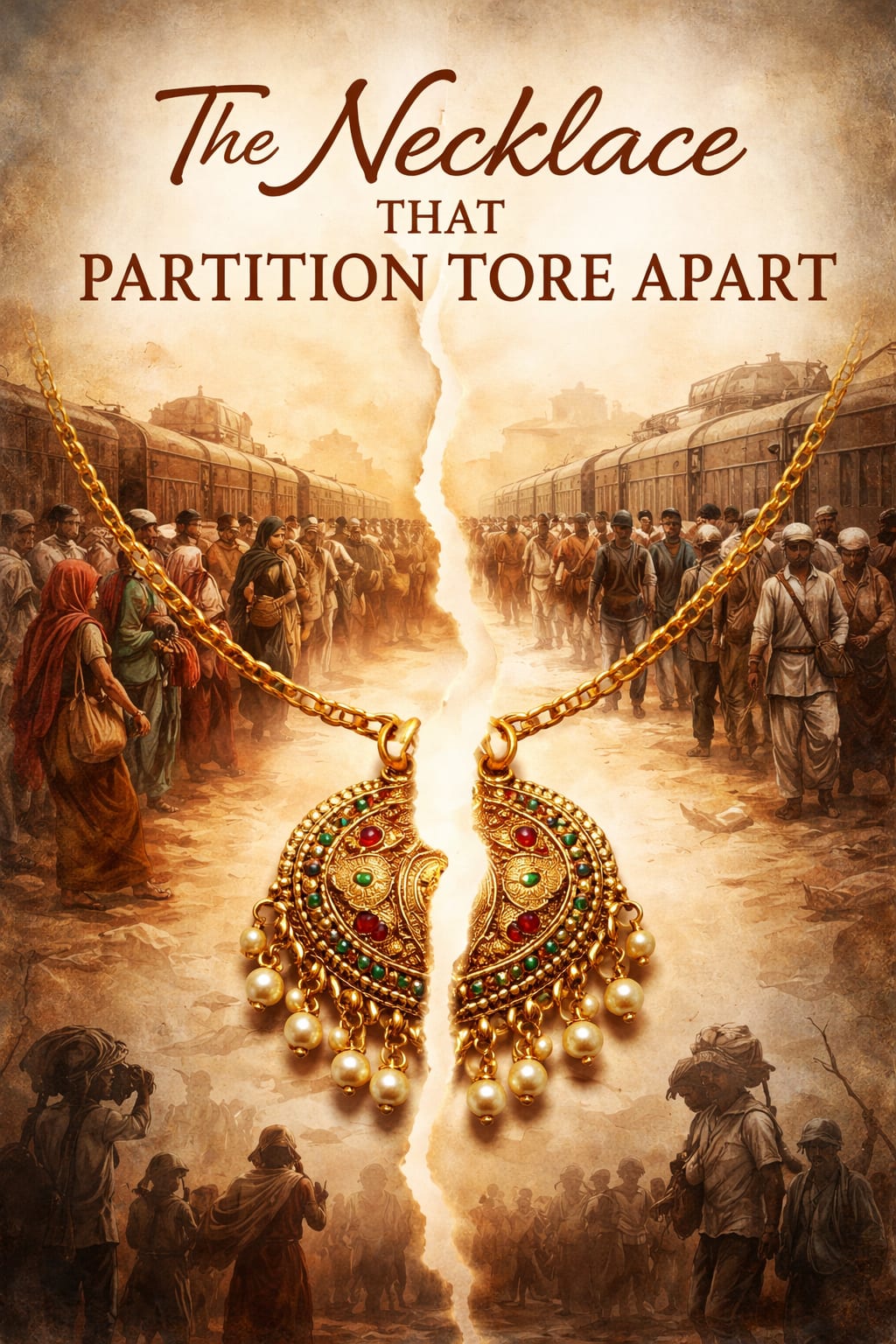
History often records wars, political decisions, and the actions of powerful leaders. Yet behind these grand narratives lie deeply personal stories—stories of ordinary people whose lives were forever changed by historic events. One such story is that of a simple necklace, a small but powerful symbol of love and separation during the tragic division of the Indian subcontinent in 1947.
The Partition of India was one of the most dramatic and painful events in modern history. When the British decided to end their rule over the subcontinent, the land was divided into two independent nations: India and Pakistan. The decision, announced in August 1947, triggered one of the largest migrations in human history. Nearly 14 million people were forced to leave their homes and move across newly drawn borders based on religious identity.
Amid the chaos and violence, countless families were torn apart. Many fled with only the clothes they were wearing, leaving behind homes, memories, and precious belongings. Among the many objects lost during this mass migration was a delicate gold necklace that belonged to a young woman named Asha.
Before Partition, Asha lived with her family in the historic city of Lahore, which later became part of Pakistan. Lahore was a vibrant cultural center where Muslims, Hindus, and Sikhs had lived together for generations. Communities were closely connected, and relationships often crossed religious and cultural lines.
Asha had received the necklace as a gift from her mother on the day of her engagement. It was not extremely valuable in monetary terms, but it held deep emotional significance. The necklace represented family tradition, blessings, and the hope of a happy future.
However, the events of 1947 shattered those hopes.
As communal violence spread across cities and villages, Asha’s family realized they could no longer remain in Lahore. Like millions of others, they were forced to flee toward India for safety. The journey was dangerous and uncertain. Trains packed with refugees crossed the border daily, many of them carrying stories of tragedy.
During the frantic escape, Asha accidentally left the necklace behind in their home. In the panic of departure, there was no time to return. Her family locked the door and left everything else behind—furniture, photographs, and the small wooden box where the necklace was kept.
For years afterward, Asha often spoke about the necklace. To others, it might have seemed like just another lost possession, but to her it symbolized an entire life that had vanished overnight. The home in Lahore, her childhood memories, and the sense of belonging she once had were all tied to that small piece of jewelry.
Meanwhile, in Lahore, the abandoned house was later occupied by a Muslim family who had migrated from India during the same turmoil. One day, while cleaning the house, they discovered the wooden box containing the necklace. Like many refugee families, they too had lost everything during their own journey.
The new occupants kept the necklace safely for years. Though they did not know the original owner, they understood that the object must have carried great emotional meaning for someone.
Decades later, as relations between India and Pakistan slowly improved, stories of lost belongings and separated families began to surface. Researchers and journalists started documenting personal memories of Partition, collecting items and stories that had survived the passage of time.
During one such effort, the story of the necklace came to light. Through historical records and old neighborhood accounts, it was eventually linked back to Asha’s family, who had settled in the Indian city of Delhi after Partition.
In a remarkable act of goodwill, the family in Lahore decided to return the necklace. After nearly seventy years, the small piece of jewelry crossed the border that had once separated millions of lives.
When Asha—by then an elderly woman—finally held the necklace again, it was not just an object that returned. It was a piece of her past, a fragment of a world that had been lost in the violence and upheaval of 1947.
The story of this necklace serves as a reminder that history is not only about borders and politics. It is also about human emotions—love, memory, and the enduring connections that survive even the deepest divisions.
Today, the necklace stands as a symbol of reconciliation and shared history between India and Pakistan. It reminds us that while borders may divide nations, the memories and humanity of the people who lived through those times continue to connect them.
In the end, the necklace is more than jewelry. It is a silent witness to one of the most painful chapters in South Asian history—and a small but powerful symbol of hope that even the deepest wounds of the past can one day begin to heal.
About the Creator
Irshad Abbasi
Ali ibn Abi Talib (RA) said 📚
“Knowledge is better than wealth, because knowledge protects you, while you have to protect wealth.
Keep reading
More stories from Irshad Abbasi and writers in History and other communities.
The Monk Who Never Saw a Woman: The Extraordinary Life of Mihailo Tolotos
History is filled with remarkable stories of people who lived unusual lives, but few are as extraordinary as the story of Mihailo Tolotos. According to a widely shared historical account, Tolotos was a Greek monk who lived from 1856 to 1938 and reportedly never saw a woman during his entire lifetime. His story has fascinated historians, journalists, and readers for decades because it represents an extreme example of religious devotion and isolation.
By Irshad Abbasi 2 days ago in History
India’s Biggest Bank Fraud: Vijay Mallya
An Indian man who was once called the “King of Good Times” in his era lived a life like a king. He would throw parties worth millions of rupees in a single night. While billionaires around the world owned private jets, he even had his own Boeing 727.
By Imran Ali Shahabout 14 hours ago in History


Comments
There are no comments for this story
Be the first to respond and start the conversation.