
The Mystery of Supermassive Black Holes
Could Dark Stars Be the Missing Link?

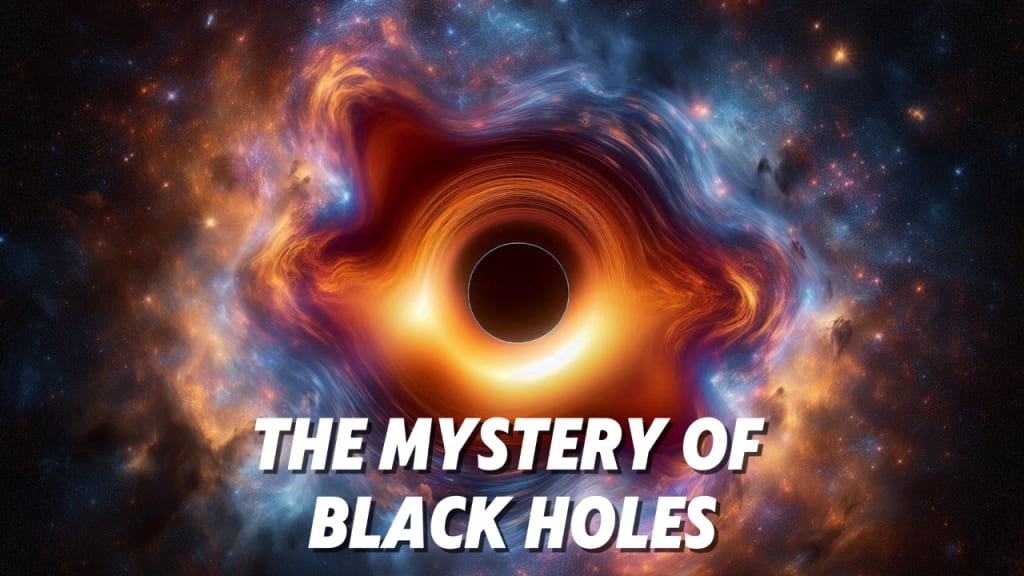
For centuries, black holes have fascinated scientists and space enthusiasts alike, but even among these cosmic marvels, supermassive black holes stand apart. Their origins remain one of the most intriguing mysteries in astrophysics. Despite their vital role in the formation of galaxies and, by extension, life as we know it, scientists still can't say for certain how these cosmic titans came to be.
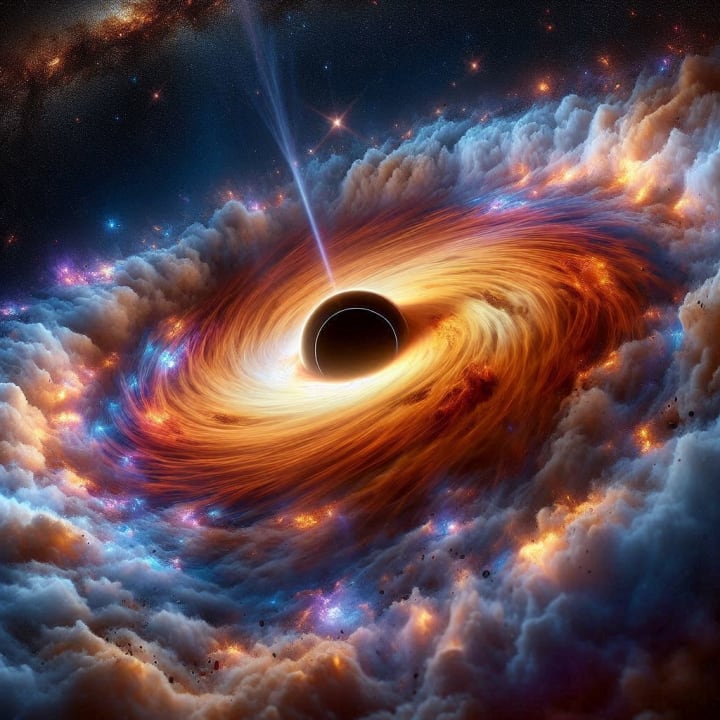
Let’s start with what we do know. Nearly every galaxy we’ve observed has a supermassive black hole sitting at its core. These black holes exert an unfathomable gravitational pull, which quite literally holds galaxies together. For some perspective, a typical black hole is 10 to 20 times the mass of our Sun. A supermassive black hole? Well, it can be millions or even billions of times that mass, yet it’s only about 177 times the diameter of our Sun. Imagine packing billions of Suns into a space not much bigger than Amber Heard’s dog (okay, maybe a bit bigger).
The Creation Conundrum
Despite their significance, how supermassive black holes formed remains a mystery. Given their sheer mass, the energy required to create such an object would have to be tremendous, but no known force seems capable of such a feat—at least, none that we’ve discovered so far.
More than 10 billion years ago, when the universe was still young and gas clouds of hydrogen and helium were common, these clouds typically collapsed to form stars. However, some scientists theorize that under the right conditions, these gas clouds could have bypassed star formation entirely, leading straight to the formation of a supermassive black hole. The challenge? As gas clouds collapse, they cool rapidly, which usually causes them to fragment into stars. To form a black hole, the collapse would need to happen so quickly that it skips this cooling and fragmenting process. Easy, right?
Primordial Black Holes: The Exotic Theory
A more out-there idea involves primordial black holes, which might have formed directly from density fluctuations in the early universe—just fractions of a second after the Big Bang. These could have later merged to form supermassive black holes, but finding evidence for primordial black holes has proven more elusive than finding your keys when you’re late for work. So while the theory is intriguing, it's far from proven science.
Enter Dark Matter: The Mysterious Suspect
Now, here’s where things get even more interesting. What if the secret to supermassive black holes lies not in regular matter but in something much more mysterious? Dark matter. For every speck of visible matter you can see in the universe, there’s an estimated six times more dark matter lurking in the shadows. To break it down, baryonic matter (the regular stuff you, me, and the stars are made of) makes up just 5% of the universe. Meanwhile, dark matter is thought to comprise 27%, with the remaining 68% consisting of dark energy (another puzzle for another time).
The thing about dark matter? We know it exists, yet we have no idea what it is. It doesn’t interact with regular matter—except gravitationally—but it’s there, and its presence has been indirectly proven time and again. And here’s the kicker: Dark matter might hold the key to unlocking the mystery of supermassive black holes.
Dark Matter and WIMPs: Could Dark Stars Be the Key?
Some scientists propose that dark matter could be made up of WIMPs—that stands for "Weakly Interacting Massive Particles." Unlike regular matter, WIMPs don’t interact with ordinary stuff but do interact with each other. When two WIMPs collide, they annihilate one another in a burst of energy. Think of it as the dark matter version of a laser tag match gone wrong.
Now, while regular stars—like our Sun—sustain themselves through nuclear fusion, what if in a “shadow universe,” a different kind of star is powered by the annihilation of dark matter particles? Introducing the idea of the dark star. Instead of burning hydrogen like ordinary stars, dark stars might burn dark matter, producing energy not through fusion, but by WIMP annihilation.
The Dark Star Theory
So, could dark stars be the missing link in the formation of supermassive black holes? Some scientists think so. Picture this: in the early universe, dark stars filled the cosmos, their massive sizes (some potentially as wide as our entire solar system!) held together not by nuclear fusion but by the destruction of dark matter. These dark stars could have collapsed under their own gravity, forming the supermassive black holes we see today.
While this theory is still speculative, it’s one of the most compelling explanations for how these enormous black holes might have formed. Regular stars can’t produce supermassive black holes because they rely on fusion, which limits their size. But dark stars, powered by WIMP annihilation, could have reached colossal sizes without those same limitations.
The Search for Dark Stars: Could JWST Have Found One?
We've Just Found a New Type of Star and It's Terrifying. You'll definitely enjoy this!
Until recently, dark stars were purely theoretical. But that may be changing, thanks to the James Webb Space Telescope (JWST). Launched in 2021, the JWST has allowed scientists to peer back in time—almost to the beginning of the universe itself. Using its infrared sensors, the JWST captured images of incredibly bright galaxies dating back to just a few hundred million years after the Big Bang.
Astrophysicists had long believed that galaxies that bright couldn’t exist until at least a billion years after the universe’s birth, yet here they are, shining away. But what if these aren’t galaxies at all? Katherine Freese, a theoretical astrophysicist, suggested that what we’re seeing may not be galaxies, but dark stars—the first ever captured by a telescope.
These objects, roughly a million times the mass of our Sun, defy conventional understanding of early galaxy formation. They could be the elusive dark stars scientists have long theorized about, burning away with the energy of dark matter annihilation rather than nuclear fusion.
But Can We See Dark Stars?
You might be wondering: if dark stars are made of dark matter, how can we see them? It turns out that dark matter annihilation still produces light, just like fusion does in regular stars. In fact, it might produce even more light, which means these ancient dark stars could have outshone entire galaxies. That’s how their light, born billions of years ago, could have traveled across space and time to reach the JWST’s golden, sexy lens (yes, the JWST is gold-plated and quite the looker in the world of space telescopes).
Are Dark Stars Still Out There?
If dark stars existed in the early universe, are there any still around today? Some scientists think so. In fact, there’s a spot in our very own galaxy, the S star cluster, that might be home to new dark stars. Located near the supermassive black hole at the center of the Milky Way, this cluster of unusually young stars (most only a few million years old) is located in a region with an exceptionally high density of dark matter. Could this be a modern breeding ground for dark stars?
Wrapping It Up: The Enigmatic Universe
The idea that dark stars could be the engines behind the creation of supermassive black holes challenges everything we thought we knew about the universe. It suggests a cosmos more dynamic, mysterious, and interconnected than we ever imagined. While dark stars remain unproven, they open a fascinating doorway into the unknown, hinting at shadowy objects that may have played a much larger role in the formation of the universe than we ever realized.
And who knows? With more discoveries from the James Webb Space Telescope, we may one day confirm the existence of dark stars—and finally solve the mystery of how supermassive black holes came to be.
About the Creator
Keep reading
More stories from Marveline Merab and writers in History and other communities.
Why Did Hitler's Right-Hand Man Make a Secret Trip to Britain? The Curious Case of Rudolf Hess
On August 17, 1987, a frail 93-year-old man stood in his summer house, unplugging a lamp from the table. With trembling hands, twisted by arthritis, he wrapped the extension cord around the latch of a nearby window. He carefully made a loop at the other end of the cord, placed it around his neck, and let his body fall slowly to the floor. Within minutes, the noose tightened, and his life slipped away.
By Marveline Merababout a year ago in History
Can the United States Leave NATO?
Can the United States Leave NATO? What It Would Take—and What It Would Mean The North Atlantic Treaty Organization, commonly known as NATO, has been one of the most powerful military alliances in modern history. Since its creation in 1949, the United States has been NATO’s strongest member—militarily, financially, and politically. But in recent years, debates have grown louder about whether the U.S. should remain in the alliance. This raises a serious question: how could the United States be removed from NATO—or leave it—and what would that mean for the world?
By Wings of Time 6 days ago in History



Comments
There are no comments for this story
Be the first to respond and start the conversation.