
The Mystery of Ancient Egyptian Boats Unearthed in the Desert: A 5,000-Year-Old Archaeological Marvel
Archaeologists discovered a 5,000-year-old fleet of 14 boats buried in the desert near Abydos, Egypt. These ancient vessels, predating the pyramids, offer new insights into shipbuilding and the pharaohs' afterlife rituals in ancient Egypt.
What is a Boat Doing in the Middle of a Desert?
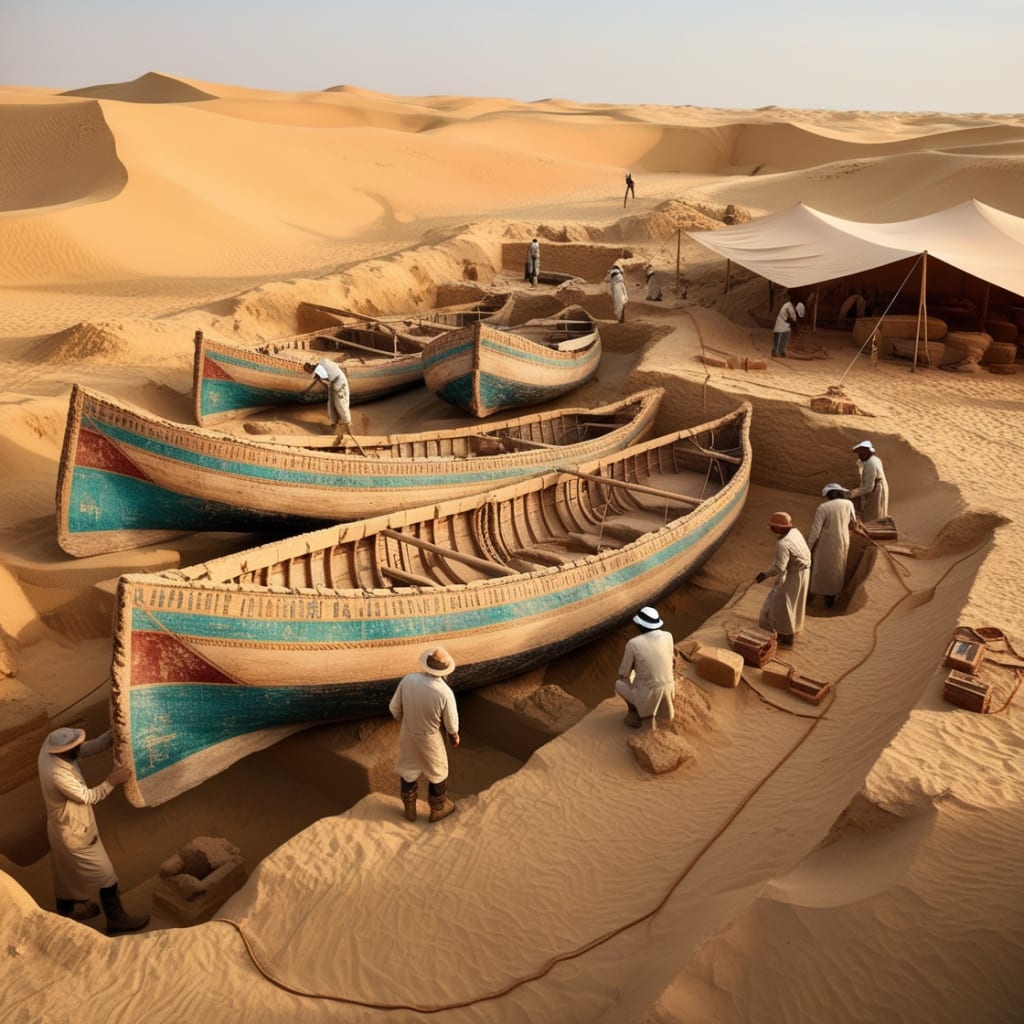
You would expect to find a seagoing vessel closer to shore. This is the question archaeologists had been asking for decades. In 1988, a storm hit near one of the most important archaeological sites in ancient Egypt. A wooden structure emerged from the sand, hollowed out by termites. Scientists were determined to solve its mystery. In 2000, they began excavating the site near Abydos. An American team of experts soon discovered a boat that was 70 feet long, but it wasn’t alone.
In total, 14 boats were neatly resting next to each other. It was impossible to fully excavate the vessels due to their poor condition, but the wood was preserved enough to get samples. Analyses revealed that the boats were around 5,000 years old—making them the oldest fleet in human history to date. Their construction predates the pyramids at Giza by half a millennium. Each ship rested in a vault that matched its dimensions, about a third of the size of a tennis court. The walls of these rooms, made of mudbrick, featured over 120 drawings of boats, etched into the whitewashed surfaces.
Archaeologists had been aware of these mysterious chambers for over a century. In 1901–1902, British archaeologist Arthur Weigall stumbled upon a strange structure west of the Nile. His team caught a glimpse of the interior walls, but a roof collapse ended the exploration prematurely. The site was abandoned, but its location remained on maps, awaiting rediscovery.
At first, the positioning of the boats led scientists to believe they once rested on the bank of the Nile. However, modern studies revealed a problem: the Nile currently flows almost seven miles west of Abydos, and further analysis indicated the river had not shifted its course over millennia. Moreover, if the boats had been docked near water, their positions would have been unstable. Instead, the vessels were perfectly parallel, placed deliberately and systematically. This required an extraordinary amount of effort.
Each boat had enough space for up to 30 rowers, and these were not mere models—they were fully functional ships. While scholars still debate whether they ever sailed any body of water, the significance of the discovery is undeniable. Before this find, archaeologists had only unearthed small-scale models in tombs, like the 35 boat figurines found in King Tutankhamun's tomb. The design of the Abydos boats confirmed they were authentic vessels and represent the earliest surviving examples of "built boats."
Ancient shipbuilders previously crafted vessels by hollowing out tree trunks or binding reeds to form rafts. The Abydos boats, however, had planks tied together—a significant breakthrough in shipbuilding technology. At the time of their construction, timber was a rare and valuable resource, especially in the desert. Cedar, the wood used for these boats, had to be imported from Lebanon. The only figure who could afford such an extravagant luxury was the pharaoh.
Excavations around the site provided more clues. Archaeologists discovered a nearby mudbrick structure where ancient Egyptians worshiped the pharaoh, dating back to the same period as the wooden boats. The same mudbrick material was used to encase the fleet in chambers, each of which originally had a ceiling, much like mummies were entombed in coffins.
The outer walls of the vaults were coated in a plaster of white limestone, designed to reflect sunlight. In its heyday, the structure housing the boats must have gleamed like a beacon in the desert sun. This technique—using fine white limestone to create smooth, gleaming surfaces—was later used to cover the pyramids, whose polished exteriors once shone in the sunlight, though they are now jagged with age.
The final question for archaeologists was to determine which pharaoh owned this magnificent fleet. The answer lay just a mile from the site—at the tomb of King Senusret III of the Fifth Dynasty. The style and construction of the tomb closely matched the chambers containing the boats.
It is likely that at the end of King Senusret III’s reign, his body was transported in a grand procession down the Nile to Abydos. Decorated boats ferried the pharaoh to his final resting place. Afterward, these vessels were lowered into chambers near the tomb, ensuring they would accompany the king into the afterlife.
The symbolic meaning of these ships goes deeper than mere transportation. In the ancient Egyptian belief system, boats held a profound role. Their supreme deity, Ra, traveled through the sky during the day in the form of the sun. At night, he sailed through the underworld in a solar boat. Pharaohs identified with Ra and believed they needed boats in the afterlife to regenerate themselves, much like the sun rising each morning. This belief persisted for thousands of years.
Other notable boat discoveries in Egypt include Pharaoh Khufu’s ship, unearthed in 1954 next to his pyramid at Giza. Khufu’s ship, four centuries younger than the fleet at Abydos, was almost twice as long, further demonstrating the importance of boats in royal burial rites.
While the Great Pyramid of Giza and King Tutankhamun’s tomb are among the most famous archaeological finds, the sands of the Sahara Desert continue to conceal countless mysteries. In 2020, archaeologists discovered a 3,000-year-old lost city near the Valley of the Kings, which they called Aten. This settlement has been hailed as the most significant find since King Tut’s tomb, and researchers hope it will offer unparalleled insights into the everyday lives of ancient Egyptians.
As scholars delve deeper into the hidden layers of Egypt's past, they continue to uncover remarkable artifacts. In 1911, scientists discovered iron beads in Lower Egypt that date back over 5,000 years. The beads, which are made from meteoric iron, were shaped by ancient artisans who lacked knowledge of their extraterrestrial origins, yet their craftsmanship remains awe-inspiring.
Even the Great Pyramid of Giza has yet to yield all its secrets. Recent research shows that the structure has the unique ability to concentrate electromagnetic energy inside its chambers, a discovery that could have modern technological applications.
These findings are a testament to the ingenuity and ambition of ancient Egyptians. With every discovery, archaeologists inch closer to understanding the complex world of a civilization that, thousands of years later, continues to captiva
About the Creator
Keep reading
More stories from SUMI AKTER and writers in History and other communities.
"Into the Unknown: The Epic Quest for the North Pole"
This place has no time zone, no land mass, and the sun rises and sets here just once a year. For over 400 years, since the era of King Henry VII, thousands of explorers from all over the world have tried to reach this elusive spot: the North Pole. Some hoped to find a Northwest or Northeast passage to China and the Indies, while others just wanted to see what it was like. In 1773, the British Royal Navy organized the first scientific expedition to the North Pole, with Constantine Phipps volunteering to lead the mission. His expedition faced formidable challenges, as the two ships struggled to navigate through thick, treacherous ice.
By SUMI AKTERabout a year ago in History
Savoy Hotel – Mussoorie: The Colonial Luxury Hotel Where an Unsolved Murder Still Walks the Corridors
The First Night: Beauty Wrapped in Silence Mussoorie looks peaceful from a distance. Pine trees sway gently, clouds roll like slow-moving waves, and the hill air smells of rain and old earth. But as evening falls, the silence becomes heavier—almost watchful.
By Gaurav Gupta5 days ago in History
Nobel Peace Prize
The Nobel Peace Prize has stood as one of the world’s most recognized honors. Awarded annually in Oslo, it is meant to celebrate individuals or organizations that have made significant contributions toward peace, diplomacy, and humanitarian progress. While its mission appears straightforward, the Nobel Peace Prize has never been free from debate. In recent years, conversations surrounding global politics—particularly discussions about the Trump Nobel Peace Prize—have brought renewed attention to how peace is defined, measured, and rewarded in the modern era. The Origins and Meaning of the Nobel Peace Prize The Nobel Peace Prize was established by Alfred Nobel, the Swedish inventor best known for creating dynamite. In his final will, Nobel directed that a portion of his wealth be used to recognize efforts that foster peace among nations, reduce standing armies, or promote diplomacy and cooperation. Since its first award in 1901, the prize has honored activists, diplomats, organizations, and world leaders whose actions shaped international dialogue. Unlike other Nobel categories, the peace prize is awarded by a Norwegian committee rather than a Swedish institution. This distinction reflects Nobel’s desire to separate the prize from national interests and focus instead on global responsibility. Over time, the definition of “peace” has expanded. Early recipients were often disarmament advocates or mediators. More recent laureates have included human rights defenders, climate activists, and international organizations working in conflict zones. Politics and the Nobel Peace Prize Despite its humanitarian ideals, the Nobel Peace Prize has always intersected with politics. Recognizing peace efforts often means evaluating political leadership, international negotiations, and long-term consequences—none of which are easy to measure in real time. Some awards have been widely celebrated, while others sparked controversy. Critics often argue that certain laureates were honored prematurely, before the lasting results of their actions became clear. Supporters counter that the prize is meant to encourage peace efforts, not merely reward completed achievements. This tension has made the Nobel Peace Prize a reflection of global priorities at any given moment, rather than a simple historical judgment. Donald Trump and Nobel Peace Prize Discussions Few modern political figures have generated as much debate in connection with the Nobel Peace Prize as Donald Trump. During and after his presidency, conversations about a potential Trump Nobel Prize emerged repeatedly, particularly among supporters who pointed to his role in diplomatic initiatives. The phrase Trump Nobel Peace Prize gained traction following agreements and negotiations in regions long marked by conflict. Advocates argued that these diplomatic efforts aligned with Alfred Nobel’s vision of reducing international tension through dialogue rather than force. At the same time, critics questioned whether these actions met the broader ethical and humanitarian standards traditionally associated with the award. They pointed to domestic divisions, foreign policy controversies, and unresolved global conflicts as reasons for skepticism. This divide highlights a core challenge of the Nobel Peace Prize: peace is rarely absolute, and political leadership is often complex and contradictory. Trump Nobel Peace Prize 2026: Speculation and Context As global politics continue to evolve, speculation around a Trump Nobel Peace Prize 2026 has appeared in media discussions and public commentary. It is important to note that nominations for the Nobel Peace Prize are confidential for decades, and speculation does not confirm consideration or selection. However, the mere discussion of Trump Nobel Peace Prize 2026 reflects how the award has become part of broader cultural and political conversations. Supporters view such recognition as validation of diplomatic achievements, while critics see the speculation as politicizing an institution meant to rise above partisan debate. This dynamic is not unique to Trump. Many past leaders, from various ideological backgrounds, were debated heavily before or after receiving the prize. The Nobel Peace Prize often mirrors global disagreements rather than resolving them. How the Nobel Committee Makes Its Decision Each year, hundreds of nominations are submitted by qualified individuals, including academics, lawmakers, and previous laureates. The Nobel Committee evaluates these nominations through research, expert consultation, and internal debate. The process considers intent, impact, and long-term significance. However, because peace efforts often unfold over years or decades, the committee must make decisions without full historical clarity. This reality explains why some awards age gracefully while others remain controversial. The committee rarely responds directly to public pressure or online campaigns. Media attention, including discussions around a Trump Nobel, does not guarantee influence over the final decision. The Broader Impact of the Nobel Peace Prize Beyond individual recipients, the Nobel Peace Prize plays a symbolic role. It brings global attention to issues that might otherwise be ignored, from humanitarian crises to fragile peace processes. Even controversial nominations can spark meaningful debate about what peace truly means in the modern world. The prize also raises questions about accountability. When leaders are considered for such recognition, the public is encouraged to examine policies, outcomes, and moral responsibility more closely. In this sense, discussions surrounding the Trump Nobel Peace Prize are not just about one individual. They reflect deeper conversations about diplomacy, leadership, and the evolving standards by which peace is judged. Conclusion: A Prize That Reflects the World The Nobel Peace Prize remains one of the most influential and debated honors in global society. Its power lies not only in recognizing peace efforts but also in challenging the world to think critically about conflict, cooperation, and responsibility. Whether discussions involve historic activists or modern political figures like those associated with Trump Nobel Peace Prize 2026 speculation, the award continues to reflect the complexities of international relations. Peace is rarely simple, and neither is the process of honoring it. Ultimately, the Nobel Peace Prize serves as a reminder that striving for peace is an ongoing journey—one shaped by ideals, actions, and the difficult choices that define human history.
By Saboor Brohi 5 days ago in History


Comments (1)
Feel free to leave your opinion 🥳