
The Mysteries of Lameta Formation
A Journey into India’s Fossil-Rich Past Where Dinosaurs Once Roamed the Narmada Valley

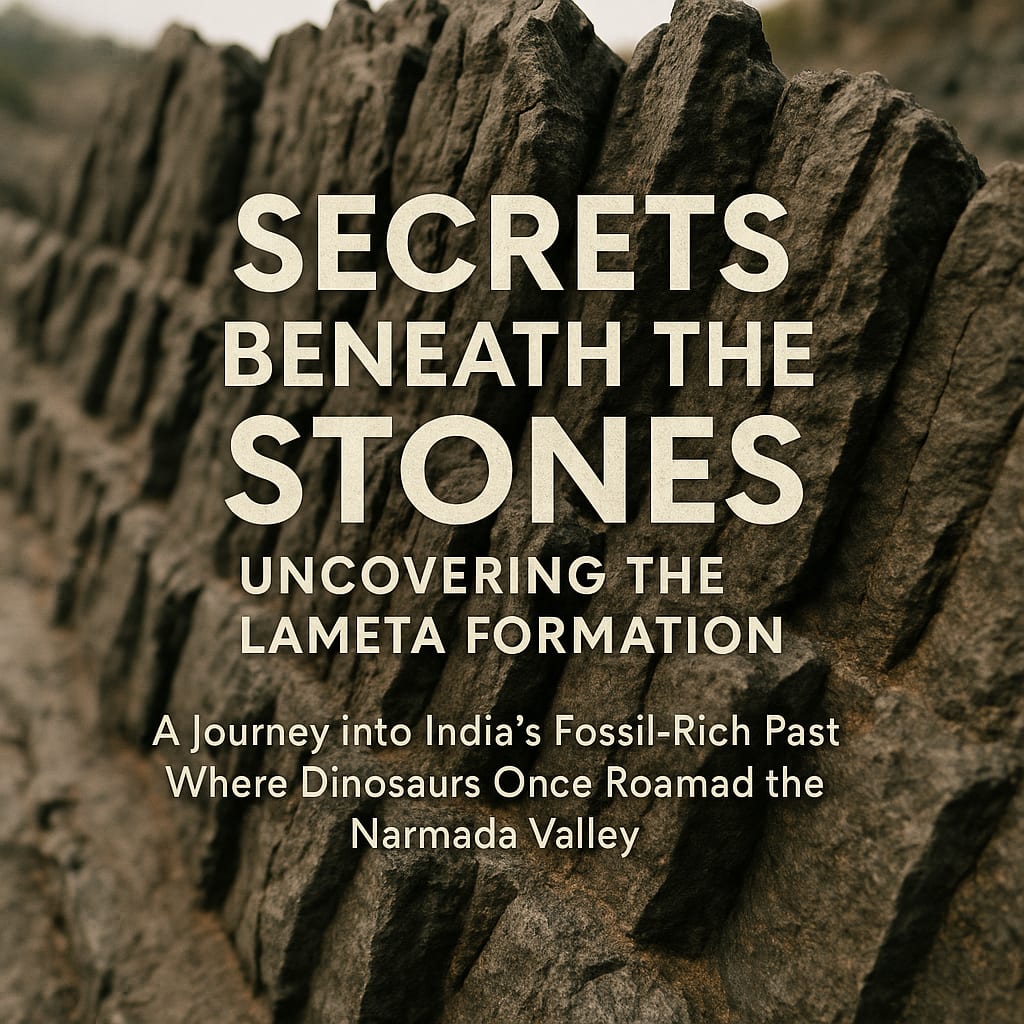
[Opening Scene: Aerial view of the Narmada River snaking through central India. Slow, dramatic music plays.]
Narrator (Voiceover):
In the heart of central India, where the ancient Narmada River carves its path through stone and time, lies a silent witness to Earth’s prehistoric past — the Lameta Formation. Hidden beneath layers of rock and dust are secrets over 65 million years old. This is a story of dinosaurs, deep time, and the scientists working to decode a forgotten world — a world that once thrived beneath our feet.
⸻
[Segment 1: Introduction to the Land]
[Scene: Shots of rocky outcrops, cracked stone ridges, and local landscapes.]
Narrator:
The Lameta Formation stretches along the Narmada Valley, particularly in regions of Madhya Pradesh and Maharashtra. These geological layers, mostly composed of limestone, sandstone, and marl, date back to the Late Cretaceous period — a time when giant reptiles roamed the Earth.
But unlike the deserts of Gobi or the badlands of Montana, this fossil bed has a uniquely Indian character — tucked among rivers, forests, and rural villages.
[Cut to: Map animation showing the spread of the Lameta Formation.]
Narrator:
Scientifically classified in the 19th century, the Lameta Beds have become a treasure trove for paleontologists searching for evidence of India’s prehistoric life.
⸻
[Segment 2: The Fossils of Time]
[Scene: Scientists excavating, brushing bones, examining rock layers.]
Narrator:
Over the past century, the Lameta Formation has yielded extraordinary fossil finds — including the remains of titanosaurs, abelisaurids, and other long-extinct species.
One of the most iconic discoveries is that of Rajasaurus narmadensis, a carnivorous dinosaur whose name means “Royal Lizard of the Narmada.” With a powerful build and a prominent horn, Rajasaurus ruled this land at the end of the dinosaur era.
[Cut to: Fossil reconstruction and artist illustrations of Rajasaurus.]
Paleontologist (Interview):
“Rajasaurus was unique. It shows us that India had its own evolutionary path — isolated from the rest of the world when it was a drifting island continent.”
Narrator:
Along with Rajasaurus, fossils of long-necked sauropods — the gentle giants — have also been found, some even with preserved egg nests. These finds paint a vivid picture of a lush environment filled with plant life, rivers, and diverse ecosystems.
⸻
[Segment 3: A Land in Motion – The Geological Story]
[Scene: Slow-motion visuals of layered rocks, volcanic flows, time-lapse of tectonic animation.]
Narrator:
The Lameta Formation is more than just a fossil site — it is a record of geological drama. Around the time these dinosaurs lived, the Indian plate was on the move — drifting northward toward Asia.
As it passed over a hot volcanic spot, it triggered massive lava flows that formed the Deccan Traps — one of the largest volcanic provinces in the world.
Geologist (Interview):
“These lava flows buried parts of the Lameta Beds. The result was both tragic and miraculous — it likely contributed to the mass extinction, but also preserved many fossils beneath layers of basalt.”
Narrator:
The Lameta Formation and Deccan Traps are thus intertwined in Earth’s history — together, they capture the final chapters of the Age of Dinosaurs.
⸻
[Segment 4: Challenges of Discovery]
[Scene: Harsh terrain, local villagers, scientists dealing with climate and access issues.]
Narrator:
Excavating fossils in India isn’t always easy. The monsoon rains, thick vegetation, and remote locations make access difficult. Much of the region is not protected, and illegal fossil trading remains a concern.
But despite these challenges, dedicated Indian scientists, students, and international collaborators continue to explore the secrets buried here.
Paleontology Student (Interview):
“When I first held a dinosaur bone in my hand, I felt a connection — to deep time, to life itself. It’s more than just science; it’s a bridge to our planet’s ancient memory.”
⸻
[Segment 5: The Global Connection]
[Scene: Footage of fossils in Indian museums, global conferences, collaborative research labs.]
Narrator:
The fossils of the Lameta Formation are not just Indian heritage — they are part of our shared human story. They connect us to a time before humans, before mammals even, when the supercontinent Gondwana was breaking apart and India was on its own path through the oceans.
[Cut to: Digital globe showing continental drift and India’s journey toward Asia.]
Narrator:
The creatures preserved here evolved in isolation, offering scientists rare insight into evolution, extinction, and continental movement.
⸻
[Segment 6: Education and Preservation]
[Scene: Ghughwa Fossil Park, school children visiting museums, community awareness events.]
Narrator:
Efforts are now underway to protect and promote this prehistoric heritage. Parks like Ghughwa Fossil National Park aim to educate the public and inspire future generations.
But much remains to be done. Awareness, conservation, and funding are essential to ensure these stones continue to speak to us.
Museum Curator (Interview):
“The Lameta Formation is India’s prehistoric legacy. If we lose it to erosion, ignorance, or neglect, we lose a part of Earth’s story that only this land can tell.”
⸻
[Closing Segment: Reflection and Legacy]
[Scene: Sunset over the Narmada Valley, slow music builds.]
Narrator:
The stones of the Lameta Formation are silent, yet they speak — of giants that walked, of worlds long gone, and of the fragility of time.
Beneath our feet lie the remnants of vanished lives, waiting to be uncovered by curious minds and careful hands.
Narrator (Closing Line):
In the heart of India, the Earth remembers. And through science, we listen.
[Title Fades In: “Secrets Beneath the Stones”]
[Subtitle: Uncovering the Lameta Formation]
⸻
[End Credits Roll with instrumental background]
About the Creator
Irshad Abbasi
Ali ibn Abi Talib (RA) said 📚
“Knowledge is better than wealth, because knowledge protects you, while you have to protect wealth.
Keep reading
More stories from Irshad Abbasi and writers in History and other communities.
Unraveling the Code of Life
Eugene V. Koonin is a name synonymous with cutting-edge evolutionary biology and computational genomics. A Russian-American biologist, Koonin has spent decades probing the mysteries of evolution, virus biology, and the origin of life itself. Through his work at the National Center for Biotechnology Information (NCBI), Koonin has become one of the foremost voices in theoretical biology, helping to shape our understanding of how life evolved and continues to evolve at the molecular level.
By Irshad Abbasi 9 months ago in History


Comments
There are no comments for this story
Be the first to respond and start the conversation.