
“The Miracle of the Cave: A German Scientist’s Discovery Through the Qur’an”
How the story of the Companions of the Cave revealed divine wisdom about sunlight, movement, and the mystery of the dog.

Introduction
Many of us recite Surah Al-Kahf every Friday, but how often do we pause to reflect on the details within its verses?
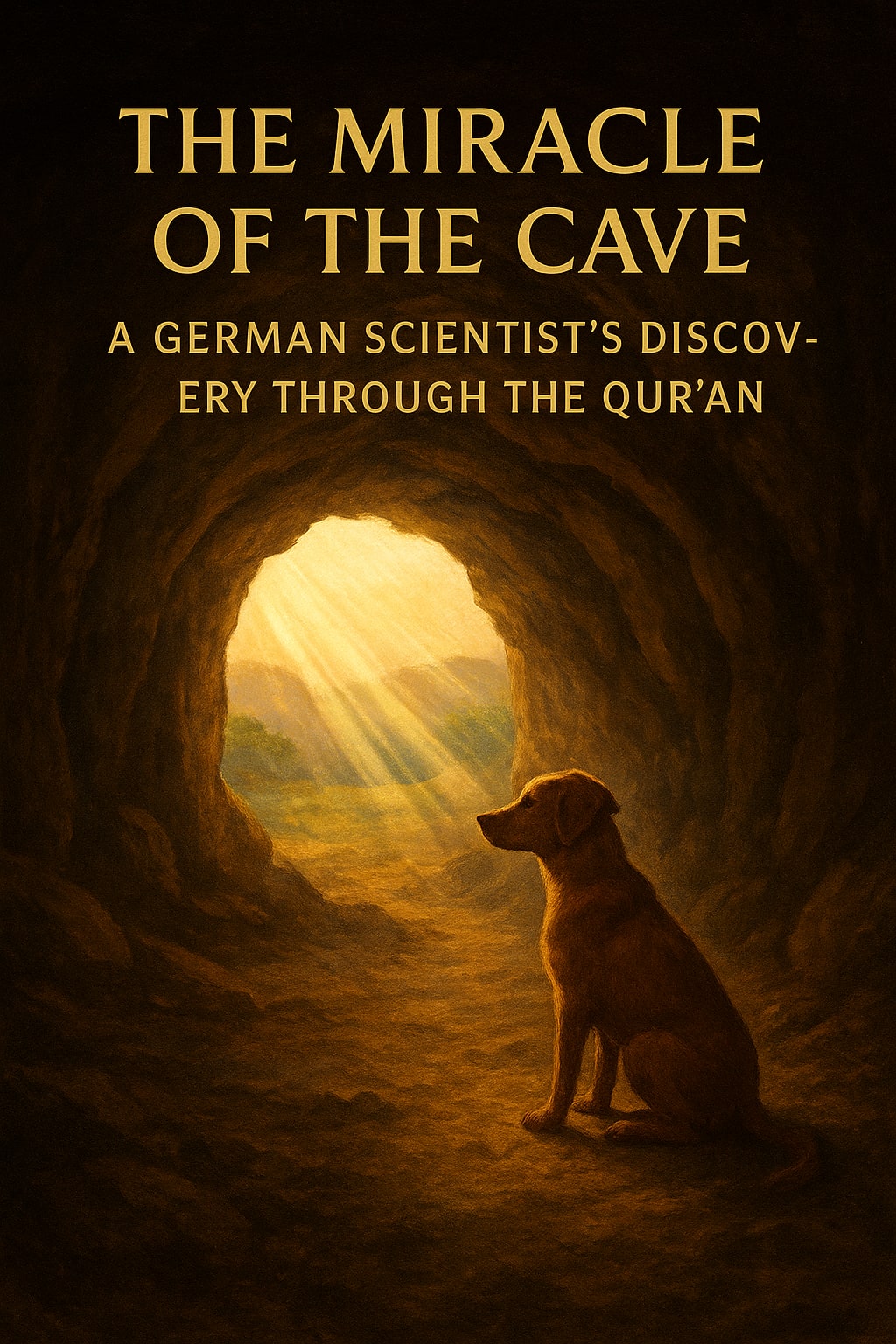
Among the many profound lessons in this chapter is one curious image: the faithful dog of the Companions of the Cave, “stretching out its forelegs at the entrance.”
Why did the Qur’an mention this detail? And what wisdom might it hold?
⸻
The Qur’anic Description
Allah says:
“And you would have seen the sun when it rose, inclining away from their cave on the right, and when it set, passing away from them on the left, while they lay in the open space of the cave. This is one of the signs of Allah. Whomever Allah guides — he is rightly guided.”
(Qur’an 18:17)
And then:
“And you would have thought them awake, while they were asleep; and We turned them to the right and to the left, while their dog stretched out its forelegs at the entrance. Had you looked at them, you would have turned away in fear.”
(Qur’an 18:18)
The Qur’an explains that the Companions of the Cave were turned from side to side during their long sleep — perhaps to protect their bodies from decay or sores.
But the dog, it seems, remained still — simply “stretching its front feet.”
Why was this mentioned at all?
⸻
A Reflection from Science
It is said that a German medical researcher once reflected deeply on these verses.
He noticed that the Qur’an described the cave as a place where sunlight entered indirectly — enough to provide warmth and ventilation, but never falling directly on the sleepers’ bodies.
He realized that this aligns with modern medical understanding:
patients who remain in one position for too long must be moved regularly, and their rooms should receive fresh air and indirect sunlight to prevent sores or infection.
But what amazed him most was the mention of the dog.
The verse does not say that the dog was turned like the others. It only says that it lay with its front legs extended.
Intrigued, the researcher studied the physiology of dogs and found that dogs have skin glands that release protective secretions — natural substances that help prevent infection and decay.
This detail, he felt, was astonishingly precise.
As the story goes, these reflections led him to study Islam further, and eventually to embrace the faith.
⸻
The Deeper Message
Whether or not we know every scientific detail, the point remains clear:
the Qur’an is full of signs — even in its smallest phrases — that invite us to think, reflect, and appreciate the perfection of divine wisdom.
“This is a blessed Book which We have revealed to you, so that they may reflect upon its verses, and that those of understanding may take heed.”
(Qur’an 38:29)
How many of us read the Qur’an every day, yet rarely pause to ponder its words?
Sometimes, even a single verse — or the mention of a dog — can open a door to faith.
⸻
Author’s Note
This story was written with the assistance of AI and edited for clarity and reflection.
About the Creator
Voxwrite ✍️
“Hi, I’m wordwanderer . Science lover, deep thinker, and storyteller. I write about the universe, human mind, and the mysteries that keep us curious. 🖋️
Keep reading
More stories from Voxwrite ✍️ and writers in History and other communities.
Global sumude flotilla.
Global Samood Flutela: A New Vision for Collective Harmony Towards Social Evolution and a Connected World The world is changing at a speed we have never witnessed before. Humanity today stands at a crossroads where scientific progress, technological advancement, and global communication have unlocked possibilities beyond imagination. Yet, one fundamental question remains: have we truly come closer as human beings, or have we created new distances? In this context, the idea of Global Samood Flutela emerges as both a philosophy and a practical framework for building a more connected, peaceful, and progressive world.
By Voxwrite ✍️ 4 months ago in History
The Rise and Fall of Nicolae Ceaușescu
Nicolae Ceaușescu’s rise to power was initially marked by promise, even optimism. Born in 1918 into a poor peasant family, he entered politics early, shaped by the ideological rigidity of interwar and wartime communism. When he became General Secretary of the Romanian Communist Party in 1965, following the death of Gheorghe Gheorghiu-Dej, many Romanians saw in him a younger leader, one who might soften the harsh Stalinist legacy that had defined the previous decades. For a society weary of repression and deprivation, Ceaușescu appeared to embody the possibility of cautious change.
By Pure child2 days ago in History
A woman from a vanished female dynasty was discovered buried with 270,000 beads.
In a Copper Age tomb close to Seville, Spain, the Montelirio bead assemblage contains over 270,000 beads that identify the ladies buried there as elites. The discovery is the biggest collection of beads ever
By Francis Dami4 days ago in History


Comments
There are no comments for this story
Be the first to respond and start the conversation.