
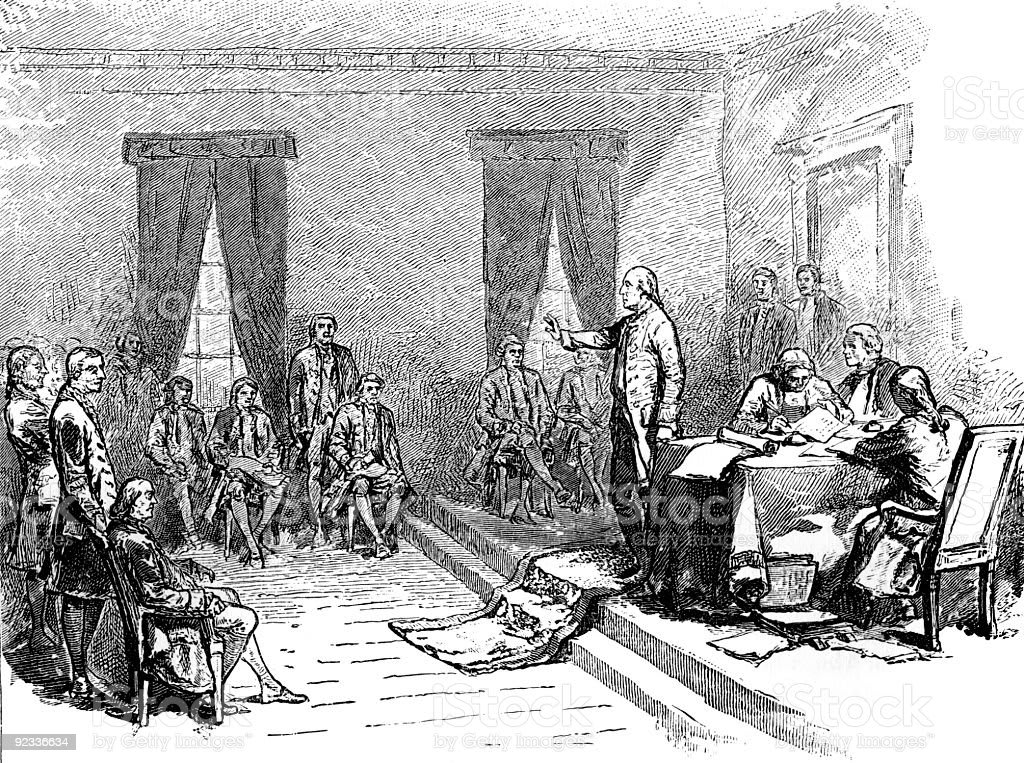
In the summer of 1787, Philadelphia was buzzing with tension and hope. America had won her independence from Britain in 1783, but the young nation was at a crossroads. Under the Articles of Confederation, the central government was weak and ineffective. Each state operated as its own little nation, coining its own money, establishing its own trade policies, and maintaining its own militia.
Leaders like George Washington and James Madison recognized that change was needed, so they called for a convention in Philadelphia. Representatives from all 13 states were invited to gather at the Pennsylvania State House, now known as Independence Hall.
It was a hot and humid summer. The windows of the Hall were kept shut to maintain the secrecy of the proceedings, amplifying the stifling heat. But the discomfort did not deter the 55 delegates. They were a group of lawyers, farmers, soldiers, and politicians - diverse in background but united in purpose. Despite their differing ideologies and personal ambitions, they all recognized the need for a stronger central government.
The debates were intense. The larger states favored the Virginia Plan, which called for a bicameral legislature with representation based on population. The smaller states, however, were afraid of being overshadowed and favored the New Jersey Plan, which proposed equal representation for all states. The issue seemed insurmountable until Connecticut's Roger Sherman proposed a compromise - a bicameral legislature with one house based on population (the House of Representatives) and one house with equal representation for all states (the Senate). The Great Compromise, as it was known, broke the stalemate.
The months of heated debates and thoughtful deliberations led to the drafting of the United States Constitution. It was an innovative piece of work, a government framework designed to preserve individual liberty while maintaining stability and order. It introduced the principles of federalism, checks and balances, and the separation of powers. It was the world's first written constitution that established a government with the people's consent.
On September 17, 1787, 39 of the 55 delegates signed the new Constitution. Benjamin Franklin, aged and frail but still sharp-minded, noted the sun painted on the back of George Washington's chair. "I have often looked at that behind the president without being able to tell whether it was rising or setting," he said. "But now at length, I have the happiness to know it is a rising sun."
The Constitution wasn't perfect, and many battles were fought over its interpretation and execution. It was, however, a turning point in American history, a testament to the power of compromise, negotiation, and the collective will for a better future. The "Miracle of Philadelphia," as the Constitutional Convention came to be known, laid the groundwork for the United States to grow into one of the world's leading democratic nations.
The fact that fifty-five men, with widely different interests and beliefs, could come together and create a document that has guided the nation for over two centuries, is indeed a miracle. The Constitution wasn't perfect, and it didn't solve all the country's problems. Yet, it laid the groundwork for the United States to grow and evolve. It symbolizes the ability of diverse people to come together for a common cause, making the Constitutional Convention the Miracle of Philadelphia.The United States Constitution stands as a testament to the power of collaboration, the triumph of reason over discord, and the belief that a nation's destiny can be shaped by the shared values and dreams of its people. The Miracle of Philadelphia remains an enduring inspiration, reminding us that even in the most challenging times, the human spirit can achieve greatness when united for a common purpose.
About the Creator
Reader insights
Good effort
You have potential. Keep practicing and don’t give up!
Top insights
Compelling and original writing
Creative use of language & vocab
Easy to read and follow
Well-structured & engaging content
Excellent storytelling
Original narrative & well developed characters
Expert insights and opinions
Arguments were carefully researched and presented
Eye opening
Niche topic & fresh perspectives
Heartfelt and relatable
The story invoked strong personal emotions
Masterful proofreading
Zero grammar & spelling mistakes
On-point and relevant
Writing reflected the title & theme
Keep reading
More stories from ALOK GUPTA and writers in History and other communities.
"In Spite of the Gods: The Strange Rise of Modern India" by Edward Luce
"In Spite of the Gods: The Strange Rise of Modern India" is a seminal work by Edward Luce that provides an enlightening exploration of the socio-economic and political transformation of India in the late 20th and early 21st centuries. A former Financial Times bureau chief in New Delhi, Luce uses his extensive knowledge and experience in India to construct a vivid narrative that offers insightful commentary on India's journey to becoming a significant player on the global stage.
By ALOK GUPTA2 years ago in History
World War I
The morning fog lay thick over the trenches of northern France, clinging to the earth as if it too feared what was about to happen. Private Thomas Hale pulled his coat tighter around himself, though it did little to stop the cold from seeping into his bones. He had been in the trenches for six months, yet the damp smell of mud, smoke, and fear still felt unfamiliar, like a nightmare he could not wake from.
By Maavia tahir5 days ago in History
Chicago Hospital Held Newborn Baby for 8 Months Over an Unpaid Medical Bill
Debts were handled much differently in the 19th and early 20th century. Back then, people who accrued debt had more to fear than letters and calls from collection agencies the same way we do today, especially if they owed a hospital or doctor money.
By Criminal Matters6 days ago in History
How to Succeed at the Benson Directory®
Congratulations and welcome to the Benson Directory® employee #22391! As our newest call handler, you will have the privilege of speaking with dozens of unique and interesting people on a daily basis as well as the opportunity to earn bonuses for high performance. Contained within this handbook you will find a set of ease to follow instructions designed to help you settle in to your new role and begin paving the way to success.
By S. A. Crawforda day ago in Fiction



Comments (1)
Good History