
The Medic Who fought a War without a Weapon
DESMOND DOSS Story

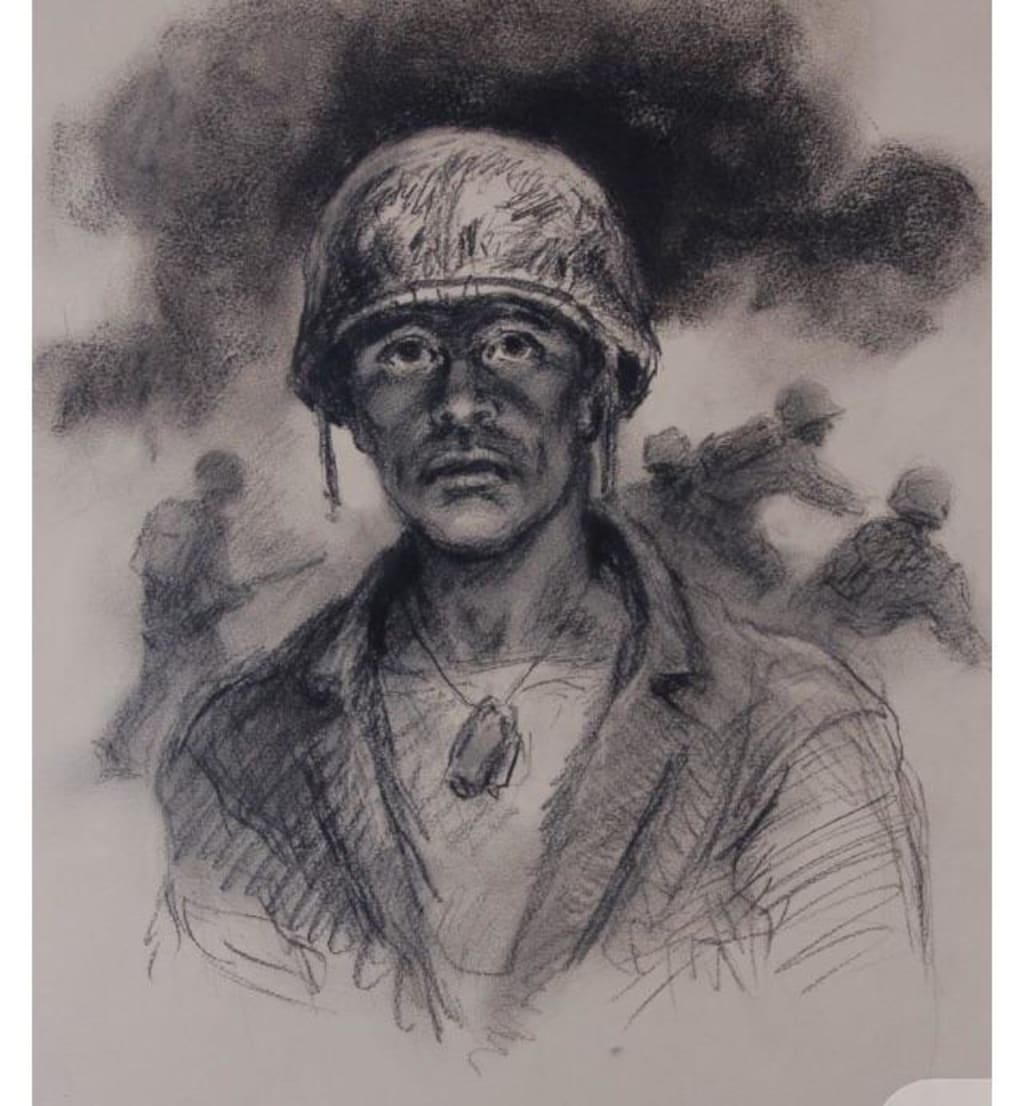
The medic who fought a war without a weapon. Desmond Das was not your average hero. He would become a Medal of Honor recipient, the United States of America's highest and most prestigious military award as a combat medic who saved many of his comrades lives in battle without firing a single shot, because he didn't take a weapon into combat because of his religious beliefs. Desmond DOS was born in 1919 in the state of Virginia, and was raised as a strict Seventh Day Adventist, a Christian denomination that believed that Saturday was the Sabbath, and that the Second Coming of Jesus Christ was imminent. They also believe strongly in non violence and a healthy diet based typically on a vegetarian diet. Dos had been raised with a strict belief in the Bible, and when it came to the 10 commandments, he took them to be the core values of how to lead his life. When World War Two started, he was conflicted as he believed the war was a just one, but he felt that to kill another human being under any circumstance was wrong. He was already employed as a joiner at Newport News Naval Shipyard, but nevertheless, he joined the United States Army on April 1 1942. He could have requested a deferment, but he wanted to do his patriotic duty. He was assigned to an infantry unit, the 77th division and presume that his classification as a conscientious objector would not require him to carry a weapon. For DOS, one commandment of the Bible stuck with him the most Thou shalt not kill. He wondered why he was assigned as a rifleman, and not in a medical role. His commanding officer tried to pressure dos into carrying a weapon as they thought he would be more of a liability than an asset in combat, but das refused. Interestingly, even for medics, which das would later become, it was common practice at the time to carry either an M 1911, A one pistol, or M one carbene. for self defense purposes. The rules go that a medic under the Geneva Convention is not forbidden from carrying a weapon. But if a medic fires his weapon, he stops being classed as a medic, and therefore can be legitimately fired upon by the enemy. The regimental chaplain, Captain Stanley would soon understand Dawson's protests and helped him transfer from rifleman to medical training. To make matters worse, his fellow soldiers mocked his religious beliefs when he was reading the Bible daily and strictly observing the Seventh Day Adventist tradition of attending church every Saturday. Das continuously requested to be allowed to have Saturday's off rather than Sundays, in order to follow his Adventist beliefs at Saturday was to be observed as the Sabbath. In the end, Captain Stanley took this up with divisional headquarters and it was decided that event US soldiers would have Saturday's off just as the other men had Sunday off. This in fact made dos even more unpopular than ever with his fellow soldiers, as he was seemed to have it easy. As he had Saturday's off none were on base on Sundays to see him pull extra duties to make up for this. One of the squads other soldiers summed up the company's feeling about him and as Saturday's off complaining, you get more passes than the general as Das was a strict vegetarian at a time when it was unusual. It meant that the rest of the unit viewed dos with such distrust and hostility that one man in his unit even warned him ominously, when we go into combat DOS, you're not coming back alive. I'm going to shoot you myself. does eventually became an Army combat medic saying while others are taking life, I will be saving it. The turning point for Dawson, his relationship with his company came with their first 25 mile march with full field pack and rifle, something they were expected to achieve in eight hours. The other soldiers thought dos would be having it easy as he would be carrying no rifle or ammo that day, but his to Canvas medical bags were almost as heavy and much more awkward to carry than any rifle. As the march progressed, the men started to suffer from exhaustion, numerous blistered feet and dehydration, some even passed out. At all the time there was DOS, always with a helping hand. Even to the extent that at the end of the March, he insisted on checking everyone's feet and administering medical aid where it was needed. By the end of that day, he had won the respect of his entire unit for his tireless devotion to his duty. For the first time, he was treated as one of their own. Dos as the qualified combat medic of the unit was now responsible for providing first aid and Frontline trauma care on the battlefield. He would be assigned to accompany his unit into the war zone and be there with them on the front line at all times. This was soon to happen for the 77th division had had their first combat experience on May 11 1943. And Dawson has comrades were urgently are being trained up to replace the combat losses and help expand the division strength. The 77 division would end up being in combat officially for no less than 208 days, suffering a total of 9212 casualties before the war would end. The Battle of Guam DOS, his first taste of combat was at the Battle of Guam, which was a bloody battle fought from July 21 to August 10 1944 to recapture the US territory of the island of Guam from a determined Japanese garrison of nearly 20,000 troops. Though according to the Geneva Convention, knowingly firing at a medic wearing a clear insignia is a war crime. The Japanese snipers and machine gunners tended to ignore this and saw combat medics as easy and valuable targets to gun down. So medics in the Pacific Theater were often told to avoid wearing medical insignia in case it would make them more not less of a target. DOS was under fire nearly every day during the battle and was busy doing his part in saving lives. Guam had shown dos how cruel war could be, as His unit was pushing forward through the jungle on their first day, a young fresh face recruited spotted a fountain pen laying on the jungle floor and went to pick it up. Before anyone could warn him otherwise, a white phosphorus grenade exploded. The pen had been booby trapped. The young man who had picked up the pen his chest now a bloody mess, had blood pouring out of an open wound, severe burns and sharp metal fragments covered his body and he was going into shock. by some miracle, das managed to stabilize his condition, administering care and helping to evacuate him and three other soldiers who had been wounded by flying red hot shrapnel. This was Dawson's first taste of combat casualties. The US casualties during the battle was truly appalling. Of the 59,000 US troops who took part in the invasion around every one in six were either killed or wounded. The Battle of Lady next Dawson, His unit was involved in the Battle of lady in the Philippines that ran from October 17 to December 26 1944, a vicious and prolonged battle which started with a huge us coastal bombardment and in Fibia s landing, followed by heavy fighting, the more inland the Americans went. During the Japanese counter attack a fellow medic, Clarence Glen had heard the call for a medic from a machine gunner. He left the cover and went into the open into no man's land to get the wounded man and was himself hit. Glen was dos his friend from back home and he couldn't leave him there. So he and a litter bear herb Schecter went out to find the two wounded and dealt with them separately. Das was attending the machine gunner who had a gash along his face while bullets wisdom or head. Both of the wounded were alive. They made an improvised litter out of a poncho and tree branches to get the wounded men back to the aid station. But his friend Glenn would die before he made it. From this point on, Doss would not look the face of the man he was treating, in case it was another friend. Sadly, his friend herb would be shot and killed when he indoors were carrying a litter, as their silhouette exposed them against the sky to the enemy. On top of losing his friends, DOS was constantly hungry, because the meat in the K rations conflicted with his vegetarianism, so he could only eat the tasteless crackers and coconuts he found. A lady the coconuts on the ground gave him diarrhea, so he climbed the trees for fresh ones. At one point DOS was looking for coconuts that attracted poorly aimed Japanese machined on fire. When they were killed by American soldiers. It was later discovered that they had been drunk on Sunday. One thing that shocked dos during the most devastating times of the campaign was that the same man who had made threats towards him during training at Fort Jackson now came to Him for guidance and to pray for him. The Battle of Okinawa and lastly for DOS and the 77th Infantry Division was a battle that was to be the bloodiest battle of the war in the Pacific, as well as its largest amphibious landing. The US objective was to secure the island as a base as it was just 350 miles south of the Japanese mainland, and would be strategically crucial for any future invasion of Japan. The battle started on April 1 1945, exactly three years to the day that dos first enlisted in the Army and the battle was to last 81 days. DOS was assigned to the first battalion as their combat medic, on April 29 1945 to 77 division was given the task of assaulting on a 400 foot high cliff called the mitre escarpment. This was nicknamed by the Americans as Hacksaw Ridge. Before they climb the cargo net dos set a prayer for his comrades. When Dawson's unit joined the assault, and as they near the top of the escarpment they came under intense Japanese artillery. It's mole arms and machine gunfire, inflicting severe casualties on the assaulting American troops.
The American forces had sent in wave after wave of troops to try to dislodge a fanatical enemy base there who were well entrenched and camouflaged. On May 4, while his unit was attacking a heavily fortified enemy position at the mouth of a cave dos went to the aid of four of his injured comrades. The lieutenant who led the attack on the emplacement had intended to throw a grenade when an enemy bullet hit him and delayed it, blowing his hand off and wounding his comrades. Despite having to get within 25 feet of the enemy lines and under attack by enemy grenades gunfire dos managed to get to the injured men. He then managed to evacuate the men back to his own lines one by one. During the night the Japanese continued to throw grenades and kept up the mortar fire. The American soldiers hit in rock crevices of the Japanese found ways to infiltrate and sneak up on them. Then on the next day, May 5, it came to the rescue of a wounded artillery officer who had gone to see how the artillery guns were doing. Doss, his left leg was now injured as he had felt the day before down the edge of a parapet. He climbed up the cargo net with his first aid gets his weight falling on his bad leg. Finding him in a shell hole. The officer had been struck by shrapnel that had made a hole from his chest to his back, and dogs could hear him breathing through it. He was bleeding heavily. It also gave him first aid while under constant enemy gunfire and shelling. He put the dressings over the large holes in the Colonel's chest and back, and administered blood plasma which dangerously exposed Doss to the enemy. As he had to hold it up. Hi, dos. His efforts here would be in vain, as the colonel carried back on a stretcher died before he reached the aid station. Later, there were orders to take a vital Japanese pillbox position on the reverse slope of a hill that was holding up the American advance. Desmond Doss, once he had read his prayers, was happy to support the assault. The American troops threw gasoline cans at the position which triggered a large explosion. All of a sudden a large Japanese counter attack overwhelm the American soldiers, causing them to panic and rush back to the edge of the cliff. But despite this dos refused to take cover, and while constantly under heavy fire by the enemy, though being totally exhausted, he spent hours carrying the wounded one by one to the edge of the escarpment. Then, to get the more severely wounded down, he tied a rope to a tree stump and lowered them down the cliff on a rope supported stretcher to safety. When the stretcher kept slipping, he turned to a new method, looping the rope around the wounded man's chest and legs to lower them down. Dos standing exposed to potential enemy fire was seen praying at the cliff edge as the men were being lowered down. And later he had said he had been praying to the Lord to help him get one more. And after that one more, until they were all down. Counted calculating the wounded men at the base of the cliff the captain worked out that dos had saved around 75 men. The Americans would eventually go back up the cliff and on May 7, would take the position. by some miracle dos survive the whole battle totally unheard. But that was soon to change. On May 21. In the confusion of a night attack, dos tended to the American wounded, risking being hit by both the Japanese and by friendly fire. DOS was in a shell hole with another American soldier when a grenade landed beneath him. His reflex action was to put his foot on it and was seriously wounded in both legs. His blood poured out from the impact of 17 pieces of shrapnel in his body. But he remained in his position for five hours tending to himself while also helping others who were wounded until a medic and a pair of litter bearers could get to them. But that was not the end of it that day, for as he was being stretchered to safety, they got caught in an enemy tank attack. As they took cover, dos spotted a critically injured man and insisted that he be taken back on the stretcher instead of himself. While dos waited for the litter bearers to return, he was found and held back by a fellow soldier. Suddenly, Das was hit by a Japanese sniper's bullet and suffered a compound fracture to his arm. The two men took cover and a shell hole, realizing how badly injured he now was. Dawson structured the soldier on how to bind his rifle stock to his shattered arm to act as a splint. Eventually pushing through excruciating pain, he would make it back to the aid station. The US Army recognized Dawson's extreme bravery and he was awarded the Congressional Medal of Honor for his heroic and selfless actions at Okinawa from April 29 to May 21 1945. Because of his heroic actions, many wounded men made it back home. Desmond das would go on to run a small family farm with his wife Dorothy and lived to the age 87
About the Creator
BRIAN CERVIN LIM
Welcome to my page! I'm a passionate and versatile writer who believes in the power of words to captivate, inspire, and transform. Whether it's crafting compelling stories, I strive to create content that leaves a lasting impact.
Reader insights
Outstanding
Excellent work. Looking forward to reading more!
Top insights
Compelling and original writing
Creative use of language & vocab
Excellent storytelling
Original narrative & well developed characters
Eye opening
Niche topic & fresh perspectives
Heartfelt and relatable
The story invoked strong personal emotions
On-point and relevant
Writing reflected the title & theme
Keep reading
More stories from BRIAN CERVIN LIM and writers in History and other communities.
Unwilling victims of an EVIL experiment
At around 1am on March 1 1954, a 20 year old fisherman named Oishi Mata Shishi finally headed down to his bed on the lower deck of the fishing boat that he worked on, which was called the lucky dragon number five a wish he was totally exhausted. He and the other 22 crew members had been working practically around the clock 18 hour days for the last six weeks trying to catch tuna. But so far, this trip had really been a disaster. They had gotten stranded on sandbars. There had been these terrible storms that had nearly capsized the boat. And then also they had lost a lot of their fishing lines when they got snagged on coral reefs. And so as a result, their tuna hauls so far had been devastatingly low and Oishi and the rest of the crew were very aware of this. In fact, Oishi was very worried that he would not bring home enough money to support his family. Back when Oishi was 14 years old, his father, who had been the breadwinner for their family had been crushed to death when he was repairing a ship. And so now we she had stepped into that patriarch role, taking care of his mother and his five other siblings. And so a week she really needed a solid paycheck from this trip, and it wasn't looking like that was going to happen. And so a week she staggered his way into his small room and he collapsed onto his bed. And as he lay there trying to sleep, he felt the ship gently rocking side to side, the ship, the lucky dragon number five was anchored relatively close to the Marshall Islands, which is a strip of islands right about halfway between Hawaii and Australia. But what's unique about the Marshall Islands is they sit over these huge ancient underwater volcanoes. Now these volcanoes are dormant. But the captain of the lucky dragon number five was weary enough about getting too close to these dormant volcanoes in fear they might erupt, that he intentionally kept them about 80 miles or so away from the Marshall Islands. And so eventually a we she did drift off to sleep in his bunk, but five hours later, Oishi suddenly sat up wide awake, because the little room he was in was now completely flooded with this very bright yellow light, and so Oishi and it was kind of confused, he felt like it was too early for sunrise. And he checked his watch. And he saw it was only 6:45am. And so yes, it was too early for sunrise. So whatever this was, it was not the sun. And then when he went to the little porthole window were all this light was coming in, you know, he had to squint his eyes, but he looked outside, and he couldn't tell where this light was really coming from or what it was, but he could clearly see it was coming from the west, and the sun rises in the east. So really whatever this light was, it was not the sun. At the same time. The rest of Alicia Keys crewmates were in this room with him. They were also starting to wake up and kind of looking around like what's going on here. And then without even saying anything. All of them just rushed out of the room and ran upstairs to the top deck to look around and see what was going on. And when they got up there, Oishi looked out towards the west where these lights were up in the sky, and he couldn't really see a clear point of origin. It wasn't like there was an obvious thing, creating these lights. It was more like the western sky was just unbelievably bright and yellow and orange. And it seemed like the light was kind of hovering over where the Marshall Islands would be. And so everyone's thinking, you know, is it possible this is a volcano eruption, you know, is there something else going on here? And then as the crew is just watching and stunned silence and all these crazy lights in the sky, the light's kind of began to fade and they turned blue and purple. And then they just went away and the entire crew was pitched back into darkness. And as everyone's just standing around having no idea what to make of these lights, the oldest crew member on board who was 40 years old, he said the one thing that everybody kind of in the back of their mind was thinking about but didn't want to say, the oldest crew member just said, atomic bomb. just nine years earlier, the United States had dropped two atomic bombs on Japan to end World War Two. Now Oishi who was Japanese, he was 11 years old at the time this happened and it had a profound impact on his life and his family's lives as friends. I mean, anybody who was alive when this happened, it changed everything. But as a way she and the rest of his crew are kind of staring out to the West, which was all dark at this point. But we she thought, you know, there's no way this could have been an atomic bomb. Number one, World War Two is over. So there's no reason a bomb would get dropped again, and to when those atomic bombs were dropped on Japan nine years earlier, it vaporized basically everything and everyone and its path. And so for them to be this close to these huge lights, you know, if that were an atomic bomb, wouldn't they to be vaporized like they would not be able to see that and live. And so we she began to tell himself, you know, okay, it probably was not a volcano eruption, it probably was not an atomic bomb. I don't know what it was, but we're okay. And while many of the other people onboard the ship felt the same way, Oishi did very quickly, the call came out amongst the crew to just go ahead and bring in the lines right now, we don't know what these lights were. But we need to head back to port back in the Aizu, Japan, and so quickly Oishi and the rest of the crew got to work pulling these lines in and prepping the boat to head back to port. And then at some point, after a week, she had done what he was supposed to do, he began walking his way down below to the galley to get some food. But when we she was about halfway, he suddenly heard this deafening explosion outside coming from the west where these lights had been. And immediately, Oishi just jumped onto the ground, covering his head thinking that was going to protect him. And as he's laying there listening to this unbelievable exploding sound, he's thinking, Oh, my gosh, one of those volcanoes under the Marshall Islands has indeed erupted. That's what's happening at any minute. Now, a giant tsunami wave from this eruption is going to flip us over, we're gonna get killed here. And so we she, as this massive exploding sound is going on, he jumps to his feet, and he runs upstairs, and he finds the majority of the crew that was still up there had jumped to the ground, and they were just kind of protecting themselves, a couple braver crew members that stood up and we're kind of looking out towards the west to see if they could see what was going on. But there were no lights. Now it was just these crazy loud exploding sounds coming from the west. And then suddenly, all the sound stopped and Oishi. And the crew at that point braced for what they believed was this inevitable tsunami wave that was going to hit them. But the weird thing was, is after the exploding sound stopped, everything was totally calm. In fact, a wish he glanced over the edge of the boat, and he saw the water was totally Placid, more calm than normal. And after a few more minutes went by, and no massive tsunami wiped them all out. The crew was like, What's going on here?
By BRIAN CERVIN LIM2 years ago in Horror
Humanity’s Greatest Promise: The Birth of Universal Human Rights
Introduction On December 10, 1948, in the aftermath of two catastrophic world wars, the United Nations General Assembly adopted one of the most significant documents in human history: the Universal Declaration of Human Rights (UDHR). Crafted as a global roadmap for freedom, dignity, and justice, the UDHR stands as a powerful commitment by the world community to uphold the inherent rights of every individual. In an age still healing from genocide, oppression, and war, this declaration became a beacon of hope, guiding the path toward a more humane world.
By DRE Explainsa day ago in History
The CEO of Everything
They say "jack of all trades, master of none," but they forgot to mention the part where the jack of all trades is also the camera woman, the makeup artist, and the person currently yelling at a tangled Wii microphone cable in a her own bathroom while recording herself singing and trying to make it look realistic and professional. (As professional as you can make it with nothing but a cell phone camera and a mic that doesn't work)
By Sara Wilson7 days ago in Humans


Comments
There are no comments for this story
Be the first to respond and start the conversation.