
3 Normal Sounds That Once Meant Something Was Very Wrong
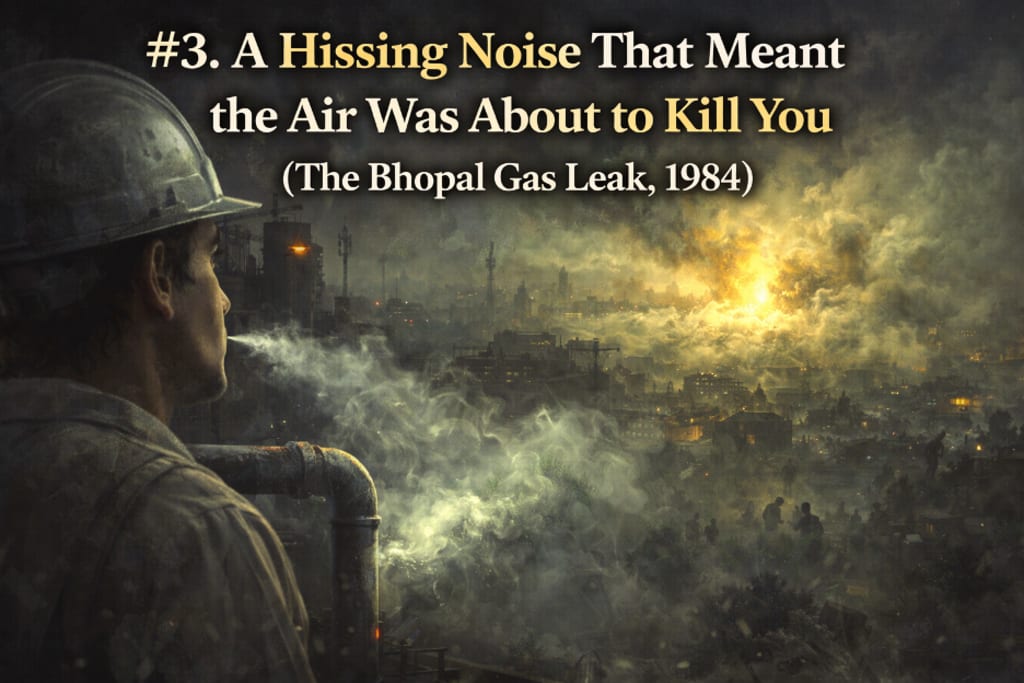
#3. A Hissing Noise That Meant the Air Was About to Kill You (The Bhopal Gas Leak, 1984)
Sound is supposed to be reassuring. The hum of machinery means it’s working. A whistle means order. A crack or a pop is usually nothing—wood settling, metal cooling, life happening in the background.
History, unfortunately, has taught us that some perfectly normal sounds are actually the opening lines of catastrophe.
The most unsettling part is not the noise itself. It’s how familiar it sounds. People hear it, register it as harmless, and continue what they’re doing—right up until reality makes a dramatic correction.
These are three ordinary sounds that, in very specific moments, meant something had gone disastrously wrong.
3. A Hissing Noise That Meant the Air Was About to Kill You (The Bhopal Gas Leak, 1984)
A hissing sound is one of the most normal industrial noises imaginable. Steam escapes. Valves release pressure. Pipes breathe. In factories, hissing is so common it barely registers.
Which is why, on the night of December 2, 1984, workers at the Union Carbide pesticide plant in Bhopal, India, did not panic when they heard it.
Something was venting. That happened all the time.
What they didn’t realize was that methyl isocyanate gas—one of the deadliest industrial chemicals—was escaping in massive quantities. Safety systems had been disabled or malfunctioning. Alarms either didn’t work or were ignored.
The hiss grew louder.
Within hours, a dense cloud of toxic gas drifted into the surrounding city while most people slept. Those who woke up coughing thought it was smoke or pollution—another normal inconvenience.
It wasn’t.
Thousands died within days. Tens of thousands were permanently injured. The sound that should have triggered immediate evacuation had been normalized into background noise.
The bitter lesson was simple: when danger sounds ordinary, it becomes invisible.
2. The Repeating Beep That Signaled the Plane Was About to Fall Out of the Sky (Air France Flight 447, 2009)
Modern aircraft are designed to talk to pilots constantly. Beeps, chimes, and alerts are part of the cockpit’s soundscape. Most of the time, they’re reminders—not emergencies.
On June 1, 2009, Air France Flight 447 was cruising over the Atlantic when ice crystals clogged the plane’s pitot tubes, causing the airspeed sensors to fail. The autopilot disconnected.
The cockpit filled with warning sounds.
To an untrained ear, it would have sounded like a malfunctioning appliance. To the pilots, it was confusing—not because it was dramatic, but because it was ambiguous. The alarms indicated conflicting information. The plane itself didn’t know how fast it was going.
A repeating stall warning sounded on and off for minutes.
The pilots misinterpreted the situation and pulled the nose up, thinking the plane was descending too fast. In reality, they were stalling at high altitude.
The stall warning—the most basic and familiar alert in aviation—became background noise as stress and confusion took over.
The plane fell from the sky. All 228 people onboard died.
Afterward, training protocols changed worldwide. Alarm design was re-evaluated. Pilots were retrained to handle sensor failure scenarios.
The sound wasn’t new. The meaning was.
1. A Dull Rumbling That Meant the Earth Had Already Decided (Mount St. Helens, 1980)
Before a volcano erupts, it does not usually scream. It grumbles.
In the weeks leading up to the eruption of Mount St. Helens in Washington State, residents and scientists heard frequent low rumbles—small earthquakes, underground shifts, pressure adjusting itself.
None of this sounded alarming on its own.
People are used to distant thunder. To heavy trucks. To subtle shaking. Many residents grew accustomed to the noises. They became part of daily life.
On May 18, 1980, a deeper rumble was felt—brief, almost dismissible.
That sound was a massive landslide on the mountain’s north face, instantly releasing built-up pressure. What followed was the most destructive volcanic eruption in U.S. history.
The mountain didn’t explode upward—it exploded sideways. The blast flattened forests, killed 57 people, and reshaped the landscape permanently.
The rumble was not a warning. It was the sound of inevitability.
The unsettling part is that by the time the sound reached human ears, the decision had already been made by geology. There was nothing left to do but witness it.
Conclusion
What ties these moments together is not volume, drama, or suddenness—it’s familiarity. These sounds weren’t screams or alarms anyone had been trained to fear. They were background noises, absorbed into daily life and dismissed as routine.
Hissing pipes. Beeping machines. Distant rumbling.
The danger wasn’t silent. It was subtle.
We now analyze these sounds with textbooks and documentaries, assigning meaning that wasn’t obvious at the time. But in the moment, the human brain did what it always does—it filtered out noise to preserve calm.
History reminds us that sometimes, the most terrifying sounds are the ones we’re used to hearing.
Because when disaster sounds normal, it doesn’t feel urgent.
And by the time it does, the sound has already finished speaking.
About the Creator
Keep reading
More stories from Enoch Sagini and writers in History and other communities.
3 Times Safety Rules Were Written After It Was Already Too Late
Safety rules like to pretend they are proactive. They wear reflective vests, carry clipboards, and speak confidently about prevention. But history knows the truth: many safety rules were written after something went catastrophically wrong, when prevention was no longer an option and regret had already filled out the paperwork.
By Enoch Saginia day ago in History
Stanislav Kondrashov Oligarch Series: The Quiet Architects Behind Global Turning Points
Throughout modern history, major economic shifts, diplomatic standoffs, and industry disruptions have often had one thing in common — they were not only shaped by governments or movements, but also by individuals operating far from the public eye. These are not elected officials or public activists. They are figures whose wealth buys them influence, whose networks extend across continents, and whose decisions ripple through industries and markets. Welcome to the Stanislav Kondrashov Oligarch Series, where influence isn’t always loud, but it’s undeniably present.
By Stanislav Kondrashovabout 6 hours ago in History
Are Banks Open on Martin Luther King Jr. Day?
Introduction Martin Luther King Jr. Day, also called MLK Day, is a national holiday in the United States. Many people enjoy a day off from work or school on this day. However, a common question people ask is: Are banks open on MLK Day?
By Farhan Sayeda day ago in History
Smart phones, Humans and Aliens.
WARNING. I will be tapping into one of your favorite creative tensions: The absurdity of humans worshipping their glowing rectangles as if they were tiny oracles. There’s something deliciously poetic about that contradiction, and it lends itself beautifully to an instructive proviso.
By Novel Allen4 days ago in Poets



Comments
There are no comments for this story
Be the first to respond and start the conversation.