
The Maya were more advanced than we thought
The Maya civilization

THE MAYA WERE FAR MORE ADVANCED THAN WE THOUGHT
A great deal occurred during the initial Millennium CE. Undoubtedly, we are referring to a millennium's worth of significant events in human history. As you may recall from your schooling, this era witnessed the remarkable ascent and decline of the Roman Empire. Moreover, it marked the transition towards the tumultuous era known as the Middle Ages. Additionally, some argue that it represented the pinnacle of the Mayan civilization in Mesoamerica. However, owing to exceptional technological progress, we now have the ability to perceive history from a completely new perspective.
Today, archaeologists have discovered concrete evidence suggesting that the Mayan civilization may have originated much earlier than previously believed. Furthermore, it appears that their civilization was far more complex than initially thought. To delve deeper into this fascinating discovery, one must venture into the dense and challenging Guatemalan rainforests. Are you prepared to embark on this journey? Rainforests pose significant obstacles due to their dense vegetation and limited accessibility. Even if you were an archaeologist, you would likely find them quite formidable. This is one of the reasons why the truth about the Mayans has remained concealed for so long. However, consider this: one would typically expect to encounter ruins like these in countries such as Portugal, England, or the United States. I am referring to roads that are 130 feet wide and painted white, designed to assist travelers during nighttime. These roads were approximately half the size of an American football field, which is quite impressive. Recently, a network of roads spanning 110 miles was discovered by scientists. It is believed that these roads predate the earliest registered Mayan ruins that we are aware of. These roadways, some of which traversed swampy terrain and were occasionally elevated, are now being referred to as the world's first superhighways. Although there is no evidence of animal-powered vehicles, it is believed that the Maya utilized these roads to navigate a network of potentially 964 settlements. These roads were constructed in a manner resembling a vast spider web, and based on the findings of archaeologists, they served as an intricate system for economic and social interactions. This discovery challenges the conventional notion that the Mayan preclassic period, dating back to 1,350 BCE, consisted solely of small tribal settlements.Consider the manpower and engineering expertise required to construct structures resembling these white highways. Scientists believe that these causeways were built in a similar manner to the Mayans' construction of their pyramids. If you're curious about these colossal architectural marvels, fret not, as we will delve into them shortly.
Currently, scientists posit that the roads were constructed using a combination of mud and quarry stone, along with multiple layers of limestone. The discovery of this information was made possible through a revolutionary technology known as liar Imaging. Similar to how sonar technology is employed to map the ocean floor, this system employs laser technology instead of sound waves. Consequently, researchers can now penetrate and explore the dense forest canopies, almost as if possessing X-ray vision. Undoubtedly, this marks a significant breakthrough. The unearthing of lost Mayan cities commenced in the mid-20th century, and since then, ruins from cities like Tall Pen and O have been rediscovered. However, let us take a moment to step back and provide some context. The Mayans were a significant pre-Colombian civilization residing in the Americas. Experts believe that at its peak, the Mayan civilization encompassed more than 40 cities, housing millions of people. This population size is quite substantial. Their civilization extended across Mexico's Yucatan Peninsula, Guatemala, and Belize. The Mayans primarily relied on agriculture for sustenance, yet the Yucatan Peninsula posed challenges for crop cultivation. Consequently, the Mayans had to devise a sophisticated irrigation system. In addition to this, their cities featured a range of ceremonial structures, including pyramids, palaces, and even courts for playing ball games.
While the Mayans were renowned for their pyramid-building skills, they also developed an advanced astronomical system using the technology available to them in ancient times.The precise positions of planets like Venus and Mars, as well as the specific dates of eclipses, were successfully predicted by them. Now, let us examine some of their celestial observations. One notable site is located deep within the Guatemalan jungle, known as Tall. It is believed to have served as the capital of the ancient Mayan Empire during its peak, rivaling the significance of modern cities like London or New York. Tall consists of a complex array of monuments, totaling 12,000 structures. Among them, the North Acropolis stands as the oldest complex, constructed entirely by human hands around 350 BCE. This area served as the final resting place for Mayan kings and Chiefs. The monuments within reach heights of up to 200 feet. Interestingly, in the past, the step pyramid temples were adorned with a vibrant red color, a hue beloved by the Mayans.
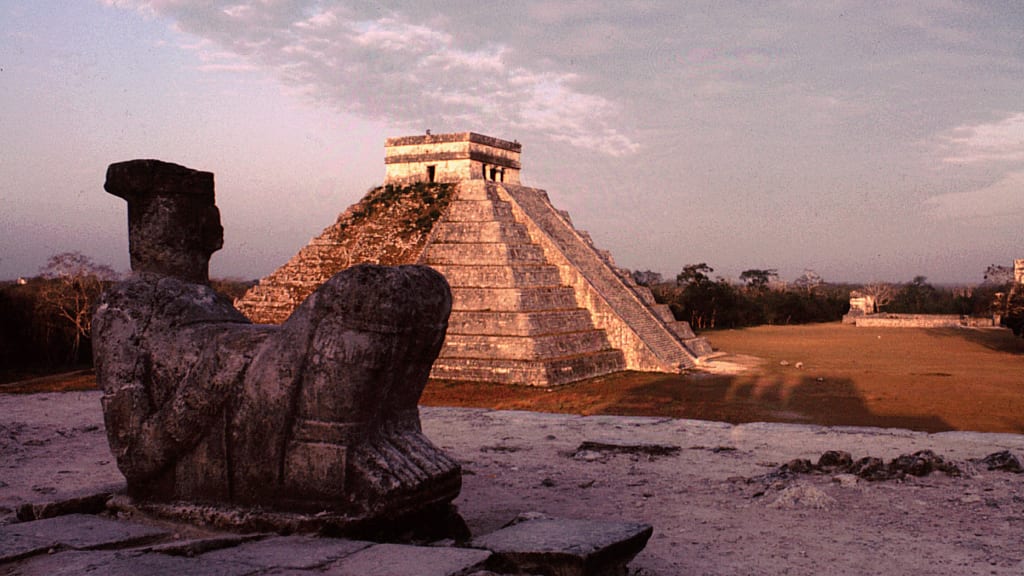
Today, it is evident that the Mayan civilization extended its influence across various countries, resulting in the presence of limestone structures in different regions. Therefore, it should not be surprising that Chichin is located a 10-hour drive away from Tial. Currently, there is no conflict between these two cities; they simply served as separate urban centers, similar to New York and Los Angeles. Chichin boasts one of the most well-preserved pyramids in the world, situated in Mexico's Yucatan State. This ancient Mayan city dates back over 1,500 years and was once inhabited by 35,000 individuals. Spanning across 4 square miles of land, the site's highlight is Elasa, an impressive temple with step-like structures towering 80 feet above the ground. Its most distinctive characteristic is the presence of 91 steps on each of its four sides, including the upper platform, resulting in a total of 365 steps, symbolizing the solar year. It truly captivates the imagination. Another significant Mayan city, known as Pen, is believed to have accommodated more than 6,000 people during its peak. Archaeologists have made remarkable discoveries at this site, with one particular building evoking thoughts of Indiana Jones and Tomb Raider. It is believed to be the final resting place of the Red Queen of Pen.The grandmother of the last Mayan King was believed to be her. In order to honor her, a massive monument was constructed to house her body after her death. The discovery of the tomb itself was already captivating, as archaeologists stumbled upon an ancient monument while excavating the site in 1994. The first thing they encountered was a room with a concealed door. Upon opening the door, they were greeted by an 8T long corridor. At the end of this corridor lay the Queen's chamber, where the mummy of the queen herself was found. Alongside her were her pearls, jade shells, and precious rocks. However, as the team examined the remains, they noticed something peculiar. The room was filled with a red-colored powder. Researchers were aware of the significance of the color red to the Mayan people, but they couldn't comprehend why the queen was buried with this unfamiliar substance. They collected a sample of the powder for further analysis and determined that it was Cinnabar, a highly hazardous mineral. Inhaling this powder could cause severe health damage. The team concluded that this was likely a trap set to deter anyone attempting to steal from the queen. One topic that has always intrigued scholars is the absence of evidence regarding the decline of the powerful Empire. The cause of their downfall has been a subject of speculation, ranging from droughts to diseases. However, recent research conducted in 2017 has shed some light on this matter. By analyzing radiocarbon data from ceramics and archaeological excavations at a site called Cabal, located in the southwest of Tial, scientists have uncovered new information about the unexpected demise of this remarkable civilization. The findings indicate that instead of a sudden collapse, the Mayans likely experienced a series of social instability and political crises, leading to the gradual decline of their city centers and the erosion of their population.
About the Creator
Keep reading
More stories from The Explorer and writers in History and other communities.
Will we ever be able to travel back in time?
Have you ever imagined the possibility of journeying through time? I am certain that we all have. Perhaps you desire to venture into the past, to witness how things were or even alter certain events. Alternatively, you may prefer to venture into the future, to observe how events unfold. Time travel has long been a staple of science fiction, with numerous books and movies exploring the advantages and risks associated with such a capability. However, the question remains: is time travel truly feasible? And if so, what prerequisites must be met in order to achieve it? To comprehend the mechanics of time travel, we must first grasp the concept of time itself. In classical physics, time was perceived as an entity that exists universally, independent of any observer, and progresses uniformly for all. This notion implies that a cause is always followed by an effect, never the other way around, forming the foundation of the universe's structure. Nevertheless, this understanding of time fails to hold true in all circumstances. This is precisely why Einstein's theory of relativity is regarded as one of the most significant scientific breakthroughs in history, as it elucidates the dynamic nature of time.
By The Explorer 2 years ago in Earth
Historical Story
For many years, battles continued between Sultan Salahuddin Ayyubi and the Crusader warriors. Finally, after various military campaigns and confrontations, a battle took place that proved decisive in history—one that brought an end to the Christian Kingdom of Jerusalem in Palestine and sealed the fate of the Crusaders. This was the Battle of Hattin, which occurred on Saturday, 24 Rabi‘ al-Akhir 385 AH. In this battle, the Muslims achieved a decisive victory.
By Sudais Zakwan4 days ago in History
The Lost City of Dreams
The Lost City of Dreams Aisha, Max, and Leo had always been the kind of friends who thrived on adventure. Growing up in the bustling city of Mumbai, they'd explored every nook and cranny, from the crowded streets of Old Delhi to the serene beaches of Goa. But nothing could have prepared them for the discovery that would change their lives forever.
By Talhamuhammada day ago in History



Comments
There are no comments for this story
Be the first to respond and start the conversation.