
The lost library of Alexandria
How the Greatest Treasure of Knowledge Vanished into Smoke and Legend
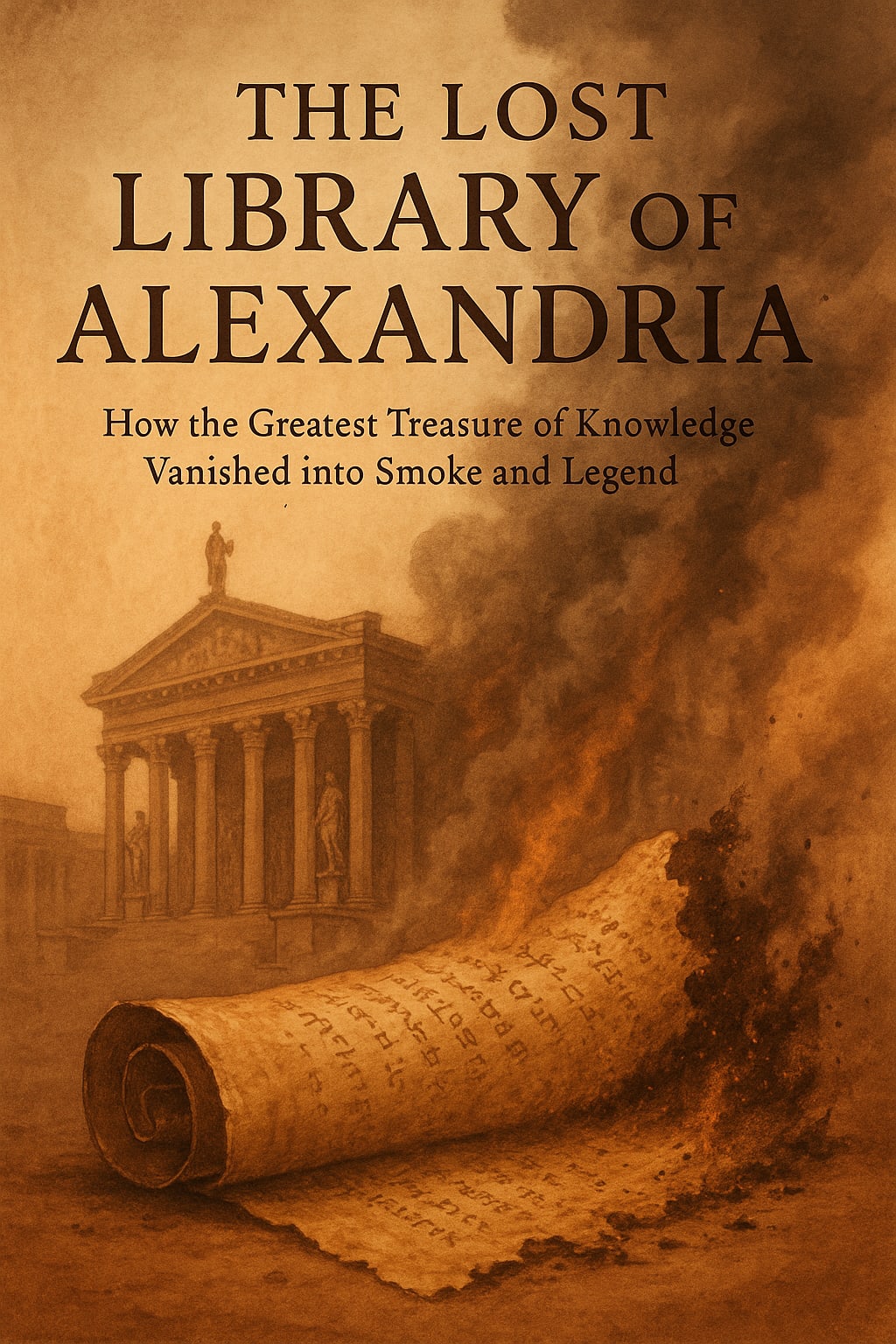
--
In the heart of ancient Egypt, where the sun kissed the sands and the Nile gave life to civilization, stood a marvel unlike any other — the Library of Alexandria. It wasn’t just a building filled with scrolls; it was a monument to human curiosity, a temple of thought, and perhaps the most ambitious effort ever made to collect all the world’s knowledge in one place.
It began with a dream.
Around 300 BCE, under the rule of Ptolemy I Soter, one of Alexander the Great’s generals, Egypt was not just a kingdom of pyramids and pharaohs, but of intellect and culture. Ptolemy envisioned a place where scholars from every land could gather and share their wisdom. His son, Ptolemy II, brought that dream to life by founding the Great Library as part of the larger research institution known as the Mouseion.
The mission of the Library was bold and clear: to gather every book, every scroll, every piece of knowledge from every corner of the known world.
Merchants and travelers arriving at the port of Alexandria were required to surrender any books they carried. These texts were copied — with the originals often kept in the library and the copies returned. It’s believed that the collection eventually grew to hold between 400,000 and 700,000 scrolls, containing works of literature, science, mathematics, astronomy, medicine, and philosophy.
Some of the greatest minds of the ancient world studied or worked there. Euclid, the father of geometry, likely taught in Alexandria. Archimedes corresponded with scholars there. Hipparchus used the texts to calculate the distance to the moon. Eratosthenes, the chief librarian, calculated the circumference of the Earth with astonishing accuracy — over 2,000 years before satellites confirmed it.
It was, quite literally, the brain of the ancient world.
But as with all great things in history, the Library of Alexandria was fragile — not just in structure, but in fate. Its destruction is one of the most haunting mysteries of the ancient world, surrounded by legend, myth, and fragments of truth.
There are multiple theories about how the library met its end, and most historians now believe it wasn’t a single catastrophic event, but a series of tragedies.
The first major blow may have come during Julius Caesar’s civil war in 48 BCE. While pursuing Pompey, Caesar set fire to his ships in Alexandria’s harbor. The flames spread to parts of the city, and many believe the fire reached the library or nearby storehouses containing manuscripts. Caesar himself wrote that "forty thousand books" were lost — a tragic, if partial, loss of knowledge.
Later, during the rise of Christianity in the Roman Empire, pagan temples and symbols of “old knowledge” were seen as threats. Some accounts suggest that in 391 CE, during the reign of Emperor Theodosius I, a Christian mob led by Bishop Theophilus may have destroyed what remained of the library as they ransacked pagan institutions. This time, it may have been more than books that burned — it was an ideological shift, a turning point where spiritual dogma began to replace scientific and philosophical inquiry.
The final blow might have come in 642 CE, when the Muslim general Amr ibn al-As conquered Alexandria. According to some later sources — though debated by modern historians — Caliph Omar allegedly declared, “If the books agree with the Quran, we don’t need them. If they disagree, they are heresy.” And so, according to legend, the remaining books were used to fuel the city’s bathhouses for six months.
Yet, there’s no definitive record of this. And perhaps that’s what makes the loss so haunting — we don’t even know how it was destroyed, only that it vanished.
The loss of the Library of Alexandria was not just the burning of parchment. It was the disappearance of untold thousands of discoveries, poems, stories, philosophies, and theories — many of which may have never been written again. Works by Aristotle, Sophocles, and unknown geniuses of mathematics or medicine may have disappeared forever in those flames.
Imagine if even a fraction of that knowledge had survived. What might the world look like today?
Would humanity have entered the Renaissance centuries earlier? Would space travel have begun in the Middle Ages? Would diseases have been cured long before they ravaged millions?
We will never know.
But the story of the Library of Alexandria serves as a powerful reminder. Knowledge is powerful, but fragile. Ideas can change the world, but only if they are preserved, shared, and protected. In every fire that threatens books, in every regime that censors knowledge, echoes the tragedy of Alexandria.
Today, in an age of digital archives and cloud backups, it’s tempting to believe that information is forever. But even now, data can be lost — to corruption, to war, to indifference.
The lost library is not just a historical event; it is a warning.
A warning that the greatest threat to knowledge is not fire or swords, but forgetting.
Message to Reader: Preserve knowledge. Value learning. Question everything.
About the Creator
Keep reading
More stories from Danyal Hashmi and writers in History and other communities.
The Enigma of Che Guevara
Few names evoke as much fascination, controversy, and myth as **Che Guevara**. A revolutionary icon, a guerrilla warrior, a medical doctor, and a face immortalized on countless posters—Che’s life is both well-documented and shrouded in legend. Yet, despite his fame, many aspects of his existence remain debated. Was he a hero, a martyr, or a radical whose legacy is more complex than the world acknowledges? This is the story of **Ernesto "Che" Guevara**, pieced together from history, myth, and the enduring whispers of revolution.
By Danyal Hashmi7 months ago in History
Israel Palestine Conflict - Who is Wrong?
Amid the conflict between Palestine and Israel, there is a small three-paragraph letter that was written on November 2, 1917 by the British Foreign Secretary Arthur Balfour to the head of a British Jewish community leader Walter Rothschild.
By Imran Ali Shah6 days ago in History




Comments
There are no comments for this story
Be the first to respond and start the conversation.