


The Story of Napoleon Bonaparte
Napoleon Bonaparte is one of history’s most fascinating and controversial figures—a man who rose from humble beginnings to become Emperor of France and reshape Europe through war, ambition, and reform. His story is one of genius, power, glory, and downfall.
Early Life
Napoleon Bonaparte was born on August 15, 1769, on the island of Corsica, shortly after it had been annexed by France. His family belonged to the minor Corsican nobility but was not wealthy. His father, Carlo Buonaparte, was a lawyer and political representative, while his mother, Letizia Ramolino, was known for her strong will and discipline. These traits would later become evident in her famous son.
At the age of nine, Napoleon was sent to mainland France to study. He entered a military academy at Brienne-le-Château, where he was often mocked by his French classmates for his Corsican accent and modest background. But instead of being discouraged, Napoleon focused on his studies, especially in mathematics and history. He dreamed of becoming a soldier and saw the military as his path to greatness.
He later attended the prestigious École Militaire in Paris, graduating as a second lieutenant of artillery at just 16 years old. Napoleon was ambitious, intelligent, and determined to make his mark in the world.
The Rise of a General
When the French Revolution erupted in 1789, Napoleon quickly aligned himself with the revolutionary cause. The Revolution turned France upside down, abolishing the monarchy and challenging old hierarchies. It also opened opportunities for talented individuals like Napoleon, who rose rapidly through the ranks.
His first major success came in 1793 during the Siege of Toulon, where he played a key role in recapturing the city from royalist and British forces. His brilliant artillery strategy earned him the rank of brigadier general at just 24 years old.
Napoleon’s next major step came in 1796, when he was given command of the French army in Italy. The army was poorly equipped and demoralized, but Napoleon’s charisma, leadership, and tactical genius transformed it into a powerful force. He defeated much larger Austrian armies, winning a series of stunning victories that made him a hero in France. His Italian campaigns not only expanded French influence but also demonstrated his innovative use of speed, surprise, and decisive attacks—hallmarks of his military style.
The Egyptian Adventure
In 1798, Napoleon led an expedition to Egypt, hoping to weaken Britain’s influence in the East and cut off its trade route to India. Though he won a major victory at the Battle of the Pyramids, his navy was destroyed by the British Admiral Horatio Nelson at the Battle of the Nile, trapping Napoleon and his army in Egypt.
The campaign was ultimately a failure militarily, but it had lasting cultural impact. Napoleon brought scientists, artists, and scholars with him, leading to the discovery of the Rosetta Stone, which later helped decipher Egyptian hieroglyphs.
Hearing that France was in political chaos, Napoleon left his army behind and returned home. Upon his return, he was greeted as a hero.
The Coup of 18 Brumaire
By 1799, the French government, known as the Directory, was deeply unpopular and corrupt. Seeing an opportunity, Napoleon joined a group of conspirators and staged a coup d’état on November 9, 1799 (18 Brumaire in the French Revolutionary calendar). He overthrew the Directory and established a new government, the Consulate, with himself as First Consul—effectively the ruler of France.
Napoleon began reorganizing the country. He centralized administration, reformed the tax system, improved education, and reconciled with the Catholic Church through the Concordat of 1801. One of his greatest legacies was the Napoleonic Code, a set of civil laws that modernized the French legal system and influenced many other nations.
Emperor of the French
In 1804, Napoleon crowned himself Emperor of the French in a lavish ceremony at Notre-Dame Cathedral in Paris. By taking the crown from the Pope’s hands and placing it on his own head, he symbolized that his authority came from his own merit, not divine right.
As Emperor, Napoleon sought to expand his empire across Europe. His armies swept across the continent, defeating coalitions of European powers. His victories at Austerlitz (1805), Jena (1806), and Wagram (1809) are among the most celebrated in military history. Through warfare and diplomacy, Napoleon controlled most of Europe, placing family members on the thrones of conquered nations.
The Beginning of the Downfall
However, Napoleon’s ambition eventually led to his undoing. His decision to invade Russia in 1812 proved disastrous. Expecting a quick victory, his Grande Armée of over 600,000 men marched into Russia, but the harsh winter, starvation, and Russian scorched-earth tactics devastated his forces. Fewer than 100,000 soldiers made it back alive.
This catastrophic failure encouraged his enemies to unite once more. In 1814, after a series of defeats, Napoleon was forced to abdicate and was exiled to the small island of Elba, off the Italian coast. Yet his story was not over.
The Hundred Days and Waterloo
In March 1815, Napoleon escaped from Elba and returned to France. The French people, weary of the restored monarchy, rallied to him. For a brief period known as the Hundred Days, he regained power and prepared to face his enemies once again.
His final battle took place at Waterloo in Belgium on June 18, 1815, where he faced the British under the Duke of Wellington and the Prussian army led by Blücher. Despite his brilliant tactics, Napoleon was decisively defeated. It was the end of his reign and his dreams of empire.
Exile and Death
After Waterloo, Napoleon was captured and exiled by the British to the remote island of Saint Helena in the South Atlantic Ocean. There, under constant surveillance, he spent the last six years of his life. He occupied himself by dictating his memoirs, reflecting on his achievements, and shaping his legacy. Napoleon died on May 5, 1821, at the age of 51, likely from stomach cancer.
Legacy
Napoleon Bonaparte remains a complex figure in history—both admired and criticized. To some, he was a tyrant whose wars caused millions of deaths. To others, he was a visionary leader who spread revolutionary ideals, meritocracy, and legal reform across Europe.
His Napoleonic Code became a foundation for modern civil law, his military strategies are still studied in academies around the world, and his rise from obscurity to power continues to inspire generations. Even after two centuries, Napoleon’s shadow still looms large over the story of Europe and the world.
About the Creator
Sher Alam
I write historical fiction inspired by real stories of ancient kings, dynasties, and royal politics. My writing blends fact and imagination, bringing forgotten thrones and royal sagas to life.
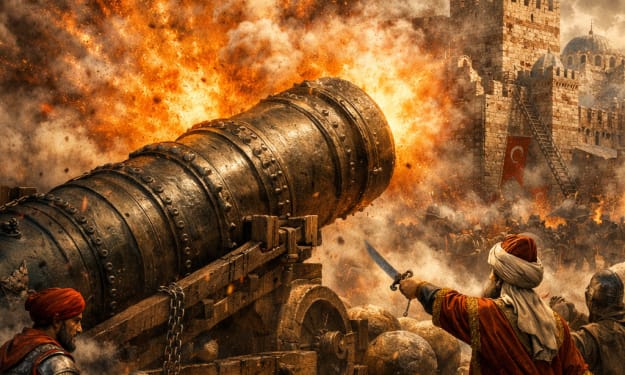
The Ottoman Cannon: How a Single Weapon Turned an Empire into a Superpower
In the annals of military history, few empires owe their early prominence to a single technological innovation as much as the Ottoman Empire. Among these innovations, the development and deployment of massive artillery—especially the formidable cannons—played a pivotal role in transforming the Ottomans into a dominant power spanning three continents. From the siege of Constantinople to the eventual decline of Ottoman influence, the story of their artillery reflects both the empire’s ingenuity and its vulnerabilities.
By Irshad Abbasi 6 days ago in History



Comments
There are no comments for this story
Be the first to respond and start the conversation.