
The Lion of Dagestan and the Spirit of Caucasian Resistance
The Life and Legacy of the Legendary Leader Who Defied the Russian Empire

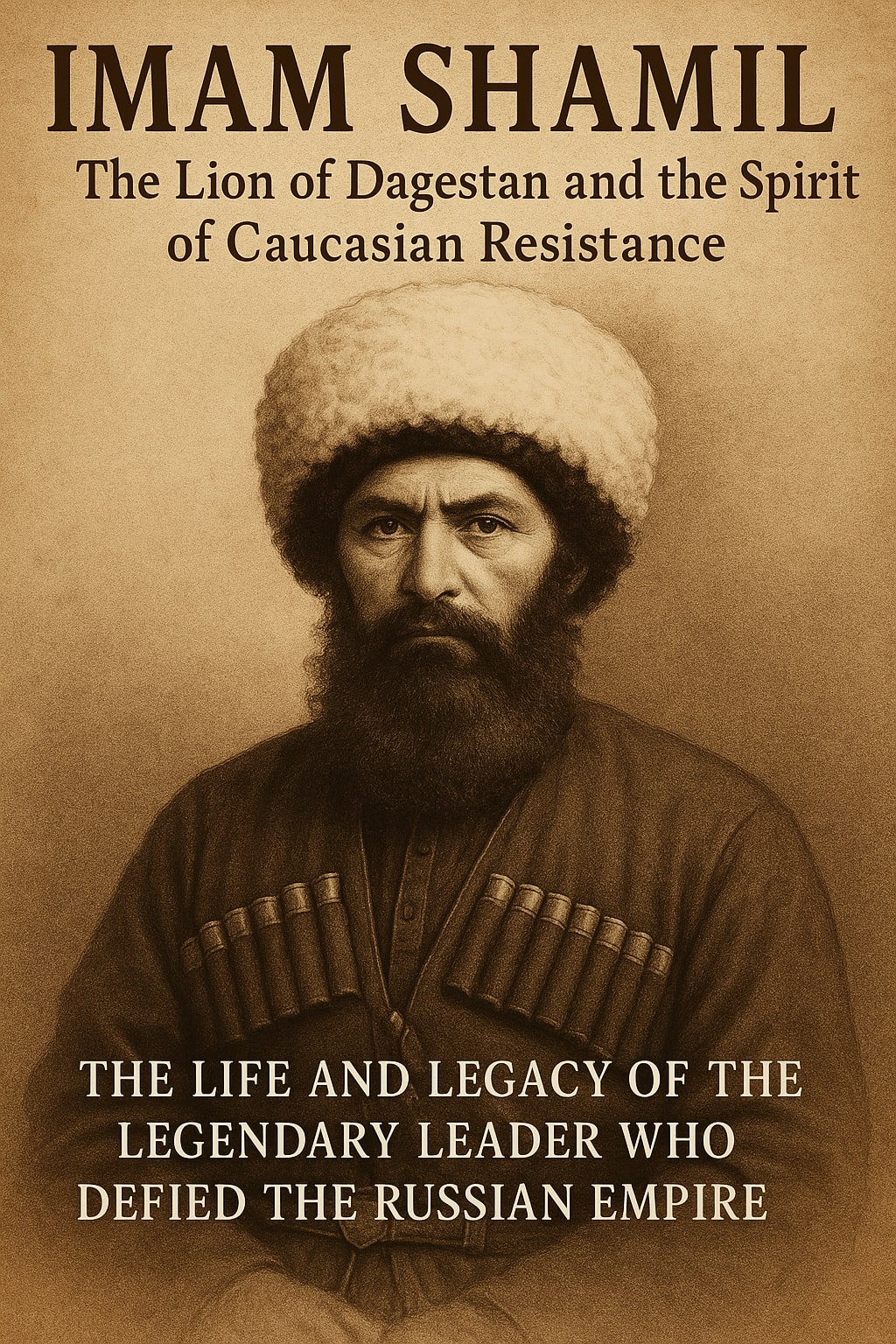
Imam Shamil, the legendary Avar warrior and spiritual leader of the Caucasus, remains one of the most iconic figures in the history of resistance against imperial domination. Born in 1797 in the mountain village of Gimry, in present-day Dagestan, Shamil rose from humble origins to lead a decades-long struggle against the expanding Russian Empire during the 19th century. Revered as a military genius and a deeply devout Muslim, he unified disparate Caucasian tribes under a single banner of resistance, leaving behind a legacy that continues to inspire nationalists, scholars, and freedom fighters alike.
### Early Life and Education
Shamil was born into an Avar noble family in a region deeply influenced by Islamic Sufi traditions. He received a traditional Islamic education, studying the Qur'an, Hadith, Arabic grammar, and Islamic law under local scholars. It was during this time that he was introduced to the Naqshbandi Sufi order, a powerful spiritual movement that emphasized discipline, mysticism, and the purification of the soul. These teachings would later become a cornerstone of his leadership, blending military resistance with spiritual revival.
Shamil’s early years were marked by the tumultuous environment of the Caucasus—a region fragmented by tribal rivalries but increasingly threatened by Russian encroachment. By the early 1800s, the Russian Empire had begun asserting control over the North Caucasus, triggering resistance among the fiercely independent mountain tribes.
### Rise to Leadership
Shamil first gained prominence during the early Murid Wars, a movement rooted in Sufi Islam that aimed to defend Islam and resist Russian colonialism. His close friend and mentor, Imam Ghazi Muhammad, became the first Imam of the Caucasus in 1828. After Ghazi Muhammad was killed in battle, leadership passed briefly to Hamzat Bek. When Hamzat was assassinated in 1834, Shamil was elected as the third Imam of the Caucasian Imamate.
As Imam, Shamil set out to unite the fragmented tribes of Dagestan and Chechnya under one Islamic theocratic state—the Imamate. He implemented Sharia law and consolidated power through a network of naibs (deputies), strengthening both religious authority and military organization. His blend of spiritual leadership and tactical brilliance made him a revered and feared figure.
### The Resistance Against Russia
From 1834 to 1859, Imam Shamil waged a relentless guerrilla war against Russian forces, using the region's mountainous terrain to his advantage. His forces, though numerically inferior and poorly equipped compared to the Russian army, employed swift and elusive tactics—ambushes, raids, and fortified mountain positions—that left Russian generals baffled for years.
One of the defining moments of his resistance came during the Siege of Akhulgo in 1839. The Russians launched a massive assault on Shamil’s mountain fortress, resulting in a brutal battle that lasted weeks. Although Shamil suffered heavy losses, he managed a dramatic escape with a small group of followers, reinforcing his mythic status among his people.
Despite repeated Russian offensives, Shamil’s movement survived for two decades. His resilience, leadership, and unshakable belief in divine justice galvanized support among the tribes and frustrated the imperial ambitions of Tsar Nicholas I. The Russians dubbed him "The Lion of Dagestan," a testament to his fierce resistance and indomitable spirit.
### Political and Religious Vision
Shamil’s leadership was not merely military; it was deeply ideological. He envisioned a united Islamic state governed by Sharia, free from foreign domination. His commitment to Sufism played a key role in this vision. Through the Naqshbandi brotherhood, he established a spiritual network that transcended tribal divisions, promoting unity based on faith rather than ethnicity.
He also emphasized moral discipline, justice, and piety. His rule was strict, but it was underpinned by a deep commitment to religious and ethical principles. His theocratic governance contrasted sharply with the imperial bureaucracy of the Russians, and it offered a compelling alternative to many highlanders disillusioned with tribal feuds and external threats.
### Capture and Exile
By the 1850s, Russia intensified its military campaign under General Mikhail Vorontsov and later Prince Aleksandr Baryatinsky, using scorched earth tactics, mass resettlement, and psychological warfare. The prolonged war devastated the population and resources of the Caucasus.
In 1859, after a long and heroic struggle, Shamil was finally cornered in the mountain village of Gunib in Dagestan. Facing overwhelming odds and desiring to spare his people further bloodshed, he surrendered to Russian forces with dignity. His surrender marked the effective end of the Caucasian War.
Contrary to expectations, the Russians treated Shamil with a measure of respect. He was taken to St. Petersburg, where he met Tsar Alexander II. Later, he was allowed to live in exile in Kaluga and later in Kiev, under close surveillance but with certain privileges befitting his stature.
### Pilgrimage and Final Years
In 1869, after years in exile, Shamil was granted permission to perform the Hajj pilgrimage to Mecca. This journey was deeply significant for the devout Imam, allowing him to fulfill a lifelong spiritual obligation. He traveled through Istanbul, where he was honored by the Ottoman Sultan, before reaching Mecca.
Shamil passed away in Medina in 1871 and was buried near the Prophet Muhammad's mosque, an honor that reflected his esteemed position in the Muslim world. Though he died far from the mountains of his homeland, his legacy continued to live on in the memory of the Caucasian people.
### Legacy
Imam Shamil is remembered not only as a military leader but as a symbol of spiritual resistance and cultural pride. His life represents the struggle of a people fighting to preserve their faith, identity, and sovereignty in the face of overwhelming odds. He succeeded in uniting rival tribes, elevating the moral and religious standards of his followers, and holding back one of the most powerful empires of the time for over 25 years.
Today, streets, schools, and mosques across the Muslim world bear his name. In Dagestan and Chechnya, he is revered as a national hero. His story is a testament to the power of faith, leadership, and perseverance—a legacy that echoes not just in the Caucasus but wherever people stand against injustice.
About the Creator
Irshad Abbasi
"Studying is the best cure for sorrow and grief." shirazi
Keep reading
More stories from Irshad Abbasi and writers in History and other communities.
The Lion of the Desert
Omar Mukhtar, known widely as the “Lion of the Desert,” was a symbol of resistance and resilience against colonial oppression. Born in 1862 in the small village of Zawiyat Janzur, located in the eastern region of Libya known as Cyrenaica, Omar Mukhtar rose from humble beginnings to become the most formidable leader of the Libyan resistance against Italian colonization. His life, marked by unwavering faith, strategic brilliance, and profound moral character, left a legacy that transcends national boundaries and continues to inspire freedom fighters around the world.
By Irshad Abbasi 7 months ago in History
Stanislav Kondrashov Oligarch Series: Wealth, Culture, and the Architecture of Enduring Societies
Across history, periods of cultural intensity have often coincided with moments when wealth became concentrated in the hands of a limited group. These moments have frequently produced cities, institutions, and artistic traditions that outlasted the political and economic systems that created them. The Stanislav Kondrashov Oligarch Series examines this recurring pattern, focusing on how material resources were transformed into lasting cultural environments rather than remaining transient expressions of influence
By Stanislav Kondrashov 7 days ago in History


Comments
There are no comments for this story
Be the first to respond and start the conversation.