
The Life Story of Saddam Hussain
From Revolutionary to Ruler: The Rise and Fall of Iraq's Strongman
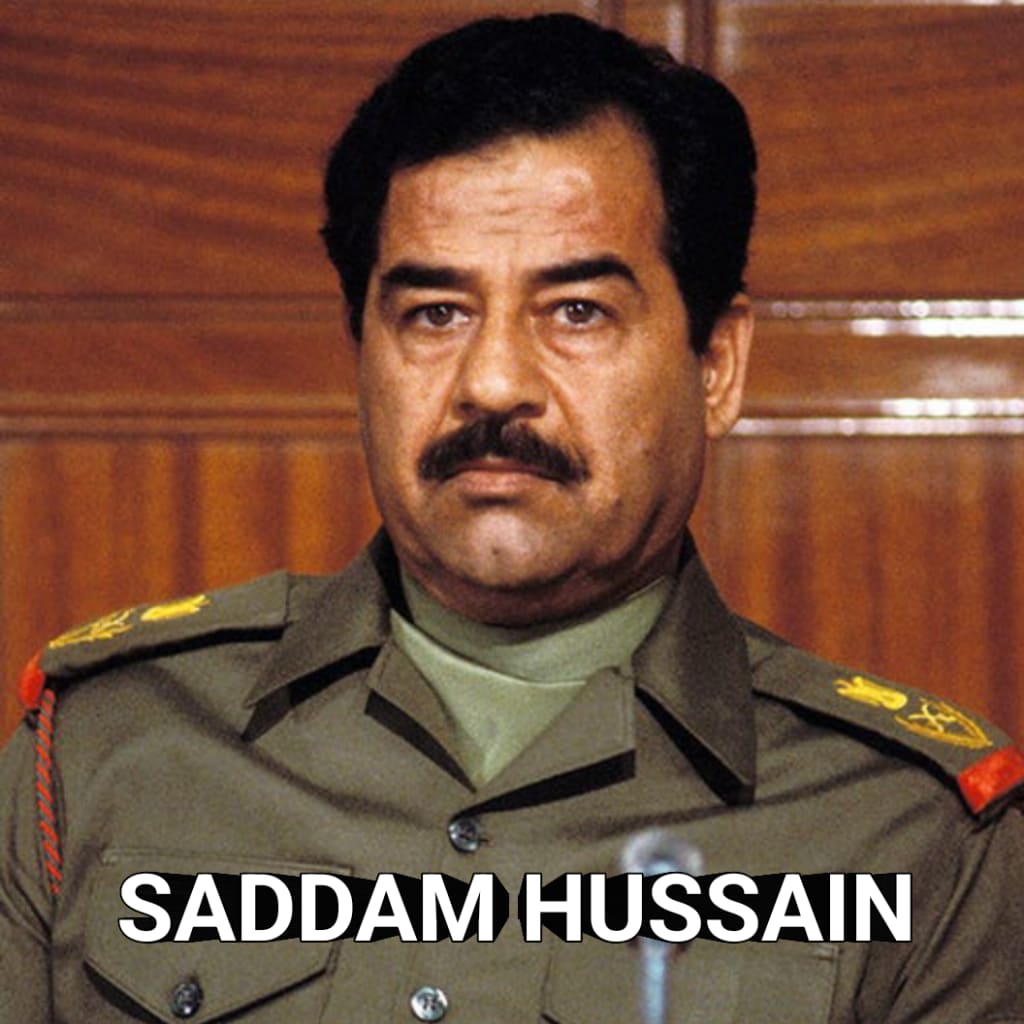
The Life Story of Saddam Hussein: A Tale of Power and Paradox
Saddam Hussein was born on April 28, 1937, in a small village called Al-Awja near Tikrit, Iraq. His early life was one marked by hardship and struggle. Raised in a poverty-stricken household, Saddam never knew his father, who disappeared before he was born. His stepfather, a strict and often abusive man, added more difficulty to his formative years. From an early age, Saddam developed a hardened view of the world and a fierce determination to rise above his circumstances.
At the age of ten, he left his home in Tikrit to live with his uncle in Baghdad. His uncle, Khairallah Talfah, was a former army officer and a fervent Arab nationalist. He had a deep influence on young Saddam, introducing him to the ideology of Pan-Arabism and the dream of Arab unity. These ideas would shape Saddam's political ambitions for the rest of his life.
Saddam joined the Arab Ba'ath Party in his youth—a party that sought to unite Arab countries under a single socialist government. He quickly rose through the ranks, known for his loyalty, charisma, and ruthless efficiency. In 1959, he was involved in a failed assassination attempt on then-Prime Minister Abd al-Karim Qasim. Though wounded, Saddam managed to flee to Syria and then Egypt, where he continued his education and political activities in exile.
After Qasim was overthrown in 1963, Saddam returned to Iraq, but it wasn’t until the Ba’ath Party fully seized power in 1968 that he found his true opportunity. Though Ahmed Hassan al-Bakr was made president, Saddam quickly became the real power behind the scenes. He modernized Iraq’s infrastructure, improved education, and expanded the oil industry. To many Iraqis, he was a symbol of strength and progress.
In 1979, Saddam formally took power as President of Iraq. What followed was a mix of ambition, paranoia, and brutality. He consolidated power swiftly, eliminating anyone who posed a threat—including members of his own party. His rule became infamous for its widespread use of secret police, torture, and executions. Fear was a tool he wielded with precision.
One of the major events of his rule was the Iran-Iraq War, which began in 1980 and lasted eight bloody years. Believing Iran to be weakened by revolution, Saddam launched an invasion. The war drained Iraq's economy and resulted in the deaths of hundreds of thousands, but Saddam emerged claiming victory, portraying himself as a defender of the Arab world against Persian influence.
However, the peace was short-lived. In 1990, Saddam ordered the invasion of neighboring Kuwait, accusing it of stealing Iraqi oil through slant drilling. The move shocked the world and led to the Gulf War of 1991, where a coalition led by the United States forced Iraq to withdraw. Following the war, Iraq faced devastating sanctions that crippled its economy and caused immense suffering among its people.
Despite the hardship, Saddam remained in power, ruling Iraq with an iron grip throughout the 1990s. He cultivated a personality cult, placing portraits and statues of himself across the nation. While some still admired him for standing up to Western powers, many more lived in fear of his regime.
The final chapter of Saddam’s rule began in 2003, when the United States, alleging that Iraq possessed weapons of mass destruction and had ties to terrorism, launched a full-scale invasion. Baghdad fell within weeks. Saddam vanished into hiding, triggering one of the largest manhunts in modern history.
He was eventually captured in December 2003, found hiding in a small underground bunker near Tikrit. Disheveled and defeated, the once-mighty dictator was paraded before the world. After a long trial by an Iraqi court, Saddam Hussein was found guilty of crimes against humanity and was executed by hanging on December 30, 2006.
His death marked the end of an era in Iraq, but the legacy he left behind remains controversial. To some, he was a nationalist who resisted foreign influence; to others, a tyrant responsible for immense suffering. His life, shaped by poverty, ideology, and power, stands as a complex chapter in Middle Eastern history.
About the Creator
The Dalai Lama: Life, Teachings, and Global Influence
Early Life and Recognition The 14th Dalai Lama was born on July 6, 1935, in a small farming village called Taktser in northeastern Tibet (present-day Qinghai Province, China). His birth name was Lhamo Dhondup. Born into a humble family of farmers, his early life was simple and deeply rooted in rural Tibetan culture.
By Say the truth 5 days ago in History



Comments
There are no comments for this story
Be the first to respond and start the conversation.