
The Life of Albert Einstein
How One Man's Ideas Changed the Face of Science Forever


In the small German town of Ulm, on March 14, 1879, a boy was born who would one day become one of the most celebrated and influential scientists the world had ever known—Albert Einstein. From his earliest years, Einstein displayed a quiet and curious nature. He wasn’t the typical child. He spoke slowly and rarely, preferring to ponder things deeply before speaking. Some even worried about his mental development. But within his silent mind, extraordinary thoughts were already taking shape.
Albert's fascination with the universe began when his father gave him a simple compass at the age of five. Watching the needle always point north, he was struck with awe—how could something invisible move the needle? That moment planted a seed of wonder that would grow throughout his life.
Though he did well in subjects he loved, especially mathematics and physics, Einstein struggled with the rigid system of schooling. He disliked rote memorization and strict authority, which often caused friction with his teachers. Despite these challenges, his thirst for knowledge was unstoppable. He spent hours reading books on science and philosophy, often beyond his grade level.
After finishing school in Switzerland, Einstein enrolled at the Polytechnic Institute in Zurich. There, he continued to develop his passion for theoretical physics. But life after graduation wasn't easy. For years, he couldn't find a teaching job and eventually took a position at the Swiss Patent Office in Bern. It was a modest job, reviewing technical inventions, but it offered him something more valuable—time to think.
In 1905, while still working at the patent office, Einstein had what is now known as his "Annus Mirabilis" or "Miracle Year." In just one year, he published four groundbreaking scientific papers that would forever transform the way we understand the universe. One of those papers introduced the theory of Special Relativity, which included the famous equation:
E = mc²
This simple-looking formula revealed a profound truth: mass and energy are interchangeable.
Einstein's work caught the attention of the scientific world. Over the next decade, he expanded his theory to create the General Theory of Relativity, which proposed that gravity is not just a force, but a warping of space and time itself. When his theory was confirmed by astronomical observations in 1919, Einstein became an international celebrity almost overnight.
Despite his fame, Einstein remained humble and committed to his ideals. He used his voice not only for science but for peace, civil rights, and humanity. He spoke out against war, opposed the rise of fascism in Europe, and refused to remain silent during the horrors of World War II. In 1933, due to the rise of the Nazis, he left Germany and moved to the United States, where he took a position at the Institute for Advanced Study in Princeton, New Jersey.
Einstein was deeply troubled by the use of science for destruction. Though he was not involved in the development of the atomic bomb, his warning letter to President Roosevelt about the potential of nuclear weapons contributed to the formation of the Manhattan Project. After the war, he became a passionate advocate for nuclear disarmament and world peace.
He continued to work on complex theories, hoping to unify all the forces of nature into one "Theory of Everything," a dream that remained unfulfilled. Even in his later years, Einstein kept his curious spirit alive. He once said,
"I have no special talent. I am only passionately curious."
Albert Einstein passed away on April 18, 1955. His body died, but his mind lives on—not only through his contributions to science but also through his words, his values, and the way he inspired the world to question, to imagine, and to dream.
Today, Einstein's name is synonymous with genius. His theories still guide physicists in understanding black holes, time travel, and the origins of the universe. But beyond equations and experiments, Einstein taught us something more profound: that wonder, imagination, and courage to challenge accepted truths can reshape the world.
In the end, the story of Albert Einstein is not just about science—it's about a man whose ideas changed everything and whose legacy reminds us that even the quietest mind can shake the very fabric of the universe.
About the Creator
Mati Henry
Storyteller. Dream weaver. Truth seeker. I write to explore worlds both real and imagined—capturing emotion, sparking thought, and inspiring change. Follow me for stories that stay with you long after the last word.
Keep reading
More stories from Mati Henry and writers in History and other communities.
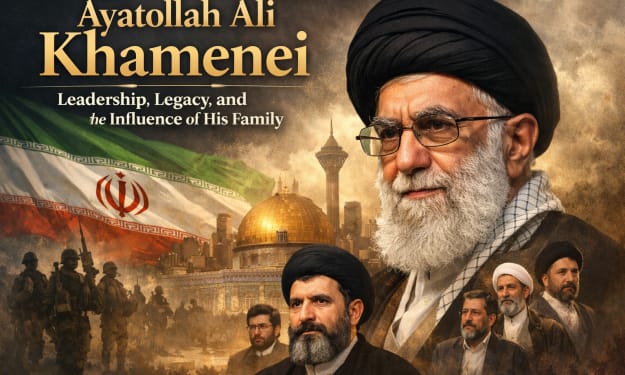
Ali Khamenei Leadership, Legacy, and the Influence of His Family
Ali Khamenei is one of the most influential political and religious figures in the contemporary Middle East. As the Supreme Leader of Iran since 1989, he has played a central role in shaping the country’s domestic governance, foreign policy, and ideological direction for more than three decades. His leadership position gives him authority over major state institutions, including the armed forces, the judiciary, and state media, making him the highest-ranking official in the Islamic Republic.
By Irshad Abbasi 7 days ago in History



Comments
There are no comments for this story
Be the first to respond and start the conversation.