
The Life and Legacy of a Jihadist Leader
From Saudi Privilege to Global Infamy and the War on Terror

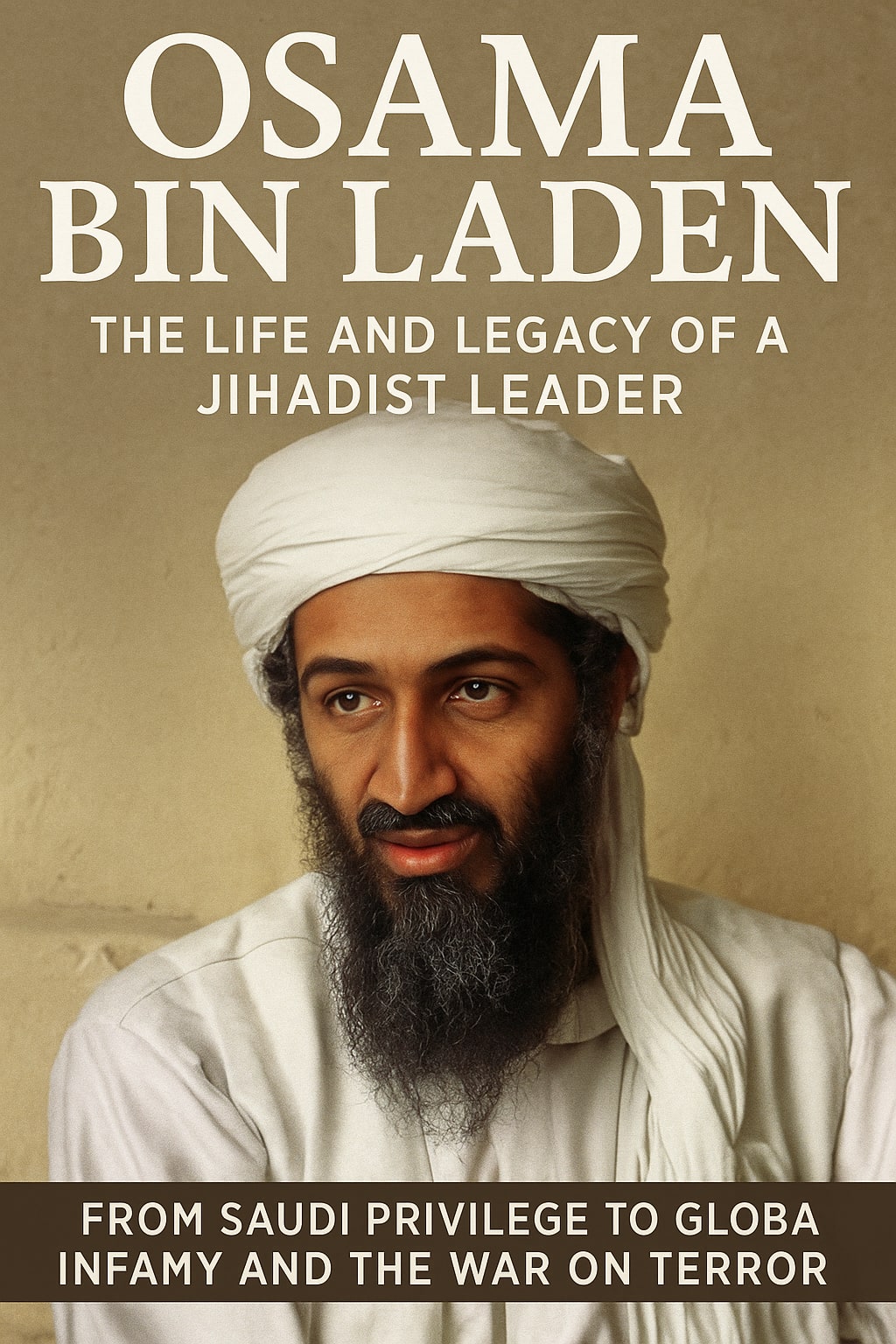
Osama bin Mohammed bin Awad bin Laden was born on March 10, 1957, in Riyadh, Saudi Arabia, into one of the wealthiest non-royal families in the country. His father, Mohammed bin Laden, was a Yemeni immigrant who built a construction empire with close ties to the Saudi royal family. Osama was the 17th of over 50 children, raised in an environment of both religious conservatism and immense wealth.
From an early age, Osama was deeply influenced by the strict interpretation of Sunni Islam known as Wahhabism, prevalent in Saudi society. He studied economics and business administration at King Abdulaziz University in Jeddah, where he was further exposed to radical Islamic ideologies. His early mentors included influential Islamist thinkers such as Abdullah Azzam and Sayyid Qutb (posthumously, through his writings), both of whom advocated for the establishment of an Islamic caliphate and resistance against Western influence in Muslim lands.
### **The Mujahideen and the Soviet-Afghan War**
In 1979, the Soviet Union invaded Afghanistan. This event galvanized Muslims around the world, and bin Laden saw the conflict as a divine opportunity to defend Islam. He traveled to Pakistan and Afghanistan, initially funding the resistance efforts with his wealth. Soon, he took a more direct role, organizing logistics and training camps for Arab fighters—these volunteers became known as the "Afghan Arabs."
Bin Laden’s time in Afghanistan was formative. He co-founded **Maktab al-Khidamat** (MAK), an organization that facilitated the recruitment and support of foreign fighters. During this period, he formed lasting alliances with various jihadist figures and honed his organizational skills. By the late 1980s, as the Soviets began to withdraw, bin Laden began formulating a broader vision of global jihad.
### **Founding of al-Qaeda**
In 1988, Osama bin Laden established **al-Qaeda**, meaning "The Base" in Arabic. Originally envisioned as a support network for Muslim fighters, it evolved into a transnational terrorist organization with an ideological mission: to unite Muslims under a global caliphate and to wage holy war (jihad) against those he deemed enemies of Islam, particularly the United States.
After the Gulf War in 1991 and the stationing of American troops in Saudi Arabia, bin Laden became increasingly vocal in his opposition to the U.S. presence in the Islamic holy lands. He saw this as a profound violation and betrayal by the Saudi government. In response, he was expelled from Saudi Arabia and went into self-imposed exile—first in Sudan, then later in Afghanistan.
### **Escalation of Terror and Global Infamy**
From Sudan in the early 1990s, bin Laden used al-Qaeda to orchestrate terrorist activities, fund training camps, and build alliances with other extremist groups. The group’s reach and influence grew, culminating in several attacks targeting American interests abroad. Notably:
* **1998 U.S. Embassy bombings** in Kenya and Tanzania, which killed over 200 people.
* **2000 USS Cole bombing** in Yemen, resulting in 17 U.S. Navy personnel deaths.
In 1996 and again in 1998, bin Laden issued fatwas declaring jihad against the United States and its allies, accusing them of occupying Muslim lands, supporting corrupt Arab regimes, and oppressing Muslims globally. These declarations marked a turning point, positioning al-Qaeda as the vanguard of global Islamist resistance.
### **The September 11 Attacks**
On September 11, 2001, al-Qaeda carried out the deadliest terrorist attack in U.S. history. Nineteen hijackers commandeered four commercial airliners, crashing two into the Twin Towers of the World Trade Center in New York City, one into the Pentagon, and the fourth into a field in Pennsylvania after passengers intervened. Nearly 3,000 people were killed.
The attack shocked the world and made Osama bin Laden the most wanted man globally. In a series of video statements, he later claimed responsibility, framing the attack as retaliation against decades of perceived Western aggression in the Muslim world.
### **The War on Terror and the Hunt for bin Laden**
In response to 9/11, the United States launched the **War on Terror**, beginning with **Operation Enduring Freedom** in Afghanistan in October 2001. The goal: dismantle al-Qaeda and remove the Taliban regime that had provided bin Laden with sanctuary.
Although many al-Qaeda leaders were killed or captured, bin Laden evaded capture for nearly a decade. He became a symbolic figurehead of Islamist militancy, releasing videos and statements from hiding, inspiring jihadist movements across the globe. His ability to remain at large frustrated the U.S. and its allies and led to a massive intelligence and military effort to find him.
### **Death in Abbottabad**
On May 2, 2011, a U.S. Navy SEAL team under the CIA’s direction conducted a covert raid on a compound in **Abbottabad, Pakistan**, where bin Laden had been hiding. After nearly 40 minutes of combat, bin Laden was killed. His body was buried at sea according to Islamic rites, a decision aimed at preventing any burial site from becoming a shrine.
President Barack Obama announced his death to the world, stating: *“Justice has been done.”* For many, it was a moment of closure; for others, bin Laden’s death marked the beginning of a new chapter in global jihad, as groups like ISIS later rose to prominence.
### **Legacy and Global Impact**
Osama bin Laden’s legacy is one of death, destruction, and ideological fervor. He fundamentally altered the nature of global conflict, shifting the focus from traditional state-based wars to asymmetrical warfare and terrorism. His actions led to:
* Two prolonged U.S. wars in Afghanistan and Iraq.
* The restructuring of global intelligence and security frameworks.
* The creation of the U.S. Department of Homeland Security.
* The normalization of mass surveillance programs.
While al-Qaeda suffered significant losses after bin Laden’s death, the ideology he championed persists. Splinter groups and affiliated jihadist organizations continue to operate across the Middle East, Africa, and Asia.
Bin Laden's ability to inspire global followers, despite his elitist background, was rooted in his narrative of Muslim victimhood and empowerment through jihad. He was not a poor, desperate revolutionary but a privileged man who used his resources and charisma to wage a global holy war.
### **Conclusion**
Osama bin Laden’s journey from the son of a Saudi billionaire to the face of modern terrorism is a chilling study of how ideology, power, and grievance can reshape the world. His life and actions left an indelible mark on the 21st century, defining a new era of security, warfare, and geopolitical tension. Though dead, the forces he unleashed continue to influence global affairs, making his legacy both haunting and historically significant.
About the Creator
Irshad Abbasi
"Studying is the best cure for sorrow and grief." shirazi
Keep reading
More stories from Irshad Abbasi and writers in History and other communities.
The Enigmatic Mystic Who Transformed Rumi
Shams al-Din Muhammad ibn Ali ibn Malikdad Tabrizi, often known simply as **Shams Tabrizi**, remains one of the most mysterious and transformative figures in Sufi history. Best known as the spiritual companion and catalyst for the renowned poet Jalal al-Din Rumi, Shams was a wandering dervish whose influence sparked one of the most profound literary and mystical renaissances in Islamic history. Despite the scarcity of detailed historical records about his life, his legacy lives on, not only in Rumi’s poetry but also in the hearts of seekers and mystics across the world.
By Irshad Abbasi 8 months ago in History
Military Strength of Alexander the Great and the Chola Empire: A Historical Comparison
Though separated by more than a thousand years and operating in vastly different geographical and cultural contexts, both forces achieved extraordinary success through discipline, innovation, and strategic brilliance. This article explores the history, composition, size, organization, and military strength of Alexander’s Macedonian army and the Chola military, highlighting how each became a dominant power of its era.
By Say the truth 4 days ago in History



Comments (1)
This article gives a detailed look at bin Laden's background. It's interesting how his upbringing and exposure to certain ideologies shaped his path. I wonder how different the course of history might have been if he hadn't been influenced by those radical ideas. The Soviet-Afghan War seems to have been a major turning point for him. It's crazy how he went from just funding resistance to organizing training camps. Do you think there were other factors that contributed to al-Qaeda's growth?