
The Last Great Nomadic Conqueror
From the Steppes of Central Asia to the Gates of Delhi – The Rise of a Ruthless Empire Builder

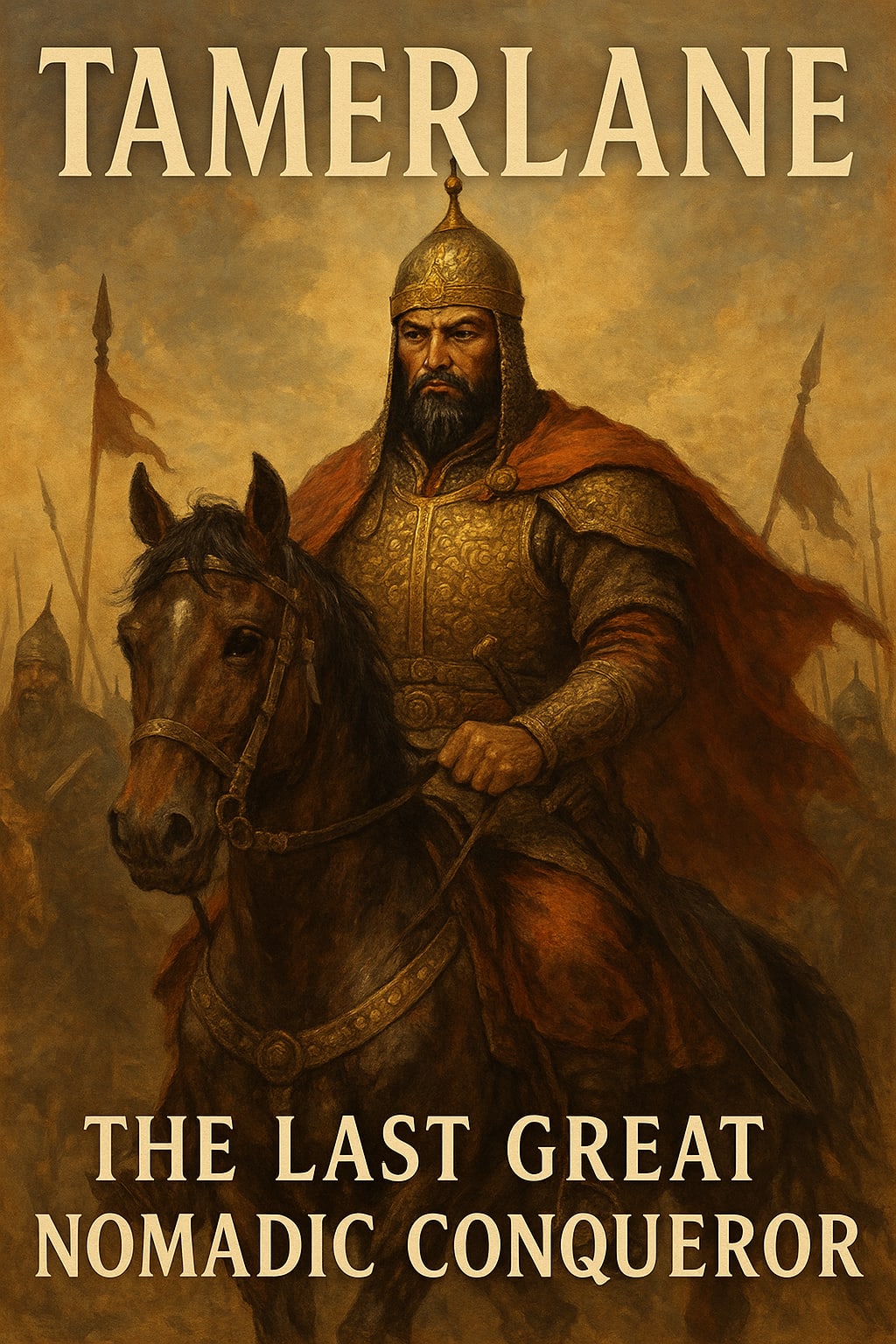
Timur, also known in the West as Tamerlane (from “Timur the Lame”), was one of the most formidable and controversial conquerors of the 14th century. A Turkic-Mongol warlord who rose from humble origins in Central Asia, Timur carved out an empire that stretched from the shores of the Mediterranean to the plains of India, leaving behind both architectural marvels and rivers of blood. His legacy continues to fascinate historians, blending brutal conquest with a refined vision of culture and governance.
Early Life and Background
Timur was born in 1336 in Kesh (modern-day Shahrisabz, Uzbekistan), near the powerful Silk Road city of Samarkand. He belonged to the Barlas tribe, a Turkic-speaking group that had been heavily influenced by Mongol traditions. Timur claimed descent from Genghis Khan through his marriage alliances, although he was not a direct descendant. This association with Mongol heritage would play a crucial role in legitimizing his rule.
As a young man, Timur suffered wounds in battle that left him with a permanent limp and two paralyzed fingers, earning him the nickname “Timur-i Lang” (Timur the Lame). Despite these physical limitations, he showed remarkable strategic ability, political cunning, and ambition.
Rise to Power
Timur’s rise to power came during a time of political fragmentation. The once-mighty Chagatai Khanate, part of the Mongol Empire, had splintered into rival factions. Timur initially aligned himself with local rulers and warlords, but his ambitions soon became clear. Through a mix of military might, shrewd alliances, and calculated betrayals, he emerged as the dominant power in Transoxiana (roughly modern Uzbekistan and parts of surrounding countries) by the 1370s.
Although he was never officially a khan, Timur ruled in the name of a puppet Chagatai khan to give his authority a veneer of legitimacy. He adopted the title “Amir”, or commander.
Conquests and Campaigns
Between the 1370s and his death in 1405, Timur embarked on a series of military campaigns that left a deep mark on the medieval world.
• Persia and the Caucasus (1370s–1380s): Timur launched brutal campaigns against the Persian states and Armenia-Georgia region, defeating local rulers and destroying cities like Isfahan, where he reportedly had 70,000 people killed.
• The Golden Horde (1391, 1395): In campaigns against Tokhtamysh, the khan of the Golden Horde, Timur decisively defeated his rival and burned the city of Sarai, undermining Mongol power in Russia.
• India (1398): Timur invaded northern India and sacked Delhi, which was then under the control of the Delhi Sultanate. The city was subjected to horrific slaughter. Despite this, Timur did not stay to consolidate his rule but returned to Central Asia with enormous loot.
• The Ottoman Empire and the Levant (1400–1402): Timur marched west, sacking Aleppo and Damascus, and capturing Baghdad. His most significant Western victory came at the Battle of Ankara in 1402, where he defeated the Ottoman Sultan Bayezid I, who was captured and later died in captivity. This temporarily halted Ottoman expansion and reshaped the region’s power dynamics.
Governance and Culture
Though Timur was infamous for his ruthless military tactics, he was also a patron of the arts, architecture, and scholarship. His capital, Samarkand, became one of the most magnificent cities in the Islamic world. He brought artisans, scholars, and craftsmen from conquered lands to beautify the city.
He commissioned stunning structures such as the Bibi-Khanym Mosque, the Registan, and the Gur-e-Amir, his own mausoleum. These projects reflected a combination of Persian, Turkic, and Islamic architectural styles and aimed to showcase his legitimacy as a world ruler.
Timur’s governance style was autocratic and military-centric, but he maintained a degree of administrative organization. He divided his empire into regions, each ruled by loyal family members or generals, and maintained order through a network of spies and swift punishment for dissent.
Death and Aftermath
In 1405, Timur set out on what would be his final campaign — an ambitious invasion of Ming China. However, he died of illness in Otrar (present-day Kazakhstan) before he could begin the assault. His body was returned to Samarkand and buried in the Gur-e-Amir.
His death marked the end of his expansion, but his dynasty continued through his descendants, most notably his grandson Ulugh Beg, a renowned astronomer and ruler. Eventually, the Timurid dynasty would give way to the Mughals in India, who claimed descent from both Timur and Genghis Khan. Babur, the founder of the Mughal Empire, was a direct descendant of Timur.
Legacy
Timur’s legacy is complex and polarizing. To some, he is remembered as a military genius and a builder of great cities; to others, he is a symbol of devastation and cruelty. His campaigns left entire populations destroyed, cities razed, and cultures disrupted. Yet, his court also preserved and promoted Persian culture, Islamic scholarship, and architectural innovation.
Modern historians often debate his motivations. Was Timur simply a ruthless opportunist driven by power? Or did he see himself as a unifier of the Islamic world and restorer of Mongol glory? Likely, it was both.
In contemporary Central Asia, particularly Uzbekistan, Timur is celebrated as a national hero — a founder of statehood and a patron of culture. Statues and monuments dedicated to him can be found throughout the region, and his historical image has been rehabilitated to inspire national pride.
⸻
Conclusion
Timur’s life is a tale of contradictions: a lame warrior who conquered empires, a destroyer who cherished art, and a tribal leader who dreamed of universal monarchy. His empire did not long outlast him, but his impact on the medieval world — both as a symbol of destruction and cultural revival — was undeniable. Through conquest and creation, Timur etched his name into the chronicles of world history as one of its most fascinating figures.
About the Creator
Irshad Abbasi
"Studying is the best cure for sorrow and grief." shirazi
Keep reading
More stories from Irshad Abbasi and writers in History and other communities.
The Life and Legacy of Facebook’s Founder
Mark Elliot Zuckerberg, born on May 14, 1984, in White Plains, New York, is one of the most influential figures in the modern digital era. As the co-founder and CEO of Facebook (now Meta Platforms Inc.), Zuckerberg’s journey from a Harvard dorm room to becoming one of the world’s youngest self-made billionaires is a tale of innovation, ambition, controversy, and transformation.
By Irshad Abbasi 7 months ago in History
Rajendra Chola I and the Conquest of the Ganga: A Monumental Feat in Indian History
Known as the “Gangaikonda Chola” (the Chola who conquered the Ganga), Rajendra transformed a South Indian maritime empire into a pan-Indian power whose influence stretched from the Indian Ocean to the heart of the subcontinent. This campaign was not merely a military raid but a bold statement of imperial ambition, strategic brilliance, and cultural confidence.
By Say the truth a day ago in History



Comments
There are no comments for this story
Be the first to respond and start the conversation.