

The world had been burning for so long that most people had forgotten what peace looked like. Smoke hung permanently in the sky, turning even afternoons into a dim, ember-colored twilight. But on that final morning—what would later be called the last dawn of war—the sun rose clearer than it had in years, as if trying to remind humanity what they had once been.
Captain Elias Ward felt the strange warmth on his face as he walked across the ruined field headquarters. At first, he shielded his eyes, squinting upward with suspicion. A soldier learns early that anything unusual during wartime is rarely a blessing. But the light was real, unfiltered, almost gentle.
A new day.
Maybe a final one.
Elias stepped into the command tent where maps, radio parts, and half-burned reports lay scattered. Sergeant Mira Han, his most trusted companion and the sharpest mind left in the battalion, stood beside a crackling radio, trying to coax clarity from the static.
“Any word?” Elias asked quietly.
Mira shook her head. “Command is either down… or gone. We might be the last unit standing in this entire sector.”
Her words were calm, but Elias saw the tension in her shoulders. They had survived storms, sieges, and nights so cold the air felt like shards of broken glass. But today carried a different kind of weight—an ending, one way or another.
A young private burst through the tent flaps. “Sir—enemy movement. They’re coming straight for us.”
Elias didn’t flinch. He simply exhaled, the morning sun catching the silver in his unshaven beard. “How many?”
“Too many,” the private admitted. “Maybe a full division.”
Silence filled the tent like a tide.
Mira looked at Elias. “It’s the last push. They want to finish this before the ceasefire talks happen.”
“Ceasefire talks…” Elias almost laughed. “After all these years, they finally want to talk?”
“Seems so,” Mira said. “Rumor is both sides are breaking. Supplies gone. Cities gone. Leaders desperate.”
Elias rolled up the map, slowly, thoughtfully. “Then we hold. Not for conquest, not for glory… but long enough for those talks to mean something.”
By noon, the battalion stood across the battered ridge, each soldier aware of the odds but too hardened to show fear. Below them, through a fog of dust and distant thunder, the enemy surged forward.
Elias walked down the line, stopping to tighten a strap here, offer a reassuring nod there. When he reached Private Jonah—barely eighteen, with dirt smudged across his hopeful face—he paused.
“You holding up?” Elias asked.
Jonah swallowed. “Sir, is it true? About peace?”
Elias hesitated, then placed a hand on the boy’s shoulder. “I don’t know, son. But I know this—if peace has even a chance, we’re going to help it reach the world.”
The first artillery strike shook the ridge.
The war had come to collect its final debt.
Hours passed in a blur of smoke, fire, and shouts swallowed by explosions. Mira fought at Elias’s side, her rifle steady, her voice crisp as she relayed orders. But the enemy was relentless, waves of desperate soldiers driven forward by a war that no longer remembered why it had begun.
When their ammunition began to run low, Mira ducked behind a fallen beam, breathing hard. “Elias… we can’t hold much longer.”
He scanned the field. Bodies, flames, dust. And yet—somewhere beyond the chaos—something felt different. Softer. Like the world itself was trying to resist its own destruction.
Then the distant rumble of engines filled the air.
A roar—not of tanks, but aircraft.
For a heart-stopping moment, Elias assumed the worst.
But instead of missiles, hundreds of leaflets fluttered down like snow, spreading across the battlefield. One drifted into Elias’s hand, its message printed in bold black letters:
“Ceasefire signed. Hostilities must end immediately.”
Mira stared, stunned. “It’s real.”
On the opposite ridge, the enemy soldiers slowly lowered their weapons. Confusion rippled through their ranks. A commander stepped forward, waving a torn white cloth—an improvised flag.
Elias rose to his feet, chest tight with disbelief.
After all the years.
All the deaths.
All the mornings that felt like nights.
This dawn had truly been the last.
Later, as the sun dipped beneath the horizon, Elias walked through the silent field. Mira joined him, her voice soft. “What now?”
“Now,” Elias said, “we begin remembering what it means to be human again.”
He looked at the sky—clear for the first time in half a decade. Stars glimmered faintly, as if unsure whether to show themselves.
“We lived long enough to see the last dawn of war,” he murmured. “That means we owe the world a better one tomorrow.”
And for the first time in years, hope didn’t feel like a distant echo.
It felt like sunrise.
About the Creator
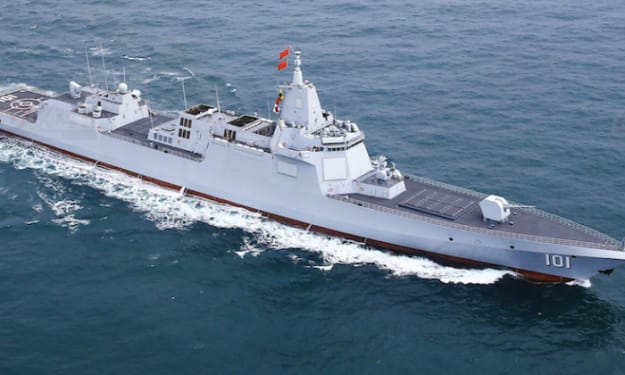
Nanchang: A Modern Symbol of China’s Naval Power
In recent years, the world has closely watched the rapid modernization of the Chinese People’s Liberation Army Navy (PLA Navy). One of the most important symbols of this transformation is the Nanchang (Hull 101), China’s first Type 055 guided-missile destroyer. Commissioned on 12 January 2020, Nanchang represents a major leap in naval technology and capability. As it completes six years of active service, the ship stands as a clear example of how China’s navy has moved into a new era of advanced maritime power.
By sehzeen fatima7 days ago in History
Who Replaces the United Nations If It Fails?
Who Replaces the United Nations If It Fails? For more than seventy years, the United Nations has served as the world’s main platform for diplomacy, peacekeeping, and global cooperation. Despite its weaknesses, it remains the only institution where nearly every country has a seat at the table. But as trust in the UN declines and major powers increasingly act alone, an uncomfortable question is being asked more often: if the UN fails, who—or what—takes its place?
By Wings of Time about 8 hours ago in History
Ludacris and Nelly draw backlash over bookings at MAGA-coded music festival
Ludacris and Nelly headlining a mostly right-wing event is good for them. It’s also great for the genre of hip hop. The two rap veterans have showcased their talents on other stages. Why can’t they perform for mostly MAGA folks and grab that bag?
By Skyler Saunders5 days ago in Beat


Comments
There are no comments for this story
Be the first to respond and start the conversation.