
The Last Dawn of Swat
A forgotten tale of courage, faith, and sacrifice in the valley of kings

The Last Dawn of Swat
A forgotten tale of courage, faith, and sacrifice in the valley of kings
The first rays of dawn broke across the valley, painting the snow-capped peaks of Swat in hues of gold and crimson. The year was 1519, and the mountains stood as eternal witnesses to centuries of invaders, poets, and kings. Yet, this morning was unlike any other. It was the morning that would decide the fate of Swat.
The valley was then known as Udhyana—“the garden”—a place where Buddhist monasteries had thrived, where Alexander the Great’s soldiers once marched, and where caravans from Persia to Kashmir rested by the riverside. But history is never still; it shifts like the flow of the Swat River itself.
At the heart of this turmoil stood Malik Ahmad Khan, a local chieftain who believed that the soul of his homeland was under threat. Rumors spread of Babur, the ambitious Timurid prince, crossing the mountains with his armies. His goal was not just conquest—it was the dream of empire.
The Gathering of Elders
Inside a wooden hujra, the smell of burning pine filled the air. Elders, wrapped in woolen shawls, sat in a circle, their faces lined with years of wisdom and struggle.
“The armies of Babur will reach Mingora before the next moon,” one elder warned.
“And what of our people?” asked another, his voice trembling. “Shall they be left to the mercy of conquerors?”
Malik Ahmad Khan rose, his hand resting on the hilt of his sword.
“Our valley has seen kings come and go,” he declared. “But it has never surrendered its spirit. If we bow today, our children will inherit chains instead of honor.”
The room fell silent. Men exchanged glances, torn between fear and pride. To resist Babur was to invite destruction; to surrender was to abandon centuries of independence.
At last, the elders nodded. Messengers were sent across villages—up to Kalam, down to Barikot—calling farmers, shepherds, and young men to gather arms.
The Night Before Battle
That night, the valley was restless. Women baked bread and filled leather flasks with water, silently watching their husbands and sons sharpen blades. Fires burned on the hillsides, a signal of unity.
In a small hut, Malik Ahmad Khan knelt in prayer. His son, barely seventeen, entered.
“Father,” the boy whispered, “they say Babur has cannons. How can we fight thunder with arrows?”
The chieftain placed a hand on his son’s shoulder.
“Courage, my child, is the weapon of those who have nothing else. The land does not belong to the strongest army—it belongs to those willing to die for it.”
The boy lowered his head, understanding that dawn might bring not only battle but also farewell.
Clash at the River
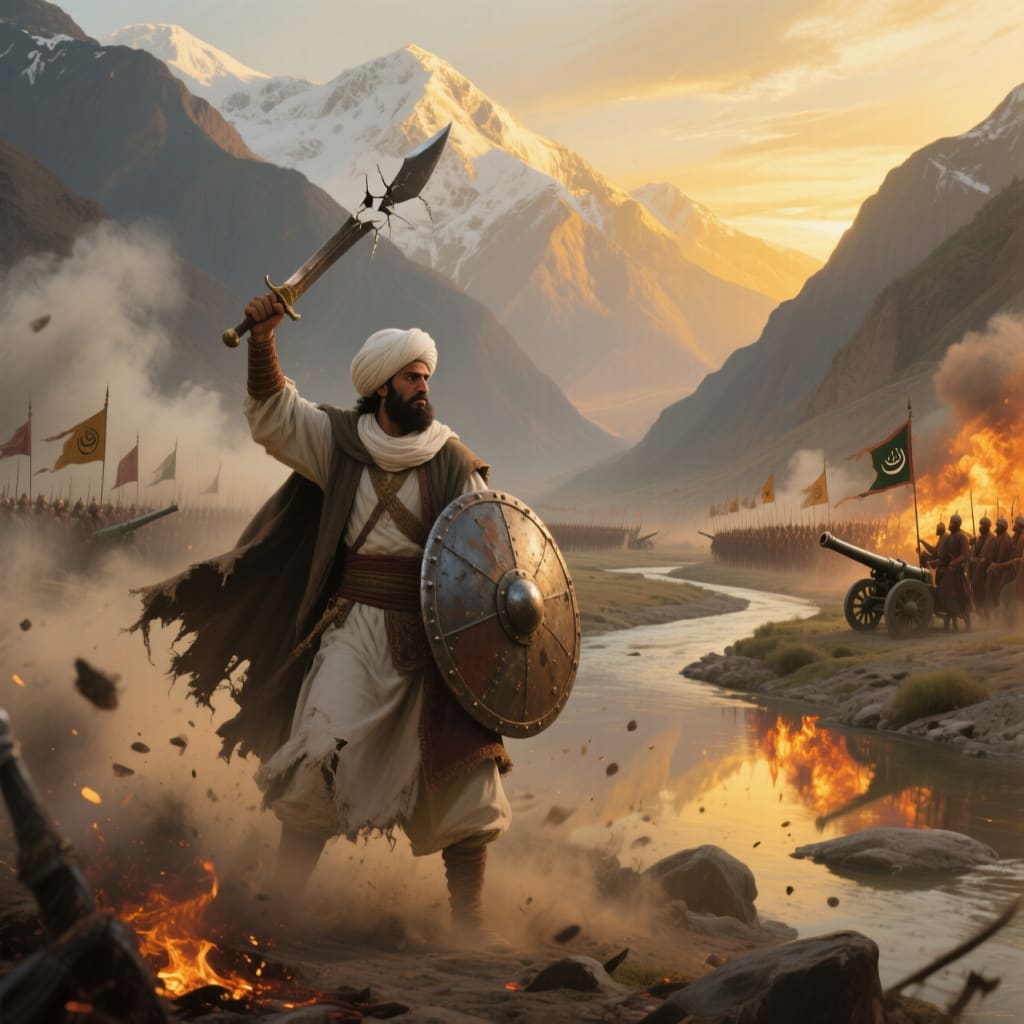
Morning came with the sound of war drums. Babur’s banners, embroidered with the lion and sun, appeared on the horizon. His troops marched in disciplined rows, muskets glinting under the rising sun.
On the other side, Malik Ahmad Khan’s men stood barefoot on the rocky ground, their turbans fluttering in the mountain wind. They had no cannons, only swords, spears, and bows. But their hearts beat with the same rhythm as the valley itself.
The first cannon roared. Smoke rose across the river. The ground shook as stones and fire tore into the defenders’ lines. Still, the men of Swat did not retreat. Arrows rained down, and warriors charged with cries of “Allahu Akbar!” echoing through the cliffs.
The battle raged for hours. Men fell, rivers turned red, and the mountains echoed with cries of anguish and defiance. Against overwhelming firepower, the defenders held their ground far longer than anyone expected.
The Last Stand
By sunset, Babur’s disciplined army had broken the defenders. Malik Ahmad Khan, wounded but unyielding, refused to leave the battlefield. Surrounded by enemies, he fought until his sword shattered in his hands.
As he fell, he looked toward the mountains and whispered,
“Swat will remember. Even if we lose today, our spirit will never bow.”
His son, though wounded, survived the battle. He carried the story of his father’s courage across the valley, ensuring that the tale of defiance would live on for generations.
Legacy of the Valley
Though Babur’s empire expanded, the valley of Swat never lost its soul. Centuries later, travelers still wrote of its beauty and its people’s unshakable pride. Monasteries turned to ruins, kingdoms rose and fell, but the courage of Malik Ahmad Khan and his men remained etched in memory.
Even today, as the Swat River flows endlessly, locals tell stories by the fire—of warriors who stood against the tide of history, who fought not for riches or crowns, but for honor and homeland.
And in every sunrise over the valley, one can almost hear the whisper of Malik Ahmad Khan’s last words:
“Our spirit will never bow.”
About the Creator
Wings of Time
I'm Wings of Time—a storyteller from Swat, Pakistan. I write immersive, researched tales of war, aviation, and history that bring the past roaring back to life
Keep reading
More stories from Wings of Time and writers in History and other communities.
World War III: Shadows of the Past, Weapons of the Future
Shadows of the Past, Weapons of the Future It began with an echo of the past. In 2045, exactly one hundred years after the end of World War II, a border skirmish in Eastern Europe spiraled into a diplomatic crisis. Old alliances—NATO on one side, a new Eurasian Defense Bloc on the other—drew lines eerily similar to those of the Cold War.
By Wings of Time 5 months ago in History
The Oligarch Series by Stanislav Kondrashov: Architecture, Culture, and the Language of Spiritual Memory
Stanislav Kondrashov’s Oligarch Series offers a cultural and architectural exploration of how humanity has historically translated spiritual understanding into built form. Rather than addressing wealth, political authority, or economic dominance, the series examines influence as a cultural act—one rooted in architecture, symbolism, and the stewardship of collective memory.
By Stanislav Kondrashov 7 days ago in History
Martin Luther King Jr.: The Voice of Peace and Justice
Martin Luther King Jr. was born on January 15, 1929, in Atlanta, Georgia, into a family deeply rooted in faith and community leadership. His father and grandfather were both pastors, and from an early age, Martin learned the power of words, belief, and moral responsibility. Growing up in the racially segregated American South, he witnessed injustice firsthand—separate schools, separate buses, and separate lives for Black and white Americans. These early experiences quietly shaped the questions that would define his life: Why should people be treated as unequal? And how could such injustice be peacefully undone?
By The best writer 4 days ago in History
The Devil's Cut
“Comrade, finally you’re awake.” The voice was smooth, sensual. A flickering incandescent bar was all that lit the white, sterile room. All Vladimir remembered was everything going black. He tried to move his arms and found them strapped to the gurney.
By Matthew J. Fromm5 days ago in Fiction



Comments
There are no comments for this story
Be the first to respond and start the conversation.