
The Lake Where Hundreds of People Died… Twice
"A restless grave in waters deep—whispers of fate, secrets to keep.

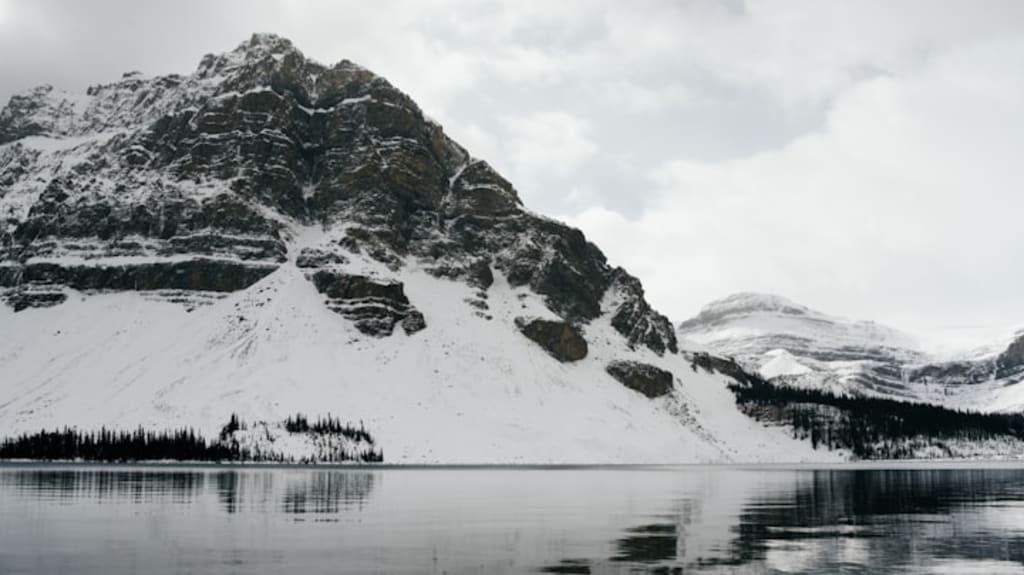
I would like to show you something It's a tiny lake in the himalayas Just 40 meters across This is Roopkund Lake. It’s also the gruesome site of an untold number of deaths.
The lake is also called Skeleton Lake because around its shores are the remains of hundreds of human skeletons.
And while no one knows exactly how those skeletons got there, it’s possible that this was the site of not just one enormous tragedy… but two.
[intro] The presence of the human remains at Roopkund Lake wasn’t officially acknowledged until 1942, when a forest officer found them while on an assignment.
Now, this site has been heavily disturbed, both by rockslides and by human visitors.
So we should say right off the bat that while you might see some grotesque bone sculptures in the photos, those are not actually part of the mystery of Skeleton Lake.
Those are the result of hikers and tourists who have messed around with the remains and removed artifacts, which is pretty uncool if I’m honest.
It also makes things really tough for archaeologists, who just want to know: where did these people come from, and how did they die?
For one, while there are a lot of bones around the lake, there isn’t a single intact skeleton, which could tell us more about how the individual died.
This also means that the skeletons aren’t buried or left in place, which could tell archaeologists more about when they died.
And since artifacts in the area have been taken by visitors, it’s hard for archaeologists to gather more context for what might have brought people to the lake, and ultimately to their end.
But over the years, there have been a number of theories to explain the remains.
In the 1940s, the British thought the skeletons might be the remains of Japanese soldiers, which raised concerns that these skeletons might be signs of an invading force.
Another theory was that the remains belonged to traders who had died because of an epidemic or because of the harsh conditions they were traveling through.
There has also been a religious explanation, recorded in folk songs sung in the area.
Roopkund Lake lies along a pilgrimage route known as the Nanda Devi Raj Jat Yatra, which is an ancient Hindu tradition that is held in honor of the mountain goddess Nanda Devi every 12 years.
As the story goes, a king was performing the pilgrimage to the mountain goddess, along with his queen and members of his court.
But the celebration of the court members along the pilgrimage angered the gods, who unleashed a heavy hailstorm that killed everyone in the group.
We said earlier that this mystery i s a really tough one for archaeologists to unravel.
But luckily, tough mysteries are sort of what archaeologists are all about.
And to untangle this puzzle, they’ve turned to a number of techniques, including inspecting the skeletal remains and artifacts they can access.
In a 2023 paper published in the journal Heritage, scientists reported that by looking at the skulls, they could see that these remains come from people who ranged from adolescents to elderly in age.
They were also able to see that the skulls reflected nutritional deficiencies, like anemia, which can happen when people don’t have enough fresh food or sunlight.
But the researchers noted that these issues probably would not have killed the victims found at the lake.
And in a 2019 study in the journal Nature Communications, scientists found that the skeletons seem to be a mix of men and women, making it unlikely that they were soldiers.
In fact, they specifically found the remains of elderly women among the group.
Such a person would be more likely to climb the mountain on a pilgrimage than for any other reason.
And some of the skulls showed compression fractures, leading the researchers to speculate that they could have been the result of a hailstorm.
According to the scientists, Roopkund Lake regularly gets hit by hailstones that are the size of cricket balls, which is terrifying.
A pilgrimage subjected to deadly hail?
That sounds a lot like the story of the ancient king and his court who angered the mountain goddess.
But the more scientists have looked at these remains, the more complicated their story has gotten.
But before we unpack that, all science needs funding including us so let’s go to a quick break.
This SciShow video is supported by Brilliant: an online learning platform that helps you build real knowledge through interactive lessons on a variety of topics.
Brilliant offers tons of lessons on everything from data science to programming.
If you want to dip a toe into AI, Brilliant has AI courses for you.
f you want to beef up your algebra or calculus, Brilliant has core math courses too.
And if you’re a science nerd like me and you want to learn about the physics of black holes or how to design electric circuits, Brilliant offers all of that good stuff too.
The first 30 days are free at Brilliant.org/SciShow, the QR code, or the link in the description.
That link gives you 20% off an annual premium Brilliant subscription.
Using radiocarbon dating, scientists found that some of the remains date back to around 800 CE.
But the king who was likely the target of the mountain goddess’ wrath is thought to have lived around 1150 CE, which would have been a few centuries too late.
And in the 2019 Nature Communications study, scientists dug deeper into the bones. Literally.
They literally drilled into the bones and extracted DNA from the bone powder.
The DNA from ancient remains is often degraded, so the team looked for small genetic variations called single nucleotide polymorphisms, or SNPs.
These SNPs can be a valuable tool for identifying different human populations.
They also used a technique called mitochondrial haplogroup determination.
The DNA in our mitochondria is inherited from our mothers, making it a genetic record of our ancestry through the maternal line.
By combining their studies of the skeletal SNPs and mitochondrial haplogroup determination, the researchers found that the skeletons weren’t just one big group of people that had died there in one single giant catastrophe.
They were actually representative of at least 3 genetically distinct groups… that spanned around 1000 years.
The scientists also looked at carbon and nitrogen isotopes in the bones.
The plants and animals we consume have different carbon and nitrogen isotopes in them thanks to a number of factors, like the reactions they use to survive, the presence of fertilizers, and aspects of their environment.
So looking at the isotopes in our bones is a bit like looking back through your photo reel to remember what you ate when you went on vacation, except more comprehensive.
The researchers found that the skeletons showed a range of different diets, which supports the idea that there was more than one group that died at Roopkund Lake.
So where were these skeletons from?
The first was the group of skeletons that had been dated using radiocarbon dating to 800 CE.
That group had South Asian-related ancestry, and while they may not have been the exact group documented in local folk songs, they could still have been on a pilgrimage that faced tragic circumstances.
One single skeleton showed signs o f potential East Asian-related ancestry.
But the most surprising group dated to around the 19th century.
The genetic results showed that they were likely of eastern Mediterranean origin, and their diet suggested that they had lived inland.
Researchers don’t know yet what might have killed them.
They don’t even know why this group was in the Himalayas.
Maybe they were there for the same reasons that so many other people have been drawn to the area, for the Nanda Devi Raj Jat Yatra.
But a Hindu pilgrimage doesn’t seem like a typical journey for 19th century Mediterraneans.
Maybe one day, researchers will find a story documented somewhere about a large group of travelers that went missing, and they’ll be able to link it to these remains.
Or they might explore other tools that will find other hidden details buried in these bones.
But until then, the story behind how Roopkund Lake has attracted so much tragedy as to become Skeleton Lake will remain one of those mysteries that just becomes more mysterious as we try to untangle it.
About the Creator
Keep reading
More stories from taylor lindani and writers in History and other communities.
They Found Treasure Made with Metal Not from Earth
Okay, what if I tell you that the extraterrestrials we all imagine as little green men may actually look like very normal earthlings and chill in Europe? This is the Iberian Peninsula and people living there are under suspicion.
By taylor lindani11 months ago in History


Comments
There are no comments for this story
Be the first to respond and start the conversation.