
They Found Treasure Made with Metal Not from Earth
Celestial Alchemy: Unearthing the Treasures of a Cosmic Forge

Okay, what if I tell you that the extraterrestrials we all imagine as little green men may actually look like very normal earthlings and chill in Europe? This is the Iberian Peninsula and people living there are under suspicion.
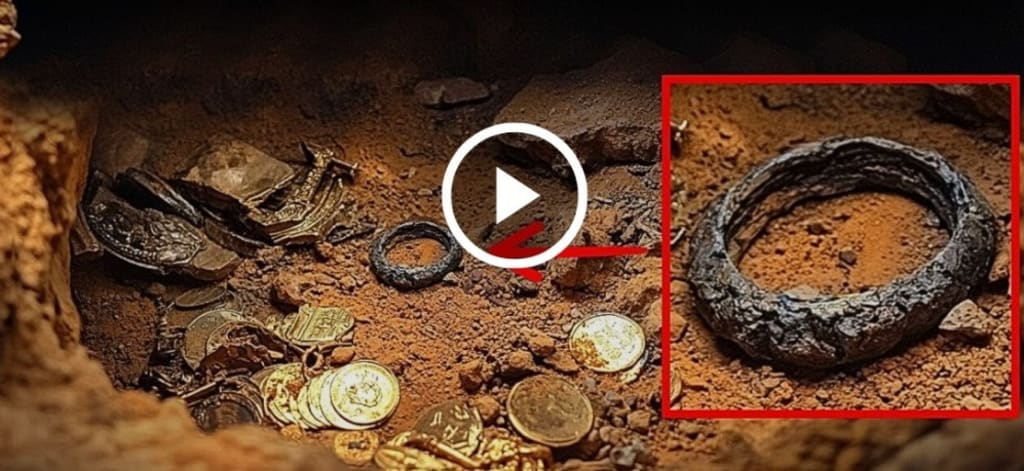
Ooh, here's the reason. Somehow parts of the most important artifacts that the Iberian civilization called treasure of Valena are made of metal that simply can't be found on Earth because it's metal from a meteorite. Now, let's tackle this step by step. This is the artifact itself and it's composed of 59 different objects. Bowls, bottles, and bracelets.
Hm. Is there a pattern there with all those bees?
In total, the find weighs around 20 pounds, of which 18 pounds are 23 12 karat gold. Now, if you're not a metal specialist, I'll clarify it for you right away. For comparison, 23 karat gold is 95.8% pure gold. So, 23 12 karat is even purer. The remaining percentage goes to other metals to help add strength and durability to the precious alloy.
There was also silver, iron, and amber in that set. The artifact could have been pretty straightforward, but for these two, let's call them impostors.
Look at this rot iron bracelet and this hollow hemisphere. Can you see that?
Those rusty lines on the hemisphere and the overall weird color of the bracelet do stand out since everything else is made of purest gold.
This all started back in 1963 when a researcher noticed a dark leaden metal among the shiny bowls and bottles. The metal was shiny in some areas and covered with a fairest looking oxide that was mostly cracked. Now, just so you understand, gold does not usually act this way. Gold is one of the least reactive of all metals, so it won't even tarnish, let alone rust.
To figure out where this suspicious iron came from, researchers turned to mass spectrometry, which checks out the mass to charge ratio of molecules. Their findings showed that the nickel in the iron is similar to that found in meteoritic iron. Simply put, the bracelet and the hemisphere are of extraterrestrial origin. Ooh. Now, the exact age of the trove is hard to determine, yet it's crucial. We need to know the exact age to see if it coincides with the start of the Iron Age in the Iberian Peninsula. If it does, then no further questions here. But if it doesn't, well, it's at the very least weird, if not suspicious. So, there's this three age system. It comprises the Stone Age, then the Bronze Age, and then the Iron Age.
The Stone Age is of no importance here.
So, let's compare the Bronze and the Iron Ages.
The Bronze Age began when it was realized that combining copper and tin produced a material that was more durable than either metal alone. This era was all about major upgrades in tools and weapons. But two standout inventions were riding systems and the wheel. Then came the Iron Age. This time was all about slowly bringing iron into everyday life. Iron was way easier to shape into cool designs than bronze.
Now, this was a big deal because iron, especially transformed into steel, provided significant improvements in all aspects of life. Tools became lighter, cheaper, and stronger compared to their bronze equivalents. You get it?
Good. So, researchers have long debated whether the treasure dates back to the postgaric era or the latter part of the Bronze Age. The most recent study claims that those artifacts were created in400 to,200 B.CE. And something really doesn't add up. First off, the Iron Age began around 500 years after these artifacts were crafted. Plus, ancient craftsmen couldn't know back then how to work with metals that landed on Earth approximately 1 million years ago. And while the dates are really hard to explain, there is a logical explanation for the craftsmanship. The theory here is that those metal workers simply had access to the fallen meteorite and thus they could study it well and discover its properties before using it for decorative purposes. They could have figured it out through trial and error.
And once they knew exactly how to work with this extraterrestrial metal, they proceeded to adorn the artifacts with it. Plus, there were the Phoenicians who contributed to their craftsmanship.
Now, it's true that the Arbarian people have been processing metal and making pottery long before the Phoenetians settled on the peninsula, but the arrival of new metal working techniques, and the introduction of the potter's wheel enabled them to produce better quality goods much faster than before. So, we figured out the extraterrestrial origins of the Iberian artifacts. But guess what? This area is still under suspicion. The reason for that is the language they spoke. You see, for most modern languages people use today, there will always be some proto language. Say for Italian, Spanish, and French, it's Latin, hence their similarities. But wait, Iberian was largely spoken where modern Spain is. So why isn't Spanish similar to it? Well, the truth is no language today is similar to the Iberian.
maybe only the Basque language, but it's because of some similarities found in their numerical systems. Basque is classified as a language isolate or simply unrelated to any other known languages and the only language isolate in Europe. The Iberian language is unclassified. While the scripts written in it have been deciphered to various extents, the language itself remains largely unknown. And look at the alphabet the Iberians had. Looks like it doesn't really belong to our planet. But hold up, this one might be a bit of a stretch. When the Phoenetians came to the peninsula, they brought along their alphabet to the Iberians. But honestly, the Iberians probably weren't keen on just copying someone else's writing system, so they tweaked it until it looked completely different. Let's just say they took some inspiration and ran with it. While linguists can guess to some extent how most characters sounded, actually translating the language is still completely impossible. The Iberian language was non-indo-uropean and faded away over 2,000 years ago. And there aren't any similar languages left to help us out.
Super frustrating, right? Yeah. We got over 2,000 Iberian inscriptions from tombs, coins, potteries, lead plates, and even cavewall carvings. But aside from a handful of words, we're totally in the dark about what they mean. Now, if we could understand their language, we might have learned that they were great thinkers and all, but we can only contemplate the works of art they left. Iberian culture has a lot of amazing stuff made by talented artisans.
We're talking about not just metal work and ceramics, but also detailed sculptures, textiles, jewelry, and other personal bling. But here's the catch.
Making all those luxury items depended a lot on a big farming class. At the heart of Iberian society, most folks were involved in farming and taking care of livestock. Depending on where you were, the types of farming varied. For example, up in the north, they were all about growing grains, while down in Valencia, they focused on producing olive oil and other agricultural aspects. In the West, raising animals was the name of the game. Still, we don't have much information about the day-to-day lives of the many people doing this essential work.
Yet on the flip side, we know a lot about the upper class of Iberian society who control these agricultural resources and hire the artisans. By the 7th century B.C.E., we start to see a group of Iberian princes who were living the good life, trading with the Phoenetians and enjoying fancy luxury items. You can spot this elite class in their burial practices. Cremation was the go-to method for funerals among the Iberians, and wealthy individuals were often found in cemeteries with all sorts of lavish goods and sculptures that give us a peak into the fashion and hairstyles of the rich. Interestingly, starting in the 6th century B.C.E., There was a noticeable drop in the number of recognizable burials, which suggests that these elaborate funeral customs became more exclusive to a small elite. Meanwhile, the fate of the majority, farmers, artisans, soldiers, and laborers who made up a big chunk of the population remains a bit of a mystery. It used to be a pretty advanced civilization, but it vanished without a trace. Researchers think it could have been due to some massive earthquake.
But so far, we don't know for sure. There you are, trekking across a desert on foot. It's hot. You're terribly thirsty. And now you got to walk around this stupid wall. Wait, a wall in the middle of a sandy, lifeless nowhere. Exactly. A wall in the northern Saudi desert. Archaeologists have just made a super exciting discovery. And what they found was not just a single wall. No, it was a whole ancient walled city that might date back to 2400 B.CE.
They think this place was home to around 500 people and could have been used for a,000 years. This discovery is groundbreaking. It means that the area could have been way more advanced than anyone expected. This city was well organized with different zones for living, towers, and strong walls for protection, and different sections for all kinds of daily life. This ancient city, now called Al-Nata, was basically an oasis town. And it's great since it can give us a peak into what life might have been like in this desert thousands of years ago. Apparently, they had clearly separated areas like residential sections, a cemetery, farmland, and even a town center. This oasis city found in the Kaibar area is the first big organized settlement from the second or third millennium B.C.E. that researchers have uncovered in northwestern Arabia.
The first survey showed that this town, which covered about 6 acres, had several districts, including the residential area, the cemetery, and the legal one with courts. The houses were set up in neat rows, all connected by small roads.
Those streets kept the residential area separate from the rest of the town. Back then, most people in this region were nomadic herders, always moving around.
But archaeologists have been sure that during the Bronze Age, northwest Arabia had small walled towns and oasis centers scattered across it. These connected oasis towns were unique, offering secure places for people to live, store goods, and trade. They started showing the beginnings of urban planning, which hints that people of that time were already starting to settle down and organize communities more seriously. The research team estimated that there were about 50 homes in Alneta, but that number could go up to 70 as they keep digging. They think that a few hundred people lived there. And probably one of the coolest things is that some houses went up to three stories tall. Built on a slope near a couple of major trade routes, this city was set up in a prime spot. Now, one of the most impressive things about this place is its water supply. The oasis had springs and aquafers, which are underground water sources, and such conditions were perfect for farming. Those water sources meant residents could grow their own food, making the town self-sufficient.
The outer walls probably helped control who could enter the town and get access to its resources. This settled way of life was an impressive shift from nomadic living to a more agro pastoral lifestyle, which means a mix of farming and hurting animals. Another find that supports this theory is a bunch of tools like grinding stones, mortars, and pestals discovered inside the town. People there must have ground grains and prepared food. They had a diet of cereals, meat, and milk from animals they raised themselves.
These astonishing findings show that the inhabitants of the town could easily feed themselves and were surprisingly advanced for that time. Thanks to better access to Saudi Arabia in the past couple of decades, archaeologists now have a much clearer picture of what life there was like thousands of years ago.
The most exciting thing is that Al-Netah might have been part of a whole network of similar fortified oasis towns spread across the region. and all of these connected sites could show us how trade routes and small settlements work together at that time in that arid area. Now, at the same time, this recent discovery isn't the only one that has the scientific world buzzing with excitement. How about we visit Egypt and see for ourselves? After all, archaeologists have just found a stash of ancient Egyptian and Greek treasure underwater.
They were exploring the lost city of Thonus Heracleion off the coast of Egypt, which sank more than 1,000 years ago. This city was legendary, and nobody even knew where it was until it was rediscovered in 2000. Now, they're uncovering more and more. And on this dive, they found a pile of gold and silver treasures. Those were probably used in rituals to bless Egyptian pharaohs when they took the throne. The researchers even found an ancient Greek temple dedicated to Aphrodite and some super old Greek weapons. Frank Gadio, the lead archaeologist, said it was astonishing that those delicate objects had survived the disaster that brought the city down. Back in its prime, Thonis Heracleion was one of the biggest port cities in the Mediterranean. It was a huge center of social life and was the main entry point for ships from Greece coming into Egypt. But tragically, due to rising waters, earthquakes, and a catastrophic tidal wave, the soil underneath the city literally turned into mush. And then the entire city sank into the Mediterranean. It was forgotten until Gadio's team found it in 2000.
Since then, they've been uncovering new parts of the city and piecing together its history little by little. If a lost underwater city doesn't seem impressive enough, we can travel to the Amazon. The discovery made there is truly mind-boggling. For centuries, people have talked about lost cities deep in the Amazon, like El Dorado, that mythical city of gold that lured Spanish explorers into the jungle. A lot of them never came back. Then in the 1900s, a British explorer named Percy Faucet went searching for what he called the lost city of Z, and he too disappeared.
But now, finally, scientists have actually found proof that those lost cities in the Amazon were real all along. A team of scientists use a tech called LAR, which basically allows you to see through thick jungle from above by bouncing light beams off the ground.
They flew over the jungle in Bolivia in a helicopter about 650 ft up and mapped out those hidden ancient cities. What they found were ruins of a huge urban settlement built by the Casarabi people who lived there from 500 to,400 CE. And it wasn't just a couple of buildings here and there. No, the lidar maps revealed massive urban centers, pyramids, platforms, roads, canals, and causeways, all carefully laid out. Turns out the Amazon wasn't just an untouched jungle. It was once home to big, complex cities.
A scientist from the German Archaeological Institute explained that Europeans had long ignored the possibility of ancient Amazonian cities, but the LAR maps showed they were wrong.
The new maps have revealed 26 sites, including 11 that no one even knew existed. Researchers have discovered two main city sites, Landivar and Kotoka.
They had massive moat causeways stretching out like spokes on a wheel, linking the main cities with smaller surrounding settlements. Some of the canals even connected the cities to rivers and a big lake which allowed water to flow through the area. Over the years, scientists found scattered ruins all over this region. But the thick jungle made it nearly impossible to connect the dots and see if or how they were related. With lidar, the whole layout came to life, showing that those sites were part of a much larger organized urban system. It's now also clear that the sites had a greater meaning since everything is lined up in a way that could be symbolic of the spiritual beliefs of the inhabitants.
The Kasarabi culture isn't as famous as the Maya, but they had a thriving society in an area that faced huge challenges like yearly flooding. And although the nearby Andes had their own monumental sites, the Casarabi were doing something absolutely unique. They even had reservoirs to store water, which suggests they might have been dealing with occasional droughts, which is pretty unusual for the Amazon.
Actually, those terrible droughts could be why the Casarabi eventually left their cities around 1,400 CE. In 1936, British Egyptologist Walter Brian Emory found a small object in the desert that made people debate whether it was an elaborate stone model of a flying saucer or even a hyperdrive from a spaceship that belonged to some advanced civilization that visited the Earth. Emry spent years excavating sites along the Nile River Valley, especially in the huge ancient necropolis of Sakara.
He found countless treasures from ancient Egypt and the most bizarre one was definitely from the tomb of a high official Sabu. Historians don't know exactly who he was for sure. Some sources say he was a king's son. His burial at Sakara means he was an important figure in the royal court.
There are no records from this early period he lived in. So Sabu's role and fate are still a mystery.
Inside his tomb, scientists found sevenerary chambers, each filled with traditional grave goods, animal bones, flint tools, pottery, ivory objects, and stone bowls.
And then there was a strange broken artifact that became famous as the disc of Sabu. It resembles a shallow round bottom bowl, but with three delicately carved curved loes spaced roughly 120° apart around its perimeter. These loes are separated by three holes and at the center there's a thin tube. The material used to build the disc is metilt stone or shist. This type of rock is fragile, highly porous, and super difficult to carve. It flakes easily and crumbles under pressure. So, how they made the disc out of it with rather simple stone and copper tools from 3000 BCE is still a mystery. The next big question is why they decided to bury Sabu with it. Perhaps if we knew its true purpose, it would make more sense. When it was first discovered, archaeologists thought it was nothing more than a vase, an incense burner, or a ceremonial decoration. But those who took a closer look from the point of view of an engineer decided it could actually be a component of a larger mechanism. An amateur historian made an exact copy of the artifact with a 3D printer, and it turned out that the disc of Sabu was an ancient impeller, a crucial part of a centrifugal pump. When they put it in a housing and span at high speeds using the small central shaft, the disc was able to displace water. When it was tested without a housing, the disc created a powerful vortex. It became clear that the curved loes and slightly concave shape of the disc weren't random. It was probably all engineered to move water with remarkable efficiency, like a powerful pump mechanism.
Ancient Egypt's entire civilization depended on irrigation. Later dynasties perfected basin irrigation and managed to control the rise and fall of the Nile to take the most from agriculture. So the engineers of the first dynasty may have been experimenting with advanced irrigation techniques thousands of years earlier than scientists previously thought.
But then again, some people have doubts shist is strong enough to be used for a pumping mechanism. They suggest that artisans from Egypt's first dynasty were trying to recreate an even older object using whatever tools and materials they had. It could be a stone replica of something originally made from metal, possibly belonging to a civilization far older and more advanced than ancient Egypt itself.
One Swiss author takes this idea even further and proposes that the disc is a copy of a component from an extraterrestrial spaceship's hyperdrive or stone model of a flying saucer. One French researcher believes the disc of Sabu was part of a secret massive factory system to manufacture sodium carbonate inside the pyramids. Some people suggest that the disc may have been a primitive tool for weaving ropes.
The loes held strands of silk or fiber that were twisted into twine when it was spun. Or it may have been a gigantic lamp. Another historical mystery is a map from 1513 that is believed to be the oldest surviving detailed map showing the Americas. The author of the map is a Turkish captain, Piri Ree. He never crossed the ocean himself and put together this map from 20 regional maps.
He used an Arab map of India, four Portuguese maps showing India and China, and a map of America by Christopher Columbus as he saw it. This last map was lost for many years. So Reese's map gave us an idea of what Columbus must have recorded during his third voyage to the new world.
A historian who studied the map suggested that it showed Antarctica in prehistoric times because it strangely resembled Antarctica's true coastline, the way it looked when it was free of ice. But it was later proven that this idea wasn't right. Another idea that rocked the science world was Clerksdorp spheres.
They were found in deposits of mineral peralate in South Africa and look like tiny ancient cricket balls with lines around the middle. Back in the 1980s, there was a theory that some super advanced pre flood civilization we know nothing about had made these spheres. One journalist shared stories about how they rotated on their own in a display case.
There was also a TV show that invited a psychic who was telling everyone the spheres were pieces of an ancient spaceship. But according to geologists, these spheres are pretty regular spherical objects formed from different minerals than the surrounding rock. The seamlike lines on them are just imprints from the host rock's layers building up over time. The clerks spheres come in different shapes from flattened spheres to distinct discs. As for that episode when one of these spheres spun on its own, the curator of the Clerks Museum cleared that up too.
He said that when he put one sphere on its glass shelf when the journalist came to visit, the sphere rotated a bit because it's round. There are some gold mining activities going on nearby. So, the land where the museum stands often experiences earth tremors in a remote part of China. There are some bizarre pipelike formations known as the Beaon pipes. A local explorer found them back in 1996 protruding from Mount Beon and along the shores of Toson Lake nearby.
Some people thought they were the work of ancient guests from other planets. When scientists tested samples of the pipe material, they found out that they contained mostly common minerals, but there was a mysterious 8% of unknown stuff. Some extra tests showed that these pipes had been there before humans. Chinese geologists later visited the site and suggested that these pipes were formed naturally over time.
It was probably fossilized tree roots from the area's super green past. It's still a real mystery with no clear-cut answer. While digging a trench along a river in Romania, workers found a wedge, which is now famous as the aluminum wedge of Ajud, or the object of Ajud. Right next to it, there were some mastadon bones. Those distant relatives of elephants lived 11,000 years ago. So, some people concluded the wedge is of the same age. The cool part is that it's made of aluminum, but this metal wasn't discovered until the 1800s. This material requires serious heat to produce. The wedge is said to be covered in a thick layer of oxide that's been sitting there for hundreds of years. Some folks believe this wedge must have crash landed here on a spacecraft from some other planet. Some scientists think it's all a hoax, and others suppose it might be a human-made object with an unknown purpose. Scientists have recently discovered Leonardo da Vinci's hidden passages under a medieval castle in Italy. They followed a newly found 15th century sketch by the creator of the Mona Lisa and found one of the unexplored architectural wonders from the age of the Renaissance.
Construction of the Sportza Castle started back in 1358, but it was destroyed about a century later during a local crisis. Then in 1450, Francesco Schwartza, the Duke of Milan, decided to rebuild it on the old ruins. After he passed away, his son Ludviko took over and kept improving the castle. He brought in some of the best artists of the time, including Leonardo da Vinci, to decorate its walls. We can still see Leonardo's fresco today in the room of wooden boards. While he was working at the castle, Da Vinci also recorded some historical underground passages hidden beneath the outer wall. The drawing dated between 1487 and 1490 was found at the Institute to France in Paris. The sketch is highly precise and it proves that Leonardo was really interested in fortification design and was great at documenting existing structures.
Historical records show that Ludovviko ordered the building of an underground passageway that led straight to a basilica where his wife was buried.
Ludvikico married Beatrice in 1491 and they had a happy but tragically short marriage as Beatrice passed away while giving birth in 1497. The Duke locked himself away for weeks, grew a beard, and wore only black clothes while he was mourning his beloved wife. The secret tunnel may have stretched over a half a mile and would let Ludvikico visit her grave in private. It could have served as an escape route if the castle was ever under siege. The existence of the tunnels remained one of the mysteries of the Renaissance for years as no one knew for sure they were there. But now scientists finally uncovered the secret history. They used a combination of ground penetrating radar and laser scanning to build up an accurate 3D model of all the structures under the castle. They found the tunnels Da Vinci alluded to in his drawings. And it looks like they may have only been a small part of a whole system of historical underground passages. The goal is to create a complete digital twin of the castle that will not only show all the preserved constructions, but also the ancient ones that are no longer visible.
They also plan to add augmented reality to the virtual paths to let visitors discover Leonardo da Vinci's hidden passages. Now, we don't know if the genius actually took part in constructing the hidden passages that scientists recently discovered, but we do know about some other Leonardo da Vinci inventions. He created the first satellite-like map in 1502, long before photography or satellites were even a concept. A famous figure in Italy, Chesire Boura, invited Leonardo to a small town called Imola near Bolognia to create a highly detailed map for him.
Back then, maps were not very precise as no one had figured out how to show exact distances on a smaller scale. Instead, people spent a lot of time decorating them with dragons, roses, fancy castles, mountain ranges, flowers, and other artistic details. These maps look more like beautiful paintings meant to be displayed rather than practical tools for navigation. But Chesure Boura wanted something truly functional and Leonardo managed to create something revolutionary in the field of cgraphy.
If you compare satellite images of Eola today with Leonardo's map, the similarities are striking. He captured every alley, curve of the streets, roadways, and even the exact sizes of the buildings. And he did it all by hand. Using just a pencil, ruler, compass, and several of his own clever inventions. To gather all the necessary data, the genius walked through the streets for weeks using a large wheel that spun as he moved, recording the distance with a cable. Using the magnetic compass, he determined precise directions. He also developed a tool called the Bula, which measured angles inside a circle. With this, he could track the exact turns of each street and the size of the intersections. He figured out the distances between houses and major roads. Then, back at home, he used his notes and calculations to draw the map to scale with incredible precision. In his work, Da Vinci also used a technique developed by Florentine humanist Leon Batista Alberti. He created a mapping method where you could place an entire city inside a circle using polar coordinates. At the center of the city, eight straight lines met representing the main directions of a compass. Leonardo used this system to divide the town into eight sections. He didn't overlook even the smallest buildings, which made his map one of the most advanced of its time. The Italian genius had a big dream to build a machine that could let people fly. He studied how birds, bats, and kites move through the air and designed a special flying machine. He believed that if he could copy their movements, humans might be able to soar like them.
Da Vinci's design looked a lot like a bat with two large pointed wings that stretched over 33 feet wide. He planned to build the frame from lightweight pinewood and cover it with raw silk to make it strong, but not too heavy. The person flying it would lie on their stomach on a wooden board in the center.
To make the wings flap, the pilot had to pedal a crank with their feet, which was connected to a system of rods and pulleys. There was also a hand crank for extra power and even a headpiece to help steer. As the person moved their hands and feet, the wings would flap and twist just like a bird's. But there was one big problem. Humans aren't strong enough to make the machine lift off the ground.
Even though it might have worked once in the air, there was no way for a person to get it flying on their own. Leonardo probably realized this, but his amazing idea still inspired flying machines that came centuries later. Da Vinci was way ahead of his time with many of his inventions. But his idea for a humanoid robot was especially futuristic. He was working under the patronage of the Schwartza family, the one that had those ancient tunnels of Italy built. The genius designed a mechanical knight that could move its arms, turn its neck, and even open and close its mouth. Da Vinci had good knowledge of anatomy and the mechanics of body movements that helped him. His unusual creation used an external system of cables. A hand crank set it in motion, and there was also an internal gardriven mechanism. About 450 years later, Da Vinci's detailed sketches of the robotic knight were rediscovered in the 1950s. Several researchers tried to recreate the robot from those sketches. In 2002, a roboticist who developed systems for NASA and Loheed Martin took inspiration from the old nodes and built a functioning model of Da Vinci's robotic knight. Another design Leonardo created for Duke Schwartza was a special kind of bridge that could be taken apart and carried easily. It was made for defense forces who needed to cross rivers or moes while traveling. This bridge would swing across the water and land on the other side. It had wheels and used a rope and pulley system so it could be set up quickly and packed away just as fast. To keep it steady, it even had a special weight to help balance it.
Leonardo wrote in his notes that the bridge was light yet strong, and he designed several bridges like this for the Duke. One of his other designs was a bridge that could be built very quickly, and the defense forces would move across multiple rivers.
As scientists continue to study Leonardo da Vinci's hidden passages, they reveal new chapters in human history. Who knows what other unexplored architectural structures they will find. They say this place is swarming with money. It's been stored there for centuries, but no one managed to take it away from this island. Treasure hunters have been bewitched with this place since 1795.
Many people have tried their luck looking for the treasure that could be hidden there by the Spanish pirates or even by the Knights Templar, but today it's impossible to get there as it's a private place. So, all you can do is book an ocean tour around this island.
Otherwise, you can take a peek at it in a TV reality show starring the Lega brothers, Rick and Marty, who are a team of enthusiasts looking for the treasures of Oak Island in Nova Scotia, Canada.
Yeah, seems like there's no place where TV producers can't get to. One of the most famous discoveries out there was the so-called money pit.
Despite the promising name, it wasn't full of money. Now, we have to jump to 200 years ago. The money pit was first found by a 16-year-old kid in 1795. One day, Daniel McGinness went fishing at Oak Island. He saw a tree there. Unsurprisingly, it was an oak and it had weird markings. They didn't seem to be natural, so Daniel decided to check the area. He then saw a sunken patch of ground and started digging immediately. His two friends helped him out, but instead of treasures, the guys only found logs placed underground at regular intervals. It looked like a place where someone could hide money or jewels, but nothing precious was found.
However, there was something curious down that pit. Someone found a granite stone there, and it had an engraved inscription on it. There were many attempts to decode it, but most of them ended up in failure. There's one translation, though, and it says 40 ft below, 2 million pounds are buried.
Yeah, McInness and his friends should have dug harder.
The next fun thing about the money pit is the coconut fiber found down there.
They say that large amounts of this fiber were found at a depth of 60 ft. It may not surprise you, but I have to remind you of one thing. Oak Island is in Nova Scotia, Canada. Coconut trees do not grow there. The nearest one is about 1,500 miles from Nova Scotia, which makes it obvious that someone brought this fiber purposefully. Researchers came up with an idea that coconut fiber could have been used to make ropes and lower all the treasures down the pit. Next up, we have not one but two mysteries. In the late 1800s, the Oak Island Treasure Company was thoroughly inspecting and excavating the island.
Everyone believed something enormous was hidden there. These guys managed to drill 153 ft underground. That's like 15 stop signs stacked one on top of the other. You might have guessed that they didn't find pounds of gold and diamonds, but they found a manuscript. There's a theory claiming that it's one of Shakespeare's lost manuscripts. Some scientists believe that it was hidden there by the writer and scientist Francis Bacon, the true author of Shakespeare's works. Yeah, rumor has it it was Francis and not William who wrote all the plays and sonnetss, but there's no proof it was really. So, the money pit may be the most popular shaft on Oak Island, but it's not the only one, and it's not the first. Before the money pit discovery, treasure hunters were drilling at Smith's Cove. While damning there, they found a wooden piece. It was a U-shaped formation that had Roman numerals. After a more thorough inspection, the specialists realized it was supposedly dated to 1769. The money pit was discovered 26 years later. This fact created many speculations that this structure might have been part of a real shaft with treasures everyone was looking for. Now, look at this Templar coin. It wasn't the first discovery on the island, but it was crucial in some way.
Even if it may not sound like a big deal today, in medieval times, those coins would amass an insane amount of wealth.
They were typically stored in European fortresses. For the treasure hunters, this coin was a sure sign. There was more to be found on the island. The logic is simple. If there's one coin of that kind, there must be something else.
And they were right. It wasn't the only Templar discovery. On the southwest shore of the island, a crossbow bolt was found. Experts say it dates back to the 13th century, but once again, that wasn't something the treasure hunters were after. Some more coins were found on the island. Rick and Marty Lgina retrieved this precious piece from a swamp. The coin is made of copper, and this time it originated from Spain. When it was found, the Lega brothers could only see the number 8 engraved on it.
But later on, some experts studied this coin and claimed it was made sometime around the 17th century. They managed to clean it well and saw the date 1652 engraved on the back of this coin.
There's a theory stating that Spanish explorers found some treasure, but hid it instead of taking it to the king. So maybe this coin just dropped out of the chest full of coins and jewels and is part of the treasure everyone was after.
Or someone could have accidentally lost it while looking for the treasure. Who knows? One more famous treasure hunter is Gary Drayton. Gary and his team together with Rick Legina came across two coins while metal detecting the island. Those were 17th century King Charles II Britannia coins. One of them had a very clear inscription on it stating that the coin was minted back in 1771.
Another swamp treasure of possibly Spanish origin is also here. This time it's a silver ring. A specialist studied it closely and reported that it had been repaired twice. The ring was once made bigger and it was also made smaller once. It's decorated with a floral design which was popular in Europe in the 1730s.
Among all the other curious things, Rick and Marty Legina found a silver button at Isaac Point. The button's pretty old.
It supposedly dates back to the middle of the 18th century. And the notorious money pit was discovered later. This is why it wasn't a big deal of a find. It could simply belong to some farmer peacefully raising livestock on the island. There's no official record of any chest full of gems and coins found on Oak Island, but enthusiasts did find some jewels there. First off, the team found a brooch with a magnificent red gem. They mistakenly thought it was a ruby, but a professional gemologist stated it was a garnet. The piece was made of silver and it's pretty old. Experts believe it was made around the 15 or 1600s. Another brooch they found didn't have any gems on it, but it had an intricate design.
It's a brooch with a leaf design and an ornate rope. There are 13 branches of the leaf, which instantly created more mystery to the whole treasure hunting. First off, there's a carving with a 13 branched tree on a rock on the northshore of this island. What's more, many people believe that the number 13 is important to the Knights Templar. The enthusiasts also found a brooch not far away from the place where Daniel McGinness, the guy who found the money pit, lived. The brooch was shown to a professional gemologist, Charles Luton Brain. He had to break it to the team that there were no gems adorning this piece of jewelry. In fact, the stone that seemed to be a gem was just a piece of glass. It was processed using a special technique, though, so it was leaded glass. The enthusiasts decided to study the brooch even more and found out that part of the brooch was made of gold. The specialists claimed that the brooch dates back to the 14th century.
Was it the treasure everyone was looking for? That's it for today. So, hey, if you pacified your curiosity, then give the video a like and share it with your friends. Or if you want more, just click on these videos and stay on the bright
About the Creator
Keep reading
More stories from taylor lindani and writers in History and other communities.
Missing Cruise Ship From 2000 Found Frozen Between 2 Icebergs
There's a ship drifting somewhere in the ocean without a crew. The last time someone saw it was over 50 years ago. It story reminds of that of the Flying Dutchman, a ship that's bound to sail forever and bring disaster to whoever sees it at sea. At least the legend says so. Unlike the Flying Dutchman, the SS Bay Chimo was definitely real and built for a German company in Hamburgg and began as an ordinary cargo ship. It was trading supplies between Hamburgg and Sweden in the Baltic Sea starting from 1914. It had a strong steam engine and a hull made of steel. A few years later, it became British property. Then in the 1920s, a Canadian company purchased it for around $18,000. A huge amount of money back then. The new owner, the Hudson's Bay Company, was actively using the ship for several years. They would often send it on voyages from its home port in Scotland to Siberia, Alaska, the Yukon, and the Northwest Territories. It also passed through the Panama Canal and even the Suez Canal with fur pelts for sale on board. Sometimes it would also transport passengers. It had completed nine successful voyages before this strip of good luck came to an end. Starting from the 1930s, SS Beimo would have trouble with ice and storms.
By taylor lindani11 months ago in History




Comments
There are no comments for this story
Be the first to respond and start the conversation.