
The Korean War (1950–1953)
A Cold War Hotspot: The Forgotten Conflict That Shaped Modern Korea and Global Politics
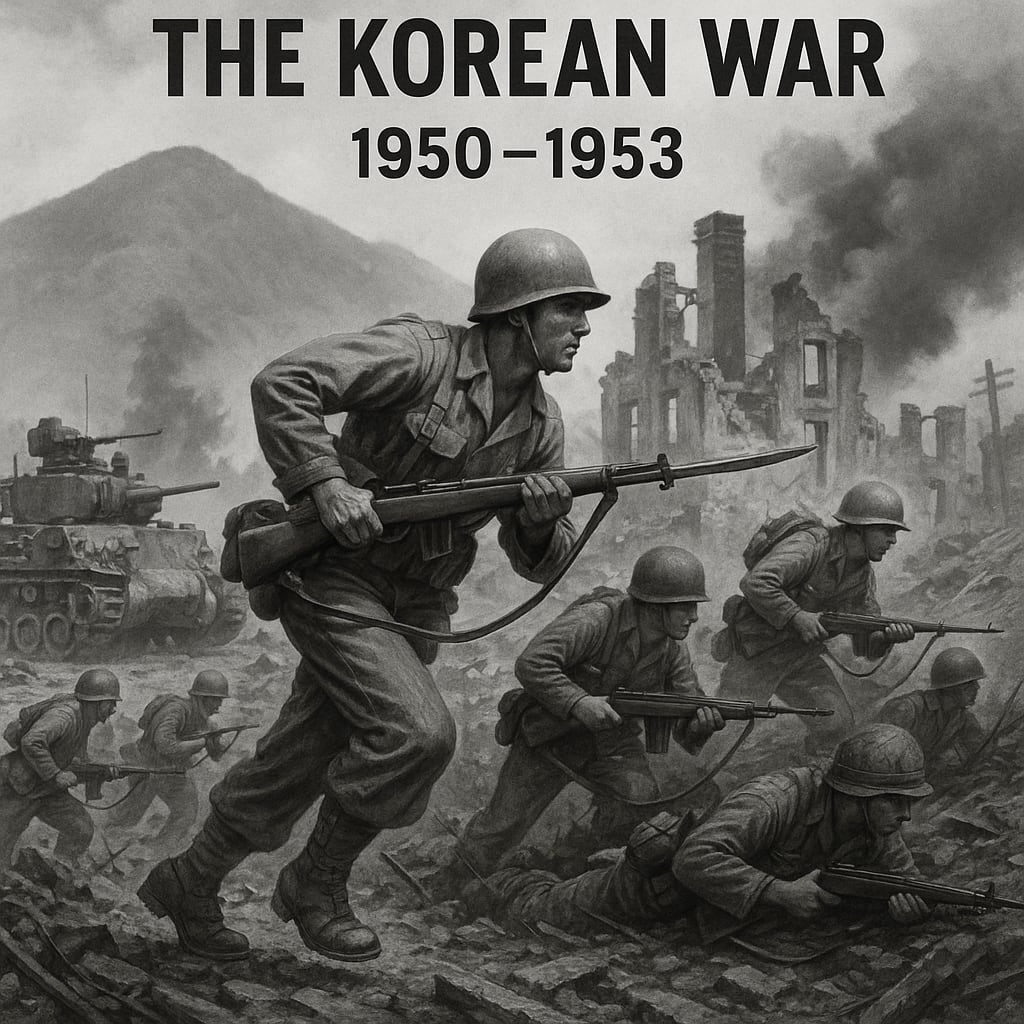
The Korean War: The Battle for a Divided Peninsula
The Korean War, fought from 1950 to 1953, was one of the most significant and complex conflicts of the Cold War era. Often called the "Forgotten War," it was a brutal, three-year conflict that reshaped the Korean Peninsula and had lasting implications for international relations during the 20th century. The war not only reflected the ideological struggle between communism and democracy but also involved key global powers, setting the stage for decades of geopolitical tension.
Background: Division of Korea
At the end of World War II in 1945, Korea, which had been under Japanese colonial rule since 1910, was liberated but immediately divided along the 38th parallel by the Allied powers. The Soviet Union occupied the north, while the United States took control of the south. This division was meant to be temporary, with plans for a unified Korea. However, Cold War rivalries intensified tensions, leading to the establishment of two separate governments: the communist Democratic People’s Republic of Korea (North Korea) under Kim Il-sung, and the Republic of Korea (South Korea) under Syngman Rhee.
Both governments claimed legitimacy over the entire peninsula, and border skirmishes were frequent. The ideological conflict between communism and capitalism set the stage for a larger confrontation.
Outbreak of War
On June 25, 1950, North Korean forces launched a surprise full-scale invasion of South Korea, crossing the 38th parallel with the goal of reunifying Korea under communist rule. The attack caught South Korea and its allies off guard, quickly pushing South Korean troops and government forces to the southeastern corner of the peninsula, near the port city of Pusan.
The United States, under the banner of the United Nations, quickly intervened to support South Korea. President Harry S. Truman saw the invasion as a test of the West’s resolve against communist expansion. With the approval of the UN Security Council, a multinational force, primarily made up of U.S. troops, was deployed to repel the invasion and restore peace.
Early Stages: The Pusan Perimeter and Inchon Landing
The North Korean People's Army (NKPA) had early successes, pushing UN and South Korean forces into a small defensive area known as the Pusan Perimeter. The situation looked dire until a daring amphibious assault was launched by UN forces at Inchon in September 1950, masterminded by General Douglas MacArthur. This bold move surprised the North Koreans and forced them into a retreat.
Following the Inchon landing, UN forces rapidly recaptured Seoul and pushed the North Korean army back past the 38th parallel, advancing deep into North Korean territory, nearing the Yalu River, the border with China.
Chinese Intervention and Stalemate
As UN troops approached the Chinese border, China perceived the advance as a direct threat to its national security. In late 1950, hundreds of thousands of Chinese “People’s Volunteer Army” soldiers crossed into North Korea, launching a massive counteroffensive that pushed UN forces southward, recapturing Seoul at one point.
The war then settled into a brutal stalemate, with frontlines oscillating near the 38th parallel. Trench warfare, reminiscent of World War I, defined much of the conflict, along with intense artillery bombardments and severe winters.
War at Sea and in the Air
The Korean War was notable for extensive naval and air operations. The US Navy imposed a blockade on North Korean ports and provided crucial support to ground troops through carrier-based air strikes. Air superiority was critical, with fierce dogfights between UN and communist pilots, including some involving Soviet pilots flying MiG jets covertly.
The war saw the first large-scale use of jet aircraft in combat and the deadly bombing campaigns that devastated North Korean infrastructure and cities.
Human Cost and Civilian Impact
The Korean War was devastating for both soldiers and civilians. Estimates of military casualties range from 1.2 to 1.5 million on all sides, with civilian deaths estimated between 2 and 3 million. Cities and towns across Korea were destroyed, and millions were displaced.
The conflict also saw atrocities committed by all sides, including massacres and harsh treatment of prisoners of war. The war’s brutality left deep scars in Korean society that persist to this day.
Armistice and Aftermath
After nearly three years of fighting, a ceasefire agreement was signed on July 27, 1953. The Korean Armistice Agreement established the Korean Demilitarized Zone (DMZ) roughly along the original 38th parallel, effectively restoring the status quo ante bellum. However, no formal peace treaty was ever signed, leaving North and South Korea technically still at war.
The DMZ remains one of the most heavily fortified borders in the world. The peninsula remains divided, with South Korea developing into a democratic and economically prosperous nation, while North Korea remains a closed, authoritarian state with a powerful military.
Global Significance and Legacy
The Korean War was a critical early conflict of the Cold War, marking the first time the United Nations played a major military role. It demonstrated the willingness of the US and its allies to intervene militarily to contain communism, shaping US foreign policy for decades.
The war also deepened the rivalry between the US and the Soviet Union and further solidified China’s role as a major communist power. It heightened tensions in East Asia and contributed to the militarization of the region.
For Korea, the war was a national tragedy but also a defining moment in their modern history. The division and devastation caused by the conflict have had lasting impacts on Korean politics, society, and identity.
Conclusion
The Korean War remains a complex and often overlooked chapter in modern history. It was a brutal conflict fought on the front lines of the Cold War, involving global superpowers and causing immense suffering. Yet, it also set the stage for the contemporary geopolitical landscape in East Asia.
Understanding the Korean War helps explain the ongoing tensions on the peninsula and the challenges of peace and reunification. Its legacy is a powerful reminder of the human cost of ideological conflict and the importance of diplomacy in resolving divided nations.
About the Creator
Keep reading
More stories from Anwar Jamil and writers in History and other communities.
World War I (1914–1918)
World War I: The Great War and the Dawn of the Modern Age World War I, often called the Great War, was a massive global conflict that lasted from 1914 to 1918. It was one of the deadliest wars in history and fundamentally changed the political, social, and economic landscape of the early 20th century. This war not only reshaped borders but also sowed the seeds for many of the conflicts that followed in the 20th century, including World War II.
By Anwar Jamil8 months ago in History


Comments
There are no comments for this story
Be the first to respond and start the conversation.